
Bulk commodity logistics present a persistent challenge: move tens of tonnes of free‑flowing dry cargo safely from origin to destination without contamination, moisture damage, or excessive cost. The packaging method you choose directly determines product quality on arrival, loading speed, labor required, and even your insurance liability.
Three broad approaches dominate international dry bulk shipping today: loading directly into a standard ISO container (often called “bare container” shipping), using a fleet of intermediate bulk bags (FIBCs or “big bags”) inside the container, or deploying a purpose‑engineered container liner. Each method has a legitimate place in the supply chain, but the cost, risk, and operational profiles are profoundly different.
The following comparison is grounded in real‑world logistics, material science, and the compliance framework required for food, chemical, and industrial bulk commodities.
Bare Container Loading: Simplicity That Conceals Hidden Costs
At first glance, loading bulk cargo directly into an empty container seems economical — no packaging material to buy, nothing to dispose of. This approach is still used for low‑value, non‑hygienic minerals like construction sand or untreated stone aggregates, where contamination tolerance is high.
However, the reality quickly becomes expensive for any product that demands cleanliness, dryness, or batch integrity. A standard container is not a sealed vessel. Its plywood floor, side-wall seams, and corner castings allow moisture ingress, insect entry, and fine‑dust leakage. Without a liner, bulk powders such as titanium dioxide or carbon black cause sifting through door seals and floor gaps. The result is not only product loss but also cross‑contamination risks for subsequent shipments — and many shipping lines now impose cleaning surcharges after bulk powder loads. Container washing and fumigation between loads can add $200–$500 per container, erasing the initial material savings.
More critically, bare containers offer zero protection against condensation. As the vessel passes through thermal gradients on long haul ocean routes, the container’s interior wall temperature drops below dew point, producing “container rain.” Moisture falls directly onto the cargo surface, causing caking in sugar, hydrolysis in resins, or mold in agricultural goods. For food‑grade commodities requiring FDA or EU compliance, bare container shipping is rarely acceptable without a liner barrier.
Bulk Bags (FIBCs) Inside Containers: Flexibility at a Handling Cost
Flexible Intermediate Bulk Containers — typically woven polypropylene (PP) bags holding 500 kg to 2,000 kg each — are a workhorse for transporting powders, granules, and pellets in unitized, manageable loads. Their primary advantage is cargo segregation: you can ship multiple products or grades in the same container, and the bag itself provides a degree of contamination control and moisture inhibition. Bags are also widely accepted in warehouse storage and downstream manufacturing processes that rely on forklift handling.
Yet transferring an entire 20‑ft container’s worth of cargo via individual bags introduces substantial hidden inefficiencies. A single 20‑ft container can hold over 20 tonnes of polyethylene (PE) resin. Filling, sewing, and stacking 15–20 FIBC bags, then loading them into the container, typically requires 4–6 hours of manual labor or bag‑filling automation with subsequent forklift placement. At destination, each bag must be cut open and discharged — often manually, or through a bag‑slitting station — creating a dust‑prone environment and leaving a pile of used bags to manage. Labor cost per tonne can be 3–5 times higher than a liner‑based direct‑load system.
Furthermore, air‑filled FIBCs do not fill the container’s full cross‑section. The remaining air gaps allow cargo movement and vibration abrasion during transit, especially around the corners where bags rub against container walls. Moisture‑vapor transmission through woven fabric (or even through a low‑barrier PE liner inside the bag) remains a risk for hygroscopic cargoes such as cocoa beans, kaolin clay, or milk powder. Premium food‑grade FIBCs with aluminum foil lamination add cost but improve barrier properties — however, that cost per tonne often approaches the price of a purpose‑built container liner without the same payload density.
Container Liners: Engineered Bulk Packaging for Full‑Load Protection
A container liner is a custom‑fabricated flexible membrane that transforms a standard ISO container into a sealed, bulk‑compatible loading chamber. The liner is installed inside the container, secured to the walls and floor with fixing straps or loops, and then loaded with dry bulk cargo through a top or side filling spout. At destination, the cargo is discharged via a bottom spout or removal of the liner end — gravity, pneumatic, or auger systems can empty 25 tonnes in under an hour.
Modern container liners deliver three critical advantages that neither bare containers nor bags can match:
Zero contact between cargo and container wall prevents cross‑contamination, eliminates container cleaning, and preserves cargo purity. For example, a manufacturer shipping PE resin to a medical‑device compounder must guarantee no metal fines or previous cargo residue. An HDPE woven liner (such as the Giant Flexpack DBL‑W01 dry bulk container liner with a tensile strength exceeding 1,800 N/5 cm provides a steadfast barrier while withstanding the pressure of over 25 tonnes of granular material. The same liner can incorporate a food‑grade LDPE lamination, achieving 100% moisture and odor barrier — essential for malt, coffee, and sugar.
Integrated moisture and dust control. A properly selected liner offers moisture vapor transmission rates far lower than FIBC fabrics. For powders like PVC resin or sift‑prone titanium dioxide, a sift‑proof liner design uses heat‑welded seams and PU tape sealing to eliminate dust leakage. This not only protects the cargo but also meets stringent environmental and shipping line “sift‑proof” mandates. The reduction in product loss — often 0.3%–0.8% of payload that would escape through container doors — directly improves the shipper’s margin.
Unmatched loading and unloading productivity. A container liner turns the container itself into a hopper. Gravity or pneumatic discharge empties the full load in 30–90 minutes, compared with 6–12 hours for bag cutting and disposal. Labor savings alone can justify the liner cost for a single round trip.
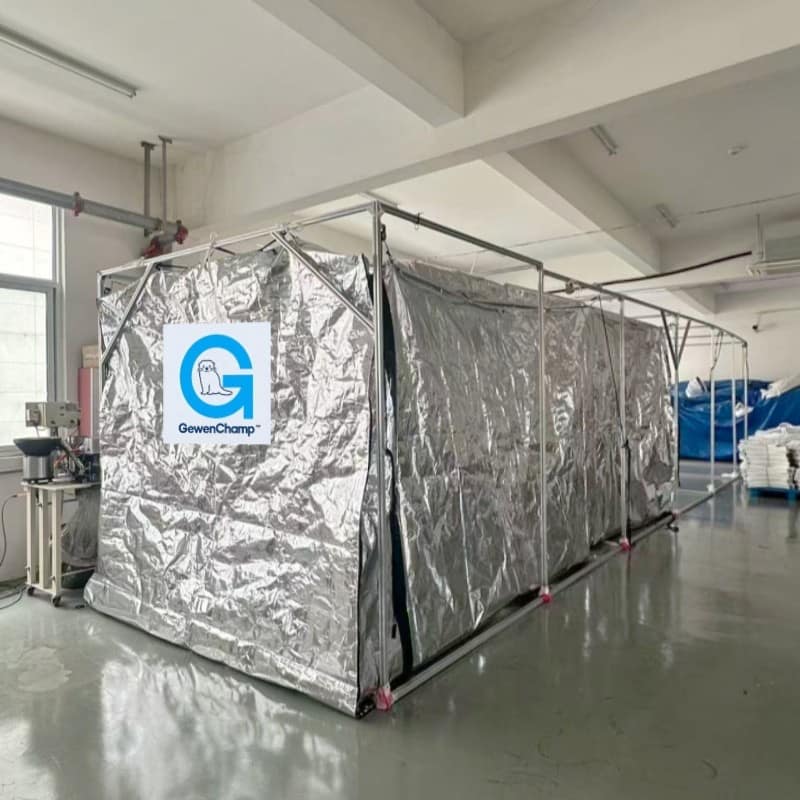
When cargo demands thermal protection — chocolate blocks, heat‑liable chemicals, pharmaceuticals, or cold‑chain foodstuffs — specialized thermal container liners add temperature management to the barrier function. The GewenChamp™ thermal insulation container liner series, for instance, uses reflective aluminum foil layers, EPE foam cores, or double‑bubble cushion structures to reduce conductive and radiant heat transfer, maintaining cargo temperature within ±5 °C during long sea journeys even without a reefer container. The TL‑02 liner’s 3 mm EPE foam achieves thermal conductivity ≤0.038 W/(m·K) and moisture vapor transmission ≤0.033 g/(m²·h·kPa), effectively preventing container rain while keeping goods stable.
A Practical Decision Framework
Not every shipment justifies a container liner, and FIBCs still have a genuine role in short‑haul, multi‑grade distribution. The table below helps match method to business reality.
| Factor | Bare Container | Bags (FIBCs) Inside Container | Container Liner |
|---|---|---|---|
| Typical cost per transaction (incl. labor, cleaning) | Lowest material cost, but high cleaning/disposal costs | Medium; bag purchase + high labor | Medium‑high liner cost but lowest total landed cost for full loads |
| Cargo purity & contamination risk | High risk; residue flushing needed | Moderate; bag material may shed, manual handling | Zero contact; full segregation |
| Moisture protection | cURL Too many subrequests by single Worker invocation. To configure this limit, refer to https://developers.cloudflare.com/workers/wrangler/configuration/#limits | cURL Too many subrequests by single Worker invocation. To configure this limit, refer to https://developers.cloudflare.com/workers/wrangler/configuration/#limits | cURL Too many subrequests by single Worker invocation. To configure this limit, refer to https://developers.cloudflare.com/workers/wrangler/configuration/#limits |
| cURL Too many subrequests by single Worker invocation. To configure this limit, refer to https://developers.cloudflare.com/workers/wrangler/configuration/#limits | cURL Too many subrequests by single Worker invocation. To configure this limit, refer to https://developers.cloudflare.com/workers/wrangler/configuration/#limits | cURL Too many subrequests by single Worker invocation. To configure this limit, refer to https://developers.cloudflare.com/workers/wrangler/configuration/#limits | cURL Too many subrequests by single Worker invocation. To configure this limit, refer to https://developers.cloudflare.com/workers/wrangler/configuration/#limits |
| cURL Too many subrequests by single Worker invocation. To configure this limit, refer to https://developers.cloudflare.com/workers/wrangler/configuration/#limits | cURL Too many subrequests by single Worker invocation. To configure this limit, refer to https://developers.cloudflare.com/workers/wrangler/configuration/#limits | cURL Too many subrequests by single Worker invocation. To configure this limit, refer to https://developers.cloudflare.com/workers/wrangler/configuration/#limits | cURL Too many subrequests by single Worker invocation. To configure this limit, refer to https://developers.cloudflare.com/workers/wrangler/configuration/#limits |
| cURL Too many subrequests by single Worker invocation. To configure this limit, refer to https://developers.cloudflare.com/workers/wrangler/configuration/#limits | cURL Too many subrequests by single Worker invocation. To configure this limit, refer to https://developers.cloudflare.com/workers/wrangler/configuration/#limits | cURL Too many subrequests by single Worker invocation. To configure this limit, refer to https://developers.cloudflare.com/workers/wrangler/configuration/#limits | cURL Too many subrequests by single Worker invocation. To configure this limit, refer to https://developers.cloudflare.com/workers/wrangler/configuration/#limits |
| Temperature control | None | None | cURL Too many subrequests by single Worker invocation. To configure this limit, refer to https://developers.cloudflare.com/workers/wrangler/configuration/#limits |
| cURL Too many subrequests by single Worker invocation. To configure this limit, refer to https://developers.cloudflare.com/workers/wrangler/configuration/#limits | cURL Too many subrequests by single Worker invocation. To configure this limit, refer to https://developers.cloudflare.com/workers/wrangler/configuration/#limits | cURL Too many subrequests by single Worker invocation. To configure this limit, refer to https://developers.cloudflare.com/workers/wrangler/configuration/#limits | cURL Too many subrequests by single Worker invocation. To configure this limit, refer to https://developers.cloudflare.com/workers/wrangler/configuration/#limits |
cURL Too many subrequests by single Worker invocation. To configure this limit, refer to https://developers.cloudflare.com/workers/wrangler/configuration/#limits
cURL Too many subrequests by single Worker invocation. To configure this limit, refer to https://developers.cloudflare.com/workers/wrangler/configuration/#limits cURL Too many subrequests by single Worker invocation. To configure this limit, refer to https://developers.cloudflare.com/workers/wrangler/configuration/#limits
cURL Too many subrequests by single Worker invocation. To configure this limit, refer to https://developers.cloudflare.com/workers/wrangler/configuration/#limits cURL Too many subrequests by single Worker invocation. To configure this limit, refer to https://developers.cloudflare.com/workers/wrangler/configuration/#limits
cURL Too many subrequests by single Worker invocation. To configure this limit, refer to https://developers.cloudflare.com/workers/wrangler/configuration/#limits cURL Too many subrequests by single Worker invocation. To configure this limit, refer to https://developers.cloudflare.com/workers/wrangler/configuration/#limits
cURL Too many subrequests by single Worker invocation. To configure this limit, refer to https://developers.cloudflare.com/workers/wrangler/configuration/#limits
The Bottom Line
cURL Too many subrequests by single Worker invocation. To configure this limit, refer to https://developers.cloudflare.com/workers/wrangler/configuration/#limits
cURL Too many subrequests by single Worker invocation. To configure this limit, refer to https://developers.cloudflare.com/workers/wrangler/configuration/#limits
 German
  English
  Spanish