
Maintaining cargo temperature during ocean freight without active refrigeration is a critical challenge for bulk shippers. Reflective bubble foil insulation liners have become a popular passive cold chain solution, but not all bubble liners are created equal. Shipments frequently encounter a decision point: single bubble or double bubble foil liners? Each promises thermal protection, but the performance reality and cost implications differ significantly. This article, written by Daniel Wu, thermal packaging specialist at Giant Flexpack, provides a practical engineer-led comparison to help logistics managers and procurement teams make data-driven decisions.
How Bubble Foil Liners Work
Bubble foil insulations combine two fundamental thermal barriers: a radiant heat reflector and an air-entrapped cushion. The outer metallic layer—typically aluminum foil or metallized polyester film (MPET)—reflects up to 95–98% of radiant heat, while the bubble layer traps still air, reducing conductive and convective heat transfer. This synergistic mechanism stabilizes internal container temperatures, protecting cargo from extreme heat or cold during long-haul sea, rail, and road transport.
Single Bubble Foil Liners: Lightweight and Cost-Effective
A single bubble foil liner typically consists of a three-layer structure: an outer reflective film (MPET or aluminum), a 4 mm polyethylene bubble cushion, and an inner reflective or white film. The bubble layer contains a single row of air cells.
Key Performance Characteristics:
– Radiant heat reflection: approximately 95%
– Total thickness: around 4 mm
– Estimated R-value (thermal resistance): 1.0–1.5 m²·K/W (depending on materials)
– Tensile strength: moderate, typically around 10–15 N/15mm for the composite
– Unit weight: very light, often less than 150 g/m²
Single bubble liners are favored in less demanding conditions: short domestic hauls, temperate routes, or where budget constraints outweigh thermal performance requirements. They install quickly and add minimal weight to the cargo. However, the single thin bubble layer offers limited resilience against punctures, and the insulation degrades noticeably on routes with high day-night temperature swings.
Double Bubble Foil Liners: Engineered for Premium Thermal Control
Double bubble liners incorporate a dual-layer air cushion, usually between two reinforced reflective surfaces. A prime illustration is the Forro térmico de contenedor TL-03 by Giant Flexpack, built from an MPET outer layer, a 5 mm double bubble layer (bubble diameter 10–15 mm), and an inner PET MPET layer—a proven four-layer composite. Unlike standard single bubble sheets, the second layer of stagnant air cells creates a secondary thermal break, substantially reducing heat exchange.
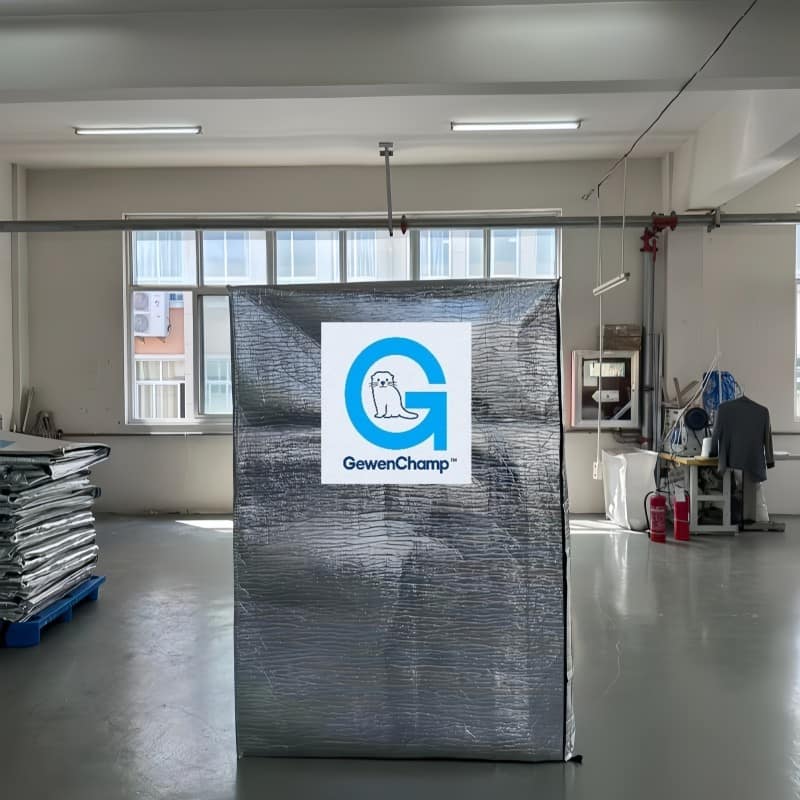
Measurable Performance Gains:
– Radiant heat reflection: up to 98% (due to high-grade MPET)
– Total thickness: 5 mm (bubble layer) plus MPET layers; overall liner gauge often 6–8 mm
– Thermal conductivity: effectively halves compared to single bubble, with a real-world temperature variance control of ±5°C inside the container
– R-value: often 2.0–3.0 m²·K/W or higher for the composite structure
– Tensile strength: significantly enhanced, reaching ≥15 N/15mm; the inner PET MPET adds tear resistance and water resistance
– Moisture vapor transmission rate: ≤0.033 g/(m²·h·kPa), actively reducing condensation risk
In field operations, a TL-03 double bubble liner can maintain cargo temperatures between -20°C and +30°C for 24–48 hours under ambient 25°C, and with ice packs it extends to 72 hours. This makes it suitable for temperature-sensitive biologics, chocolate, chemicals, and fine electronics traversing equatorial or sub-zero routes.
Head-to-Head Performance Comparison
| Parámetro | Single Bubble Foil Liner | Double Bubble Foil Liner (e.g., TL-03) |
|---|---|---|
| Typical Layers | 3 (MPET/Bubble/MPET) | 4 (MPET/Double Bubble/PET MPET) |
| Bubble Thickness | ~4 mm | 5 mm (two layers) |
| Heat Reflection | 95% | 98% |
| R-value (composite) | cURL Too many subrequests by single Worker invocation. To configure this limit, refer to https://developers.cloudflare.com/workers/wrangler/configuration/#limits | cURL Too many subrequests by single Worker invocation. To configure this limit, refer to https://developers.cloudflare.com/workers/wrangler/configuration/#limits |
| Resistencia a la perforación | Moderado | cURL Too many subrequests by single Worker invocation. To configure this limit, refer to https://developers.cloudflare.com/workers/wrangler/configuration/#limits |
| Reutilizabilidad | cURL Too many subrequests by single Worker invocation. To configure this limit, refer to https://developers.cloudflare.com/workers/wrangler/configuration/#limits | cURL Too many subrequests by single Worker invocation. To configure this limit, refer to https://developers.cloudflare.com/workers/wrangler/configuration/#limits |
| cURL Too many subrequests by single Worker invocation. To configure this limit, refer to https://developers.cloudflare.com/workers/wrangler/configuration/#limits | Very low | cURL Too many subrequests by single Worker invocation. To configure this limit, refer to https://developers.cloudflare.com/workers/wrangler/configuration/#limits |
| cURL Too many subrequests by single Worker invocation. To configure this limit, refer to https://developers.cloudflare.com/workers/wrangler/configuration/#limits | cURL Too many subrequests by single Worker invocation. To configure this limit, refer to https://developers.cloudflare.com/workers/wrangler/configuration/#limits | cURL Too many subrequests by single Worker invocation. To configure this limit, refer to https://developers.cloudflare.com/workers/wrangler/configuration/#limits |
cURL Too many subrequests by single Worker invocation. To configure this limit, refer to https://developers.cloudflare.com/workers/wrangler/configuration/#limits
cURL Too many subrequests by single Worker invocation. To configure this limit, refer to https://developers.cloudflare.com/workers/wrangler/configuration/#limits
cURL Too many subrequests by single Worker invocation. To configure this limit, refer to https://developers.cloudflare.com/workers/wrangler/configuration/#limits
cURL Too many subrequests by single Worker invocation. To configure this limit, refer to https://developers.cloudflare.com/workers/wrangler/configuration/#limits
cURL Too many subrequests by single Worker invocation. To configure this limit, refer to https://developers.cloudflare.com/workers/wrangler/configuration/#limits
cURL Too many subrequests by single Worker invocation. To configure this limit, refer to https://developers.cloudflare.com/workers/wrangler/configuration/#limits
cURL Too many subrequests by single Worker invocation. To configure this limit, refer to https://developers.cloudflare.com/workers/wrangler/configuration/#limits
cURL Too many subrequests by single Worker invocation. To configure this limit, refer to https://developers.cloudflare.com/workers/wrangler/configuration/#limits
cURL Too many subrequests by single Worker invocation. To configure this limit, refer to https://developers.cloudflare.com/workers/wrangler/configuration/#limits
cURL Too many subrequests by single Worker invocation. To configure this limit, refer to https://developers.cloudflare.com/workers/wrangler/configuration/#limits
cURL Too many subrequests by single Worker invocation. To configure this limit, refer to https://developers.cloudflare.com/workers/wrangler/configuration/#limits
cURL Too many subrequests by single Worker invocation. To configure this limit, refer to https://developers.cloudflare.com/workers/wrangler/configuration/#limits
cURL Too many subrequests by single Worker invocation. To configure this limit, refer to https://developers.cloudflare.com/workers/wrangler/configuration/#limits
cURL Too many subrequests by single Worker invocation. To configure this limit, refer to https://developers.cloudflare.com/workers/wrangler/configuration/#limits
cURL Too many subrequests by single Worker invocation. To configure this limit, refer to https://developers.cloudflare.com/workers/wrangler/configuration/#limits
cURL Too many subrequests by single Worker invocation. To configure this limit, refer to https://developers.cloudflare.com/workers/wrangler/configuration/#limits
cURL Too many subrequests by single Worker invocation. To configure this limit, refer to https://developers.cloudflare.com/workers/wrangler/configuration/#limits
cURL Too many subrequests by single Worker invocation. To configure this limit, refer to https://developers.cloudflare.com/workers/wrangler/configuration/#limits
cURL Too many subrequests by single Worker invocation. To configure this limit, refer to https://developers.cloudflare.com/workers/wrangler/configuration/#limits
cURL Too many subrequests by single Worker invocation. To configure this limit, refer to https://developers.cloudflare.com/workers/wrangler/configuration/#limits cURL Too many subrequests by single Worker invocation. To configure this limit, refer to https://developers.cloudflare.com/workers/wrangler/configuration/#limits cURL Too many subrequests by single Worker invocation. To configure this limit, refer to https://developers.cloudflare.com/workers/wrangler/configuration/#limits
Frequently Asked Questions
cURL Too many subrequests by single Worker invocation. To configure this limit, refer to https://developers.cloudflare.com/workers/wrangler/configuration/#limits
cURL Too many subrequests by single Worker invocation. To configure this limit, refer to https://developers.cloudflare.com/workers/wrangler/configuration/#limits
cURL Too many subrequests by single Worker invocation. To configure this limit, refer to https://developers.cloudflare.com/workers/wrangler/configuration/#limits
cURL Too many subrequests by single Worker invocation. To configure this limit, refer to https://developers.cloudflare.com/workers/wrangler/configuration/#limits
cURL Too many subrequests by single Worker invocation. To configure this limit, refer to https://developers.cloudflare.com/workers/wrangler/configuration/#limits
cURL Too many subrequests by single Worker invocation. To configure this limit, refer to https://developers.cloudflare.com/workers/wrangler/configuration/#limits
cURL Too many subrequests by single Worker invocation. To configure this limit, refer to https://developers.cloudflare.com/workers/wrangler/configuration/#limits
cURL Too many subrequests by single Worker invocation. To configure this limit, refer to https://developers.cloudflare.com/workers/wrangler/configuration/#limits
cURL Too many subrequests by single Worker invocation. To configure this limit, refer to https://developers.cloudflare.com/workers/wrangler/configuration/#limits
cURL Too many subrequests by single Worker invocation. To configure this limit, refer to https://developers.cloudflare.com/workers/wrangler/configuration/#limits
cURL Too many subrequests by single Worker invocation. To configure this limit, refer to https://developers.cloudflare.com/workers/wrangler/configuration/#limits [email protected] o llama al +86 523 87683880.
cURL Too many subrequests by single Worker invocation. To configure this limit, refer to https://developers.cloudflare.com/workers/wrangler/configuration/#limits
 Spanish
  English
  German