
Maintaining cargo temperature during ocean freight without active refrigeration is a critical challenge for bulk shippers. Reflective bubble foil insulation liners have become a popular passive cold chain solution, but not all bubble liners are created equal. Shipments frequently encounter a decision point: single bubble or double bubble foil liners? Each promises thermal protection, but the performance reality and cost implications differ significantly. This article, written by Daniel Wu, thermal packaging specialist at Giant Flexpack, provides a practical engineer-led comparison to help logistics managers and procurement teams make data-driven decisions.
How Bubble Foil Liners Work
Bubble foil insulations combine two fundamental thermal barriers: a radiant heat reflector and an air-entrapped cushion. The outer metallic layer—typically aluminum foil or metallized polyester film (MPET)—reflects up to 95–98% of radiant heat, while the bubble layer traps still air, reducing conductive and convective heat transfer. This synergistic mechanism stabilizes internal container temperatures, protecting cargo from extreme heat or cold during long-haul sea, rail, and road transport.
Single Bubble Foil Liners: Lightweight and Cost-Effective
A single bubble foil liner typically consists of a three-layer structure: an outer reflective film (MPET or aluminum), a 4 mm polyethylene bubble cushion, and an inner reflective or white film. The bubble layer contains a single row of air cells.
Key Performance Characteristics:
– Radiant heat reflection: approximately 95%
– Total thickness: around 4 mm
– Estimated R-value (thermal resistance): 1.0–1.5 m²·K/W (depending on materials)
– Tensile strength: moderate, typically around 10–15 N/15mm for the composite
– Unit weight: very light, often less than 150 g/m²
Single bubble liners are favored in less demanding conditions: short domestic hauls, temperate routes, or where budget constraints outweigh thermal performance requirements. They install quickly and add minimal weight to the cargo. However, the single thin bubble layer offers limited resilience against punctures, and the insulation degrades noticeably on routes with high day-night temperature swings.
Double Bubble Foil Liners: Engineered for Premium Thermal Control
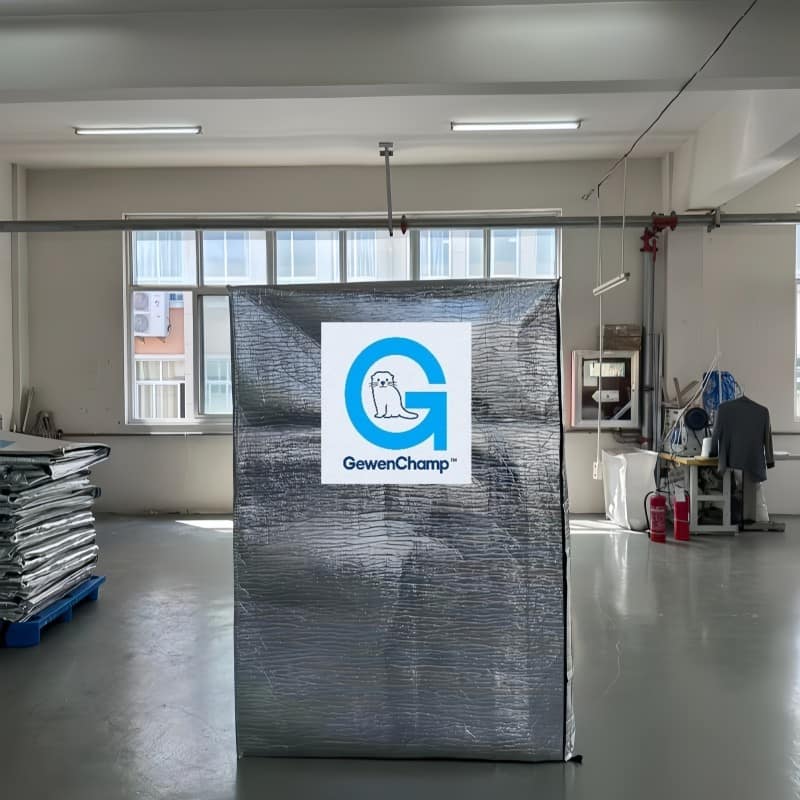
Double bubble liners incorporate a dual-layer air cushion, usually between two reinforced reflective surfaces. A prime illustration is the TL-03 Thermal Container Liner by Giant Flexpack, built from an MPET outer layer, a 5 mm double bubble layer (bubble diameter 10–15 mm), and an inner PET MPET layer—a proven four-layer composite. Unlike standard single bubble sheets, the second layer of stagnant air cells creates a secondary thermal break, substantially reducing heat exchange.
Measurable Performance Gains:
– Radiant heat reflection: up to 98% (due to high-grade MPET)
– Total thickness: 5 mm (bubble layer) plus MPET layers; overall liner gauge often 6–8 mm
– Thermal conductivity: effectively halves compared to single bubble, with a real-world temperature variance control of ±5°C inside the container
– R-value: often 2.0–3.0 m²·K/W or higher for the composite structure
– Tensile strength: significantly enhanced, reaching ≥15 N/15mm; the inner PET MPET adds tear resistance and water resistance
– Moisture vapor transmission rate: ≤0.033 g/(m²·h·kPa), actively reducing condensation risk
In field operations, a TL-03 double bubble liner can maintain cargo temperatures between -20°C and +30°C for 24–48 hours under ambient 25°C, and with ice packs it extends to 72 hours. This makes it suitable for temperature-sensitive biologics, chocolate, chemicals, and fine electronics traversing equatorial or sub-zero routes.
Head-to-Head Performance Comparison
| Parameter | Single Bubble Foil Liner | Double Bubble Foil Liner (e.g., TL-03) |
|---|---|---|
| Typical Layers | 3 (MPET/Bubble/MPET) | 4 (MPET/Double Bubble/PET MPET) |
| Bubble Thickness | ~4 mm | 5 mm (two layers) |
| Heat Reflection | 95% | 98% |
| R-value (composite) | 1.0–1.5 | 2.0–3.0 |
| Puncture Resistance | Moderate | High (reinforced inner film) |
| Reusability | 2–3 cycles under light use | 3–5 cycles standard; up to 8 heavy-use |
| Unit Weight | Very low | Low, but slightly heavier |
| Relative Cost per 40ft Liner | Base cost | 25–40% higher than single bubble |
Cost Trade-offs: Total Expenditure vs. Cargo Risk
Procurement teams often focus on the unit liner cost. A single bubble liner can be 25–40% cheaper per container. For a low-value, heat-tolerant commodity moving from Rotterdam to Hamburg in April, that savings might be justified.
But when the cargo is high-value cocoa beans crossing from West Africa to Europe in July, or titanium dioxide powder risking caking from moisture and heat, the cost calculation must shift. A single container of premium cocoa can exceed USD 150,000. Keeping that cargo within 2°C of target using passive insulation—or avoiding a USD 3,000+ reefer slot—makes the additional USD 150–250 liner cost trivial. Moreover, the double bubble liner’s higher durability means it can be reused for multiple voyages, amortizing the premium.
Real-world example: a Southeast Asian resin exporter shipping to the Middle East replaced single bubble liners with TL-03 double bubble liners. Initial liner cost rose by 30%, but cargo damage claims dropped by over 80%, and the liners were reused an average of four times, ultimately cutting their thermal packaging cost per ton by 12%.
Choosing the Right Liner for Your Route
A single bubble foil liner may suffice when:
– The transit time is under 5 days.
– The route experiences mild seasonal temperature shifts (e.g., Mediterranean in spring).
– The cargo has a wide acceptable temperature range (e.g., many industrial chemicals).
– Budget is the absolute primary constraint, and the supplier’s single bubble product is tested and certified.
Upgrade to a double bubble foil liner when:
– Ocean transit exceeds 10 days, or passes through equatorial/temperate extremes.
– Cargo is food-grade, pharmaceutical, or luxury temperature-sensitive items.
– You aim to replace active reefer containers on specific lanes.
– Condensation and container rain are known risks (the improved moisture barrier matters).
– You need a reusable liner that withstands multiple loading/unloading cycles.
Always ask potential manufacturers for third-party thermal performance reports and food-grade certifications (FDA, LFGB, EU regulations) if your goods are consumables.
The Giant Flexpack TL-03 Solution
At Giant Flexpack, we engineered the TL-03 double bubble thermal container liner specifically for shippers who refuse to compromise between cargo safety and cost. Certified to FDA, LFGB, ISO9001, and SGS standards, the TL-03 is fully customizable for 20ft, 40ft, and 40ft high-cube containers. Our factory in Taixing, Jiangsu, integrates Sino-American quality systems, ensuring every liner meets rigorous tensile, reflectivity, and moisture transmission specifications.
We also offer single bubble or alternative insulation materials like woven thermal fabric and EPE foam for specialized applications. Explore our full range of thermal insulation container liners to find the right fit for your cargo. Our engineering team works with you to match the liner construction to your exact route profile, not the other way around.
Frequently Asked Questions
Can I use a single bubble liner with ice packs for extra cold protection?
Technically yes, but the thinner bubble layer has lower thermal break efficiency, so ice packs will sweat faster and the cool duration is shorter. Double bubble liners with ice packs routinely achieve 72-hour cool stability.
Is a double bubble liner noticeably heavier?
The weight difference is minor—typically 10–20 kg extra per 40ft liner. This adds negligible freight cost relative to the thermal benefits.
Do I need certification for my liner if shipping non-food goods?
Even for industrial chemicals, we recommend ISO 9001 and REACH/RoHS compliance to ensure material safety and workplace handling. Food-grade goods absolutely require FDA or LFGB.
Can double bubble liners be reused?
Yes. Gentle handling and proper storage after unloading allow 3–5 reuse cycles for standard double bubble liners. Some clients achieve more with our heavy-duty variants.
Making the Informed Choice
The decision between single and double bubble foil liners is a balancing act of upfront price, thermal performance, and cargo risk. While single bubble liners satisfy basic insulation needs on short, mild routes, double bubble liners deliver the engineering margin needed for global, multi-day voyages with premium cargo. At Giant Flexpack, we work closely with shippers to evaluate route data, custom-fit liner designs, and provide sample testing before order commitment.
For a personalized thermal insulation assessment or to request samples of our TL-03 double bubble liner, contact our team at [email protected] or call +86 523 87683880.
Daniel Wu is a thermal packaging specialist at Giant Flexpack with over fifteen years of experience in container liner manufacturing and temperature-controlled transport solutions.
 English
  German
  Spanish