
In over fifteen years of managing container liner logistics, I’ve seen cargo worth hundreds of thousands of dollars rejected at the destination port because moisture content was never verified before loading. Cargo moisture testing is not a precaution you can skip; it is the checkpoint that determines whether your goods survive weeks at sea or arrive damaged by mold, caking, or frost. A 1% variance above the safe moisture threshold can set off condensation cycles inside a container that no liner can fully reverse. This guide shows how to test moisture levels accurately and then use those results to build a moisture defense system that protects your shipment from dock to delivery.
The Hidden Cost of Skipping Pre-Loading Moisture Checks
Moisture-related cargo damage is one of the most under reported causes of financial loss in bulk shipping. When hygroscopic materials like grains, cocoa beans, or plastic resins absorb ambient humidity, they do not simply get damp; they can swell, clump, or ferment, triggering a chain of biological and chemical degradation. I recall a shipment of cocoa beans from West Africa to Europe where the exporter relied on a visual inspection at the warehouse. The containers crossed the equator, internal temperatures rose, and the beans’ moisture content, which had been 7.2%, climbed past 9% in the container’s headspace due to temperature fluctuation condensation. The result was mold colonies visible on the top layer of bags, an insurance claim, and a damaged relationship with the buyer. The monetary loss was compounded by the hidden cost of reputational damage and lost future container volume. This scenario plays out every season for commodities that were never properly tested.
Accurate Moisture Measurement: Tools and Techniques
Cargo moisture testing is not a process that fits every cargo type. The right method depends on your commodity, packaging, and the logistics environment. In our project work, we have standardized on a few reliable techniques that combine speed with accuracy.
Moisture Meters: Capacitance vs. Pin-Type — Which to Choose?
Capacitance (dielectric) moisture meters have become the default for many bulk cargo inspectors because they are non-destructive and provide instant readings. The instrument emits a radio frequency field that penetrates a certain depth into the material and measures the dielectric constant, which correlates with moisture content. I prefer capacitance meters for testing grains, plastic pellets, and powdered cargoes where surface moisture can mislead pin-type meters. However, these meters must be calibrated for the specific material’s density and temperature; a reading from corn is not directly transferable to crushed rubber. Pin-type meters, which measure electrical resistance between two inserted electrodes, deliver more localized readings, useful for checking the core of baled fibers or timber, where moisture gradients may hide wet pockets. For container loading inspections, carrying both types provides a more complete picture.
Sampling Strategies for Bulk and Bagged Cargo
A moisture meter reading is only as good as the sample. I have seen receivers pull a random handful from the top of a container and declare the load dry, only to find that moisture migrated downward during transit, wetting the floor-level bags. Proper sampling means pulling cores from at least three vertical points in a container (top, middle, and bottom) and from several horizontal positions. For bagged goods, open at least 5% of bags across the stack. For free-flowing bulk, use a grain trier or a deep-cup sampler to extract material from the center of the pile. Seal each sample in an airtight container immediately to prevent moisture exchange with ambient air. Only then should you measure. This disciplined approach catches the kind of stratification that ruins entire shipments.
Setting Moisture Thresholds for Common Commodities
Knowing how to measure moisture is not enough; you need a target. Each commodity has a safe moisture range derived from its equilibrium moisture content at the expected transport conditions. I have assembled a reference table based on our work with major commodity exporters and international standards such as the Gafta (Grain and Feed Trade Association) contracts.
| Commodity | Safe Moisture Content (wet basis) | Critical Moisture Level (damage risk) |
|---|---|---|
| Corn (maize) | ≤14.0% | >15.5% |
| Soybeans | ≤13.5% | >15.0% |
| Cocoa beans | ≤7.5% | >8.5% |
| Wheat | ≤13.0% | >14.0% |
| Plastic resin (PE/PP) | ≤0.10% | >0.25% |
| Crumb rubber | ≤0.5% | >1.0% |
Data compiled from Gafta No.125, ISO 11294, and field observations.
The table shows that plastic resins essentially require near-zero moisture, which is achievable only with pre-dried material and sealed storage. Cocoa beans, on the other hand, can accept slightly higher moisture but are extremely sensitive to mold; any deviation above 7.5% calls for immediate intervention, possibly a forced air drying before loading.
Grain and Oilseeds: The 14% Rule and Beyond
The “14% moisture” rule for grains is widely quoted, but it originates from safe storage at ambient temperatures, not the dynamic conditions inside a container crossing climate zones. In practice, I advise shippers to aim for 0.5% below the safe threshold to create a buffer against condensation. For soybeans, targeting 13.0% instead of 13.5% reduces the risk that condensation in tropical transit will push moisture over the damage line. This is a simple margin that costs nothing except discipline.
Specialty Cargo: Cocoa Beans, Resins, and Powders
Cocoa beans are hygroscopic and also contain fat that can oxidize with moisture. We always recommend using a forced-air sampling technique that measures not just the shell moisture but the internal kernel moisture, because beans can feel dry externally while the interior retains 8% moisture. For powdered chemicals like kaolin clay or titanium dioxide, a conductivity meter may not work; instead, use the oven-dry method (ASTM D2216) on a representative sample. These powders can cake irreversibly if moisture exceeds 0.5%, so the pre-loading check must be rigorous.
If your program involves a commodity not listed here, or you are dealing with a high-moisture material like wet distillers grains, our team can help you establish a testing protocol and select a container liner that matches your moisture profile. Send your commodity spec to [email protected] and we will confirm the appropriate threshold and packaging strategy.
From Test Result to Container: Building a Moisture Defense System
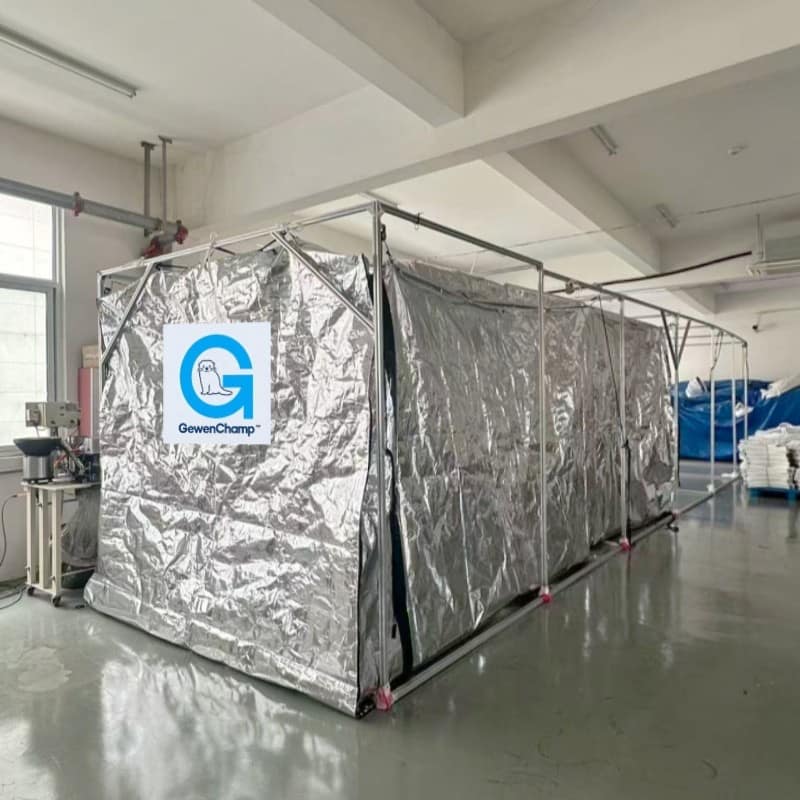
Moisture test results provide a snapshot, but a container is a moving microclimate. Temperature fluctuations cause air to expand and contract, pulling humid outside air through container vents if liners are not properly sealed. This is where the choice of container liner becomes critical. A liner is not just a bag; it is an engineered moisture management layer.
Interpreting Moisture Readings to Choose the Right Container Liner
After you have measured your cargo moisture, compare the result to the equilibrium moisture content at the anticipated transit relative humidity. If the cargo moisture is marginally safe but the route includes high-humidity ports (such as Southeast Asia monsoon season), a high-barrier liner is warranted. For example, our TL-02 EPE Foam thermal liner has a moisture vapor transmission rate of ≤0.033 g/(m²·h·kPa), which effectively shuts down vapor migration even when the container wall sweats. We have used this liner for shipments of moisture-sensitive polycarbonate resin that tested at 0.12% moisture, well within spec but still vulnerable to headspace condensation. The liner maintained internal dew point below the cargo surface temperature, preventing any condensation. In contrast, for a dry commodity like PVC resin with moisture below 0.15%, a standard PE film liner may suffice. The test result directly informs the liner spec: overly permeable liners allow moisture to equalize across the membrane, risking cargo absorption; over-engineered liners add cost and complexity. The right choice sits at the intersection of measured moisture, route duration, and ambient humidity extremes.
When Desiccants Alone Are Not Enough: The Case for Anti-Condensation Liners
I often encounter shippers who rely on silica gel desiccants to “fix” moisture after loading. Desiccants absorb water vapor in the air, but they cannot stop hygroscopic cargo from releasing its own moisture into the headspace. If your cargo tests at the borderline of safe moisture, adding desiccants is a patch, not a solution. An anti-condensation container liner, like the TL-01 woven thermal fabric liner with its aluminum foil lamination, reflects radiant heat and prevents the container wall from reaching dew point. By keeping the container interior temperature stable, it stops the condensation cycle at its source. In our field tests for a sugar shipment from Thailand to the Middle East, we used a combination of a TL-01 liner and only a half-dose of desiccants; the sugar arrived with moisture content unchanged at 0.04%, despite an outside temperature swing of 35°C. The liner’s multi-layer structure absorbed thermal shock while the desiccants handled residual humidity. This dual strategy is something I recommend for any cargo testing within 1% of its damage threshold.
Pre-Loading Moisture Inspection Protocol
A practical pre-loading checklist that our logistics team follows will help you avoid the common oversight of testing one area and assuming the rest is uniform.
- Verify cargo moisture documentation from the supplier and cross-check with your own measurements.
- Calibrate your moisture meter against a reference standard or a known sample immediately before use.
- Sample at multiple depths and locations; pool samples for an average, but also note the highest reading.
- Record ambient temperature and relative humidity at the time of sampling; this affects meter readings and later comparison.
- Weigh and dry a control sample (oven method) if you suspect meter error or for high-value cargo.
- Compare results to your commodity’s safe threshold and determine the required liner specification.
- Document all measurements with date, time, location, and operator; attach to the shipping manifest.
Following this protocol reduces the likelihood that a container arrives with moisture damage that could have been avoided.
Pre-Loading Moisture Testing Alone Is Not a Guarantee: Your Container Liner Is the Second Half of the Defense
Moisture damage is a supply chain risk that starts before the container doors close. If your cargo has been properly tested and you have identified the right moisture threshold, the next step is selecting a container liner that matches those results. We can help you evaluate your moisture data against our range of thermal and anti-condensation liners to design a packaging solution that keeps your cargo dry from port to port. Send your cargo specifications and testing results to [email protected], or call +86 523 87683880, and we will recommend a liner specification that aligns with your measured moisture profile.
Common Questions About Pre-Loading Moisture Testing
How soon before loading should I run moisture tests on my cargo?
Test moisture as close to loading time as possible, ideally within 24 hours and after the cargo has been exposed to the environment it will experience in the container. Cargo stored in an open warehouse in humid weather can absorb moisture in a matter of hours. If you test a week in advance, the reading may no longer be valid. For grain in silos, we recommend a final core sample immediately before transfer to the container.
What if my cargo tests within safe limits but still gets moisture damage?
This is a common frustration. Safe limits are based on equilibrium moisture content under stable conditions, but a container at sea is anything but stable. Temperature cycling drives water vapor from the cargo itself into the headspace, where it condenses on the cool container ceiling and drips back down. If this happens, it usually indicates that the container liner’s moisture vapor barrier was insufficient or damaged. Review the liner’s MVTR specification and ensure airtight installation. If the cargo is near the threshold, add a thermal liner to dampen temperature swings.
Are moisture meters accurate for all types of bulk cargo?
No. Moisture meters are calibrated for specific material types; a grain meter will not give an accurate reading on plastic pellets. For non-grain commodities, we verify meter readings with the oven-dry method on a subset of samples. Additionally, high-metal-content minerals or conductive powders can distort capacitance readings. Always check the meter’s calibration chart and run a side-by-side oven test if you are uncertain. In our quality assurance process for titanium dioxide, we use a gravimetric method as the reference standard.
Can container liners compensate for borderline moisture levels?
To some extent, yes, but they are not a fix for wet cargo. A high-barrier liner like the TL-02 with its quadruple-layer construction can retard moisture migration and buffer humidity, but if the cargo itself is above its safe moisture threshold, microbial activity and chemical degradation can still occur inside the liners. Liners create a controlled environment; they do not dry the cargo. Use the test result to enforce the supplier’s drying obligation, then select a liner as insurance, not as a remedy.
Do I need to test moisture if I’m using a thermal container liner?
Absolutely. Thermal liners manage temperature and condensation, but they cannot prevent the consequences of inherently wet cargo. In fact, a thermal liner’s airtight nature can trap moisture inside if the cargo is damp, leading to accelerated spoilage. Testing is always required to ensure the cargo is fit for containerization, regardless of the packaging system. If you have a shipment with unpredictable moisture conditions, we can help design a liner solution combined with a testing protocol for your specific cargo. Share your requirements at [email protected], and we will confirm the right approach.
 English
  German
  Spanish