
Sustainability targets are pushing logistics teams to reconsider every component of the supply chain, including the single-use liners protecting millions of containerized bulk shipments each year. Biodegradable container liners have entered the conversation as a potential alternative to conventional polyethylene and woven polypropylene, but the gap between environmental aspiration and operational reliability remains wide. Having spent fifteen years in container liner manufacturing and thermal protection engineering, I understand the appeal of materials that promise faster end-of-life breakdown. What I do not yet see is a biodegradable film or fabric that matches the moisture barrier integrity, tensile strength, and predictable shelf life our industry demands for intercontinental routes where one failed liner can mean a lost cargo claim. This article sets aside sustainability headlines and examines whether biodegradable container liners, as commercial products today, can meet the physical and logistical demands of real-world bulk shipping.
Material Composition of Biodegradable Container Liners
Biodegradable container liners are typically fabricated from bio-based polymers such as polylactic acid (PLA), polyhydroxyalkanoates (PHA), thermoplastic starch blends, or composites incorporating cellulose fibres and biodegradable aliphatic-aromatic copolyesters. This contrasts sharply with conventional liner materials. Standard dry bulk liners at our facility are built from high-density polyethylene woven fabric with controlled lamination, delivering a pore-free barrier rated for ≥98% moisture resistance. A 140-micron low-density polyethylene film liner, our workhorse product for food and chemical cargoes, provides 100% moisture and dust blockage with tensile strengths above 1,500 N/5cm in the warp direction.
The molecular structure that makes PLA or PHA susceptible to enzymatic hydrolysis in a commercial composting environment is the same structure that limits their ability to hold back water vapour over a 40-day ocean voyage. Most biodegradable polymers absorb significantly more ambient moisture than PE, and their mechanical properties degrade faster under elevated humidity and temperature cycling, precisely the conditions encountered inside a container on a tropical route. Certification labels like “industrially compostable” reference controlled facilities operating at 58 °C with forced aeration and specified microbiology. A shipping container crossing the Equator may reach 50 °C inside but offers none of the microbial activity required to trigger controlled biodegradation. The risk is not that the liner composts prematurely; the risk is that it weakens in ways that standard quality-control protocols were never designed to predict.
Performance Limitations Against Established Container Liner Specifications
When I evaluate a new liner material, the first parameters I check are tensile strength, tear propagation resistance, elongation at break, moisture vapour transmission rate, and friction characteristics on steel container walls, because these five numbers determine whether a 25-ton load of polycarbonate resin arrives dry and contained or ruptured and contaminated. No biodegradable liner I have examined or reviewed in published technical literature matches the baseline performance of a 140 gsm woven HDPE liner across that entire set.
| Property | Biodegradable Liner (PLA/Starch Blend) | Conventional PE Woven / Film Liner |
|---|---|---|
| Tensile Strength (N/5cm) | 800–1,200 (warp) | ≥1,800 (woven), ≥1,500 (film) |
| Moisture Vapour Transmission Rate (g/m²·24h) | 3–8 (ambient) | <0.5 (film), <2 (coated woven) |
| Elongation at Break | 10–25% | 30–35% (film), 20–25% (woven) |
| Shelf Life (unused) | 6–12 months (controlled storage) | ≥3 years |
| Reusability | Single-use only | 5–8 times for woven thermal liners |
Moisture vapour transmission is the critical differentiator. A biodegradable liner allowing several grams of water vapour through per square metre each day, multiplied across a 120-square-metre liner surface over a 35-day voyage, can introduce enough humidity to cause caking in sugar, hydrolysis in polycarbonate resin, or rust on steel components. I have seen polymer pellet shipments rejected because moisture content rose by 0.04% above specification, an invisible damage mechanism that a biodegradable liner with even modest permeability can accelerate.
For non-moisture-sensitive cargoes such as sand, gravel, or certain construction minerals, a lower barrier performance may be acceptable. But for the high-value commodities that justify containerized bulk shipping in the first place, the margin for error is too slim to accept a material that does not yet demonstrate equivalent vapour resistance.
Certification and Standards Complexity for Bulk Shipping Applications
Navigating biodegradability claims requires understanding which standard actually applies to the logistics scenario. EN 13432 and ASTM D6400 certify compostability in managed industrial facilities, conditions entirely absent from a shipping container. ASTM D7081, which addressed marine biodegradation, was withdrawn in 2014 and has not been replaced by a globally recognized shipping-specific standard. A liner labelled “biodegradable” may break down in soil under optimal microbial conditions, but those conditions are irrelevant when the liner is wrapped around 20 tons of kaolin clay in a steel box.
This regulatory gap creates a dangerous grey area for shippers. A liner that meets European composting requirements can still fragment into persistent microplastic particles if discarded in a marine environment, and a liner that would eventually degrade in warm seawater may lose structural integrity well before port arrival. At Giant Flexpack, every liner we ship carries certifications mapped to the cargo’s destination market: FDA for food contact, REACH for chemical safety, LFGB for EU food-grade compliance. A biodegradable liner with only EN 13432 certification lacks equivalent user-protection credentials for international bulk food transport. If you are shipping cocoa beans or wine intended for human consumption, the fastener securing the discharge spout is regulated, and the liner body is not exempt. Any manufacturer marketing a biodegradable liner for food-grade commodities must present not just compostability test results but a complete migration testing report under EU 10/2011 or FDA 21 CFR conditions. I have not yet seen that combination of data from a single biodegradable liner supplier.
Sourcing, Cost, and Operational Integration: The Commercial Equation
The supply chain for biodegradable bulk liners is fragmented. A small number of European and North American film producers offer compostable films that could, in theory, be fabricated into a container liner, but the conversion steps (heat-sealing large panels, attaching filling and discharge spouts, reinforcing high-stress points) require equipment and workflow knowledge not typically found in compostable packaging factories. A liner that fails under static load testing because of poor seam welding is as useless as one that dissolves in seawater.
Commercially, the price gap is substantial. A standard 40-foot PE film liner from a volume manufacturer in Jiangsu costs roughly one-third to one-half of the quoted price for a biodegradable equivalent of comparable thickness and coverage. This premium does not buy performance parity; it buys a potential end-of-life story whose credibility depends on the receiving country’s waste infrastructure. For a shipper moving 200 containers per month, the cost differential translates into a six-figure annual premium without a guarantee of cargo protection improvement.
Operational integration introduces further friction. Biodegradable films often have different elongation behaviour, which means the standard insertion and strapping procedures may tear the material if not adjusted. Our installation crews are trained to handle specific fabric weights and friction coefficients, and introducing a new material without revised handling protocols and training would increase the risk of installation damage before the container even leaves the warehouse. If your team decides to pilot a biodegradable liner, plan for installation training as a separate line item and expect a higher reject rate during the initial learning curve.
A Practical Pilot Framework for Evaluating Biodegradable Liners
With all the performance caveats on the table, I do not recommend dismissing biodegradable liners entirely. The technology will improve, and the regulatory pressure to reduce plastic waste will grow. What I counsel shippers who are considering a pilot is to isolate the variables in a way that separates material performance data from operational noise. Start with a short sea route, under four days, on a lane where you have full container temperature and humidity data history. Select a cargo that is dry, free-flowing, non-food-grade, and not sensitive to a small humidity increase: construction sand, recycled glass cullet, or clean mineral aggregate all work as trial loads. Install a standard data logger inside the container and run a parallel shipment with your existing liner as a control.
In our own facility, when we evaluate a new liner construction, we perform burst testing, cyclic temperature stress from -20 °C to 60 °C, and 72-hour high-humidity soak before approving a single prototype for a customer trial. Any shipper trialling a biodegradable liner should request these same test reports from the supplier and compare them against the conventional liner data you already trust. If the supplier cannot provide moisture vapour transmission rate data measured to ISO 12572 or tensile strength to ISO 527, the material is not ready for a live shipment, regardless of its biodegradation certification.
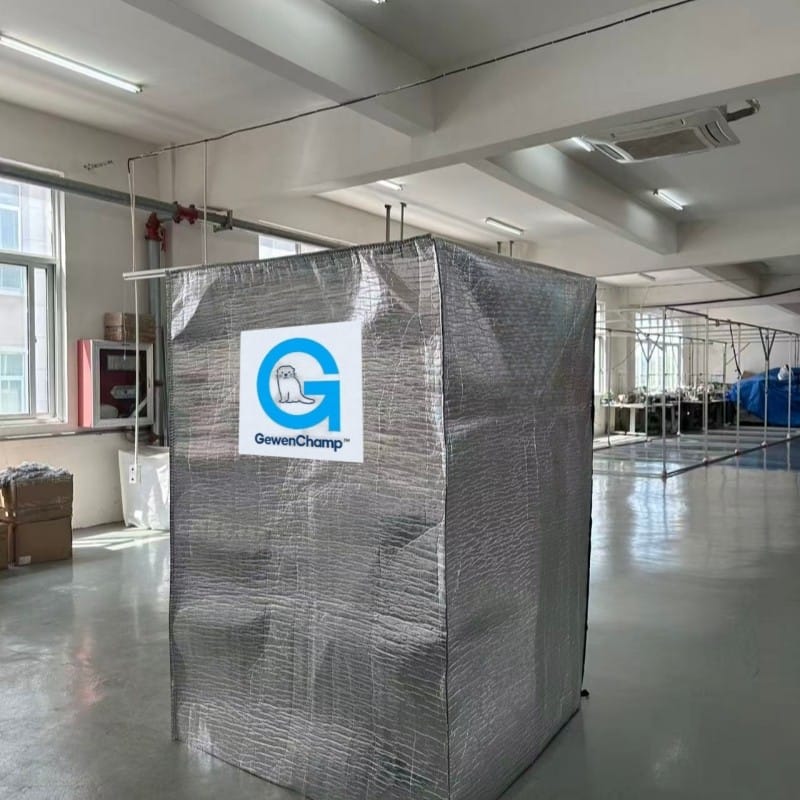
For cargoes that cannot accept any compromise on moisture or contamination control, our GewenChamp series thermal liners and our DBL series dry bulk liners continue to offer proven, certified protection with full traceability. An experienced manufacturer who understands both the traditional material science and the emerging bio-based alternatives can serve as a technical partner, helping you evaluate when the transition makes sense rather than marketing a premature switch.
Common Questions About Biodegradable Container Liners for Bulk Transport
Do biodegradable container liners start breaking down during a normal ocean voyage?
In most cases, no. A properly stored biodegradable liner inside a sealed container without active microbial inoculation will not undergo meaningful biodegradation during transit. The more immediate risk is physical weakening caused by heat and humidity softening the polymer matrix, which can reduce tear resistance well before any visible degradation occurs. I have retrieved liner samples after accelerated humidity testing and found a 20–30% drop in tensile strength with no visible decomposition, a performance change that does not show up on a visual pre-shipment inspection but that translates into a higher probability of rupture at seams and stress points.
Are biodegradable liners strong enough for heavy bulk cargoes like cement or mineral concentrates?
Not for high-density, abrasive cargoes unless the liner is significantly thicker and supported by additional reinforcement, which erodes the cost and weight advantages. Starch-based and PLA films lack the tear propagation resistance of oriented woven polypropylene or HDPE, meaning that a point load from an angular particle can initiate a tear that travels quickly under the shifting loads typical of bulk transport. If your cargo has a high angle of repose and experiences minimal shifting, a thicker biodegradable liner may be acceptable, but I would not use one for materials exceeding 1,500 kg/m³ without a woven reinforcement layer, which negates the biodegradability of the composite.
What is the cost difference between a biodegradable and a standard container liner?
Expect to pay 2–3 times the unit price of a conventional PE film liner of similar coverage, with narrower availability in standard container sizes. This premium is driven by higher raw material costs, lower production volumes, and the additional documentation burden for biodegradability certification. Volume discounts that are standard for woven and film liners at quantities above 500 units are rarely available for biodegradable options today. Total landed cost including shipping, duties, and potential handling modifications increases the gap further, especially for buyers sourcing from different continents than their liner supplier.
What recyclability or disposal pathway actually exists for biodegradable liners at destination ports?
This is the most overlooked question in the sustainability conversation. Very few ports operate industrial composting facilities capable of processing a used bulk container liner, and most port waste streams are directed to incineration or landfill. A biodegradable liner deposited in a landfill without oxygen and microbial activity will persist similarly to conventional plastic. Shippers who invest in biodegradable liners without confirming the waste infrastructure at every discharge port are paying a premium for a theoretical end-of-life benefit that may never materialize. I recommend mapping the full disposal chain before ordering, and if your route does not support composting, a reusable thermal liner with a take-back and recycling programme may deliver a more verifiable environmental saving.
Which cargo types are the best candidates for an initial biodegradable liner trial?
Dry, low-value, non-hygroscopic bulk solids on short-haul routes are the logical starting point. Construction aggregates, recycled materials, and certain non-food-grade minerals offer the lowest risk if the liner underperforms. I would not trial biodegradable liners with food commodities, resin pellets, or any cargo where a moisture excursion triggers a contamination claim or a regulatory non-compliance report. Once you have accumulated performance data across several seasonal cycles and the material demonstrates repeatable strength and barrier data, you can consider expanding the scope incrementally. Share your cargo specification and route details with our technical team at [email protected] or call +86 523 87683880, and we will help you evaluate whether a pilot makes engineering sense for your specific supply chain.
 English
  German
  Spanish