
When selecting a bulk container liner, thickness often becomes the first technical specification buyers look at — and for good reason. A liner that’s too thin tears under load, while one that’s unnecessarily thick adds cost, weight, and installation difficulty. Understanding how thickness is measured, and how it translates into real-world protection for your cargo, is the foundation of a reliable bulk packaging decision.
This guide explains the two most common thickness systems — GSM and Mil — and shows how they affect performance across different liner materials, from blown PE films to woven polypropylene fabrics and multi-layer thermal barriers.
How Container Liner Thickness Is Measured: GSM vs Mil
Two distinct measurement systems exist because container liners are manufactured from fundamentally different families of materials. Using the wrong scale leads to confusion when comparing products.
GSM (grams per square meter) is the standard for woven fabrics — PP, HDPE, and composite woven structures. It describes the actual weight of the fabric per unit area, which is a direct proxy for thread density, coating thickness, and overall robustness. A higher GSM means more material is packed into every square meter: heavier yarns, tighter weaves, and stronger laminations.
Mil (1/1000 of an inch) or its metric equivalent micron (µm) is used for plastic films, especially blown PE liners. One mil equals 25.4 microns. Film thickness is measured as a single-layer gauge because most PE liners are made from continuous extruded film rather than woven substrates.
| Measurement | Unit System | Material Type | Common Range for Liners |
|---|---|---|---|
| GSM | Metric (weight) | Woven PP / HDPE | 110 – 200 gsm |
| Micron (µm) | Metric (thickness) | PE blown film | 100 – 300 µm |
| Mil | Imperial | PE blown film | 4 – 12 mil |
Understanding this difference prevents mismatched expectations. A 140 gsm woven liner and a 140 micron PE liner are not comparable in strength or function — they are entirely different material structures.
How Thickness Affects Core Performance Metrics
Thickness alone doesn’t tell the full story, but it strongly correlates with several essential performance characteristics.
Tensile strength and puncture resistance
In woven liners, increasing GSM generally raises warp and weft tensile strengths. For example, a standard 140 gsm HDPE woven container liner can achieve warp tensile values ≥1,800 N/5cm, while a lighter 110 gsm uncoated PP fabric used for agricultural grains delivers lower absolute strength but provides the breathability essential for preventing mold on soybeans or corn. In PE film liners, moving from 120 micron to 200 micron can double puncture resistance, which matters when loading coarse minerals or sharp-edged polymer pellets.
Moisture barrier integrity
Thicker films naturally create a more robust moisture barrier. A 140-micron LDPE food-grade liner provides 100% waterproofing for sugar or flour, while thinner 100-micron films may be sufficient for low-humidity routes but risk pinhole leaks under rough handling. Woven liners rely on lamination — double-sided PE lamination at 60–120 micron per side transforms a breathable fabric into a 100% moisture barrier, as seen in malt-grade liners where the dual lamination protects grain quality and flavor.
Flexibility and installation efficiency
Thicker isn’t always better. Highly flexible liners are easier to unfold and install inside a 20ft or 40ft container, reducing setup time. Excessively thick, stiff materials require more labor and can create air pockets. This is why many standard PE film liners stay within the 140–160 micron range, balancing barrier performance with manageable handling weight (a complete 40ft liner typically weighs only 15–40 kg).
Cost per unit
Thickness directly impacts raw material consumption. A 10% increase in GSM or micron adds roughly 10% to material cost, though the total liner cost is only part of the logistics expense. The trade-off: a liner that costs slightly more upfront can save thousands in cargo damage claims, especially on long-haul sea freight.
Thickness Ranges by Liner Type and Application
Experienced shippers match thickness to the specific demands of their cargo, discharge method, and route conditions.
PE Film Container Liners
Blown PE liners are available in a broad spectrum, and the right choice depends on cargo density and abrasiveness.
| Thickness | Typical Use | Material Example |
|---|---|---|
| 100–120 micron | Light free-flowing granules, plastic pellets, coffee beans | Standard LDPE liner for agri-bulk |
| 140–160 micron | General dry bulk: grains, soybeans, flour, sugar | Standard PE film container liner (DBL-F01) |
| 180–200 micron | Dense or semi-sharp cargo: sand, minerals, starch | Mid-weight LDPE with enhanced tear resistance |
| 250–300 micron | Heavy, angular cargo or multi-use liners for rough discharge | Heavy-duty PE film, often for repeated pneumatic unloading |
Specialist applications like the European 30FT PE film liner (DBL-F02) use a recommended 140-micron specification with four top filling spouts, optimized for compatibility with European plastic pellet loading systems while maintaining full REACH compliance.
Woven PP/HDPE Container Liners
Woven liners derive their strength from fabric weight and coating treatments. GSM is the primary specification.
| Fabric Weight | Configuration | Typical Applications |
|---|---|---|
| 110 gsm uncoated PP | Barless, breathable | Soybeans, corn, coffee beans — allows moisture vapor escape to prevent mold (DBL-W05 Barless Liner |
| 140 gsm HDPE woven | Standard with top/bottom spouts | General dry bulk: grains, fertilizers, plastic pellets (DBL-W01 Standard Dry Bulk Liner |
| 140 gsm HDPE woven + double-side PE coating + PU tape sealed seams | Sift‑proof | Powdery materials: cement, lime, talcum powder, pigment powder — zero leakage for particle sizes ≥50 mesh (DBL-W06 Sift-Proof Liner |
| 150–200 gsm high-strength woven PE, heat‑welded | Seamless railway wagon liner | Alumina powder and dense minerals in gondola or covered wagons, load capacity 20–60 tons (DBL-04W Wagon Liner |
| 110 gsm HDPE woven + double‑sided food‑grade LDPE lamination | Malt‑grade liner with absolute odor barrier | Barley malt, wheat malt for breweries — replaces 1,000–1,500 × 25kg bags per 40ft container (DBL-W02 Malt Grade Liner |
Thermal Container Liners and Multi‑Layer Thickness
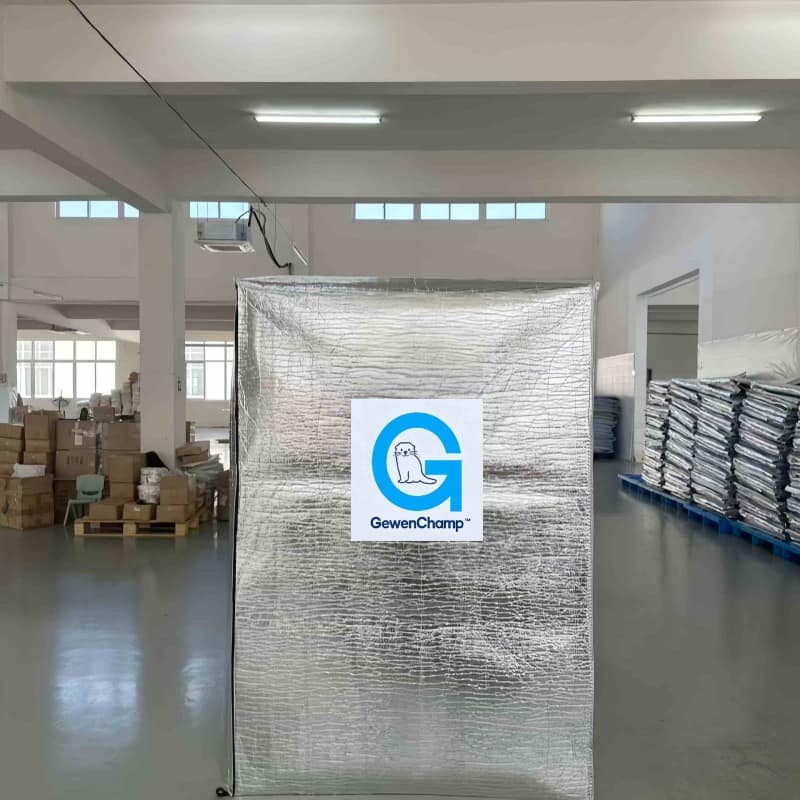
With insulated liners, thickness isn’t a single number — it’s the sum of functional layers, each engineered for a different job. A thermal insulation container liner typically combines reflective foil, woven fabric, and foam or bubble cushion layers. For instance:
- TL-01 Woven Thermal Fabric uses a 2‑layer construction with woven PE (40–120 gsm) and double‑sided aluminum foil lamination. Its strength comes from the woven core, while reflectivity blocks 95–97% of radiant heat.
- TL-02 EPE Foam Liner employs a 4‑layer composite: PET aluminum foil (12–15µm) / woven PE / 3mm EPE foam (density 25 kg/m³) / PET aluminum foil. The foam core adds thermal conductivity ≤0.038 W/(m·K), essential for controlling temperature swings in pharmaceutical or chocolate shipments.
- TL-03 MPET/Double Bubble/MPET builds a 4‑layer barrier with 5mm total bubble cushion thickness, reflecting up to 98% radiant heat while absorbing shock. This makes it ideal for vaccines or frozen food where both temperature stability and impact protection are critical.
In thermal liners, thickness metrics shift from pure mechanical strength to R‑value and temperature variance control. Buyers should evaluate performance data rather than assuming thicker equals better insulation.
How to Choose the Right Thickness for Your Cargo
A systematic approach prevents costly over-specification or dangerous under-specification.
1. Analyze your cargo properties
– Weight and density: Heavy materials like cement (1.4 t/m³) exert high static pressure on liner walls, requiring thicker substrates.
– Abrasiveness and sharpness: Crumb rubber, broken glass, or coarse minerals can puncture thin PE films. Woven liners with lamination or sift‑proof designs resist such damage.
– Powder vs granule: Fine powders (titanium dioxide, kaolin clay) need seamless or heat‑welded construction and at least 140 gsm with coating to prevent sifting. Free‑flowing granules (plastic pellets) are less demanding.
2. Match thickness to loading and discharge method
– Gravity loading through a top spout: Gentle enough for 110–140 gsm woven or 120–160 micron PE liners.
– Pneumatic conveying: Pressurised air can create high fabric stress; a 160–200 micron PE film or reinforced woven liner with strong seams is recommended.
– Manual bag filling: Allows lighter liners if handling is controlled, but over-stuffing can still cause failures.
3. Consider the shipping route
– High‑humidity, tropical routes: Thicker moisture barriers are essential. For example, a 140‑micron LDPE liner or a woven liner with double‑sided lamination prevents condensation from penetrating the cargo.
– Long transit times (30+ days): Choose a thickness that resists fatigue and creep. Repeated thermal cycling can weaken thin films over weeks at sea.
4. Evaluate one‑way vs reusable economics
– Disposable liners are often selected at the minimum viable thickness to reduce cost and waste.
– Reusable liners — such as the TL‑01 or TL‑02 thermal liners rated for 3–5 uses — warrant thicker, more robust construction. The extra material cost is recovered across multiple trips.
A practical example: shipping PVC resin from China to South America. The granular resin is non‑abrasive but hygroscopic. A 140 gsm HDPE woven liner with double‑side PE coating (moisture resistance ≥98%) provides the necessary barrier at a competitive weight, avoiding the expense of an over‑specified 200 gsm fabric.
Common Mistakes When Evaluating Thickness
Even experienced logistics managers can fall into these traps.
- Comparing GSM and Mil directly: As outlined earlier, these are different measurement systems. A 140 gsm woven liner is not the same as a 140 micron PE liner. Always convert to the same family or request test certificates for tensile, tear, and puncture values.
- Assuming thicker always means better moisture protection: A woven liner with a proper lamination at 110 gsm can outperform an unlaminated 200 gsm fabric. The coating technology matters more than the base weight.
- Ignoring the role of seams: Heat‑welded seams without stitching holes (as in the TL‑03 or DBL‑04W) eliminate leak paths that no thickness increase can fix. A thick liner with poorly sealed seams still fails.
- Overlooking installation factors: A very thick, stiff thermal liner may be difficult to unfold and fit snugly against container walls, leaving air gaps that compromise insulation effectiveness. Thickness must be balanced with flexibility.
FAQ: Container Liner Thickness
Which is stronger for heavy minerals, 140 gsm woven or 200 micron PE?
The 140 gsm HDPE woven liner commonly has higher tensile strength (e.g., ≥1,800 N/5cm) compared to typical 200 micron LDPE film. However, for extremely fine powders, the sift‑proof woven design with PU‑sealed seams (DBL‑W06 is needed to prevent dust leakage, which a thick PE liner may also resist well.
Can I use a 100 micron PE liner for sugar?
A 100 micron liner may handle light sugar loads on short, smooth routes, but for long‑distance ocean freight or humid conditions, at least 140 micron is recommended. The standard DBL‑F01 PE film liner at 140 micron provides reliable moisture protection for sugar without excessive cost.
Do thermal container liners need a minimum thickness to work?
Thermal liners rely on insulation value (R‑value) rather than sheer thickness. For example, the TL‑03 MPET/Double Bubble/MPET liner with 5mm bubble core and reflective MPET layers can maintain temperature variance within ±5°C, while a thinner TL‑04 MPET/PE Composite Film (62–175µm total) is sufficient for moderate temperature control. It’s the layered structure, not just the total gauge, that drives performance.
How do I know if 110 gsm PP is enough for my soybeans?
The 110 gsm barless woven PP liner (DBL‑W05 was designed specifically for soybeans, corn, and coffee beans. Its breathable uncoated fabric allows moisture vapor to escape, preventing mold, while the barless design avoids bean jamming. If your soybeans are heavily loaded and require absolute moisture sealing, a 140 gsm PE‑coated woven liner (DBL‑W01 may be more appropriate.
What thickness do I need for chemical powders shipped by rail?
Rail transport involves significant vibration and pressure cycles. The DBL‑04W Wagon Liner uses 150–200 gsm high‑strength woven PE with heat‑welded seams, capable of withstanding 5–8 tons/m² static pressure. For standard container rail‑on‑flatcar, a 140 gsm sift‑proof liner (DBL‑W06 with PU‑sealed seams often suffices.
Make Thickness Work for Your Supply Chain
Container liner thickness is not a standalone metric; it’s a design variable that must balance cargo protection, operational handling, and logistics cost. Start with your cargo’s physical and chemical profile, then verify your liner’s GSM or micron rating against documented tensile strength, moisture barrier performance, and seam integrity.
Whether you need a food‑grade PE liner for bulk sugar, a sift‑proof woven liner for titanium dioxide, or a multi‑layer thermal insulation system for temperature‑sensitive pharma, getting the thickness right eliminates the most common cause of liner failure before the container even leaves the warehouse.
Need help calculating the optimal liner specification for your next shipment? Contact the Giant Flexpack technical team with your cargo details and route conditions. We’ll recommend the right material, thickness, and configuration backed by over 20 years of bulk packaging expertise.
 English
  German
  Spanish