
When a bulk shipment of cocoa beans arrives at a European port and customs requests LFGB documentation before the liner can even be opened, the exporter’s entire compliance file is tested in that single moment. Food contact compliance for container liners is not a paperwork formality. It is the difference between cargo that clears and cargo that sits, accruing demurrage, while a buyer questions whether the packaging itself contaminated the product. Over fifteen years of manufacturing container liners for food exporters shipping to North America, the EU, and Asia, I have watched procurement teams lose weeks and tens of thousands of dollars because a liner supplier’s certificate did not align with what the destination market actually requires. The real work is not collecting certificates. It is understanding which ones apply, what they test, and how to confirm they are still valid for your specific cargo and route.
Why Food Contact Compliance Is a Supply Chain Requirement
Food contact compliance moves from a quality discussion to a supply chain requirement the moment goods cross a regulated border. A container liner holding bulk sugar or flour is classified as a food contact material. In the United States, that places it under FDA 21 CFR. In the European Union, it falls under Regulation (EC) No 1935/2004, with Germany’s LFGB and France’s DGCCRF setting additional national benchmarks. No single certificate covers every destination. An FDA letter satisfies US importers. It does not satisfy an EU buyer whose own regulatory obligations require LFGB or a Declaration of Compliance under EU 10/2011 for plastic materials. The practical consequence for exporters is that the compliance package must be assembled by destination, not by factory. We have supported shipments where a polyethylene film liner carried full FDA and LFGB certification but still required a supplementary statement for a specific Swiss buyer whose internal standards exceeded both. These cases are not rare. They are routine.
Understanding the Core Food Contact Standards
Four certification frameworks dominate food contact compliance for container liners in international trade. Knowing what each covers, and where they stop, avoids the common mistake of assuming one certificate equals global acceptance.
FDA 21 CFR (United States). FDA compliance confirms that materials in contact with food meet the safety requirements of the Code of Federal Regulations Title 21. For a polyethylene container liner, the relevant sections are typically 177.1520 for olefin polymers. The key question for a buyer is whether the liner manufacturer’s FDA documentation references specific material formulations or is a general statement. A formulation specific letter of guaranty holds up. A general certificate without test data does not.
LFGB and EU Framework Regulation. The EU system is layered. Regulation (EC) No 1935/2004 sets the broad requirement that food contact materials must not transfer constituents to food in quantities that endanger human health. Germany’s LFGB (Lebensmittel- und Futtermittelgesetzbuch) provides the most commonly requested national standard for sensory testing, confirming that the liner does not impart taste, odor, or color to the food product. For plastic liners, Regulation (EU) 10/2011 adds specific migration limits. A container liner carrying a test report under EU 10/2011 with LFGB sensory pass provides the strongest EU compliance position.
REACH and RoHS (chemical safety). REACH (Registration, Evaluation, Authorisation and Restriction of Chemicals) and RoHS (Restriction of Hazardous Substances) are not food contact standards per se. They are chemical safety regulations. However, EU buyers frequently request them alongside food contact documentation because they address a broader concern: has the liner material been manufactured without substances of very high concern? For a procurement manager, a liner carrying REACH and RoHS alongside LFGB signals that the manufacturer’s material supply chain has been scrutinized beyond the minimum food contact requirement.
ISO 9001 (quality management). ISO 9001 certification verifies that the manufacturing process operates under a documented quality management system. It is not a material safety test. But it matters because it provides audit trails. When a European buyer asks whether Lot 2407 of container liners matches the certified sample tested two years earlier, an ISO 9001 system produces the traceability record. Without it, the answer is a judgment call.
| Standard | What It Covers | What It Does Not Cover |
|---|---|---|
| FDA 21 CFR | Material safety for US food contact | EU regulatory acceptance |
| LFGB / EU 1935/2004 | EU food contact safety incl. sensory | US FDA requirements |
| REACH / RoHS | Chemical substance restrictions | Food contact migration limits |
| ISO 9001 | Manufacturing quality management | Material safety testing |
How Container Liner Construction Affects Compliance
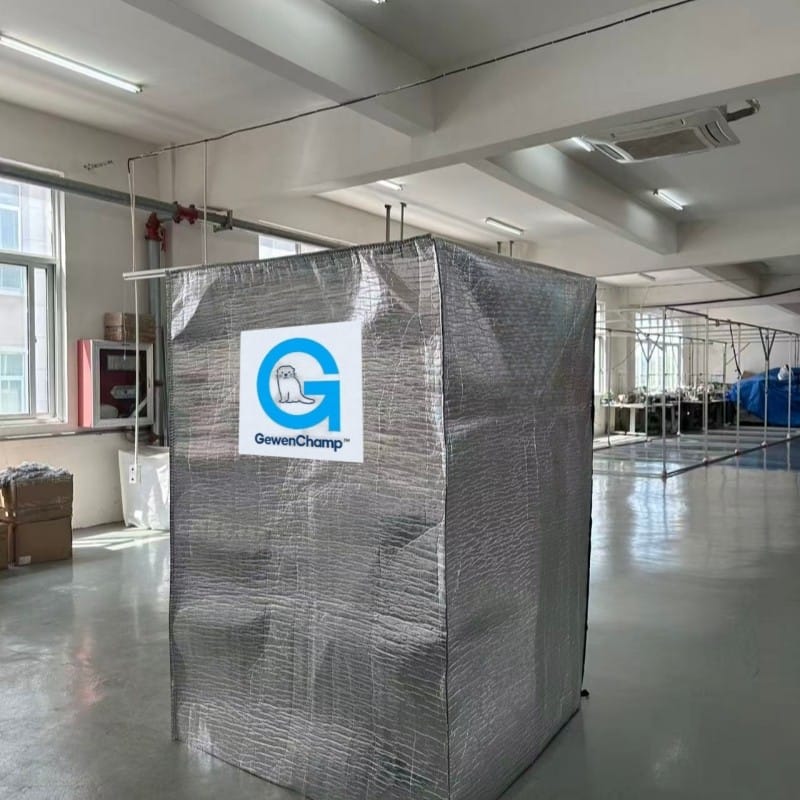
The compliance profile of a container liner is determined by the materials at the food contact surface, not the marketing description. A thermal liner sold as food grade still needs to be evaluated by layer. The TL-04 Thermal Container Liner from our GewenChamp series uses a metallized PET and polyethylene composite film with the PE layer forming the innermost product contact surface. The compliance documentation references the PE formulation because that is the material touching the food. The MPET layer provides thermal reflection but does not contact the cargo, so it falls under a different assessment scope under EU regulations.
Woven dry bulk liners present a different compliance profile. A standard DBL-W01 liner uses 140 gsm HDPE woven fabric. If the liner is uncoated, the woven HDPE surface contacts the cargo directly, and the entire fabric weight must meet food contact requirements. The DBL-W02 malt grade liner adds double-sided food-grade LDPE lamination, creating a smooth PE surface at the product contact side. This shifts the food contact evaluation entirely to the lamination layer, which simplifies the regulatory pathway because LDPE has well-established migration data under both FDA and EU 10/2011. For powdered food ingredients like flour or milk powder, the PE film liner series provides a homogeneous contact surface with consistent thickness, typically 140 microns, that can be certified to food-grade LDPE specifications across the full liner surface.
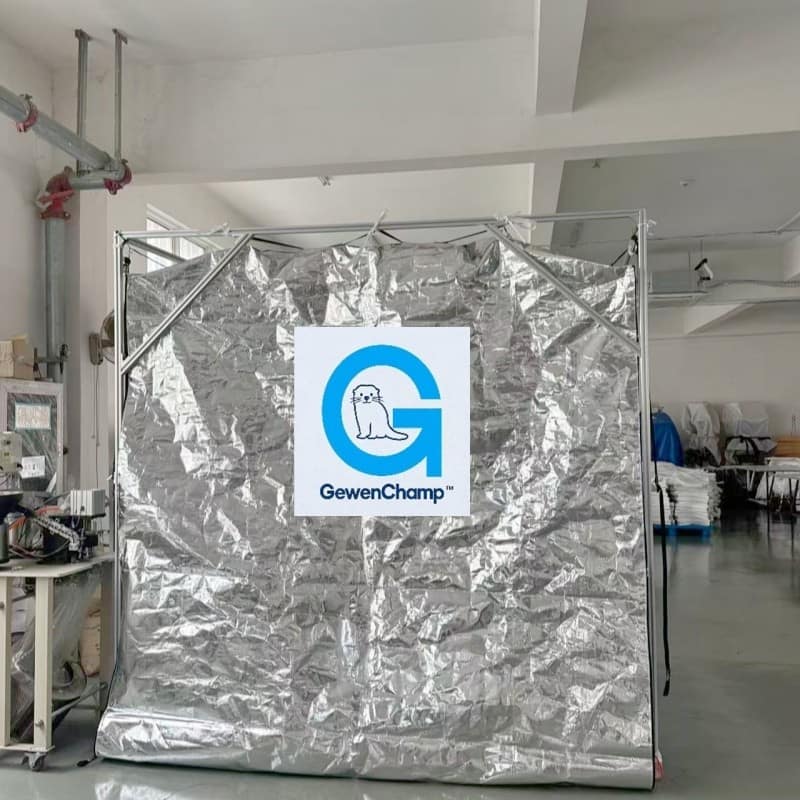
The critical compliance distinction, and one that is frequently overlooked during sourcing, is between single-layer and multi-layer liners. A single-layer PE film liner has one material to certify. A multi-layer thermal liner like the TL-02, which bonds PET aluminum foil, woven PE, 3mm EPE foam, and another PET aluminum foil layer, requires that every layer be evaluated under the appropriate regulatory framework. The EPE foam core sits between foil layers and does not contact food, but it is still part of the food contact article under EU definitions and must be documented. For buyers evaluating suppliers, the practical test is whether the manufacturer can produce a full material breakdown with corresponding test reports for every layer, not just a single certificate for the finished product.
Third-Party Testing and What Factory Certificates Actually Mean
A factory certificate stating that a container liner is food grade is a starting point. It is not verification. The distinction matters because most food exporters are not buying liners for their own consumption. They are buying packaging that will be scrutinized by their buyer’s quality department, their buyer’s customs authority, and potentially a third-party auditor acting on behalf of a retailer. Each of those downstream parties can reject a factory self-declaration.
The liners we produce at Giant Flexpack carry certification from SGS and other accredited third-party laboratories. The TL-03 Thermal Container Liner, for example, has undergone migration testing under EU 10/2011 conditions simulating contact with aqueous, acidic, alcoholic, and fatty food simulants. The test report identifies the specific simulants used, the contact time and temperature, and the measured migration values against the regulatory limits. That level of detail is what a European food manufacturer needs to include the liner in their own HACCP documentation. A certificate that says “FDA compliant” without specifying the regulation section, the test conditions, or the laboratory that performed the testing is not sufficient for a technical buyer.
For exporters shipping to multiple regions, the most efficient path is to work with a liner manufacturer whose third-party testing covers the full regulatory set required by the destination markets. Our GewenChamp thermal liners and dry bulk liners carry FDA, LFGB, REACH, RoHS, and ISO 9001 certifications as a baseline. We maintain current test reports and issue batch-specific certificates of compliance tied to production lots. This is not extra service. It is standard documentation for buyers who cannot afford to have a shipment held while a lab retests liner material that should have been verified before the container was loaded.
Verifying Container Liner Compliance Before Your Shipment Ships
Verification before loading is cheaper than remediation after arrival. I recommend three checks that require only documentation the manufacturer should already hold.
First, request the third-party test reports, not just the certificate. A test report names the accredited laboratory, the test standard, the test conditions, and the result. A certificate alone may summarize the conclusion without showing the underlying data. If the liner will contact fatty foods, confirm that the testing used a fatty food simulant, typically vegetable oil or 95% ethanol under EU 10/2011. If the liner will hold dry sugar only, aqueous simulant testing may be sufficient. The simulant must match the cargo.
Second, check the certificate date against the production lot. A test report from 2022 does not automatically apply to liners manufactured in 2025 unless the manufacturer can demonstrate that the material formulation, supplier, and production process have not changed. Ask for a batch certificate tied to your specific order.
Third, confirm that the compliance documentation covers every layer of a multi-layer liner. A thermal liner with an aluminum foil outer layer, a woven PE middle, and an EPE foam core requires documentation for each constituent material. A single certificate for the finished liner is not enough under EU 1935/2004, which requires that all materials in a multi-material article be assessed.
If your program involves fatty food products like bulk cooking oil or cocoa butter, the migration testing requirements are more stringent, and it is worth confirming simulant compatibility before finalizing your liner specification. Reach out at [email protected] or call +86 523 87683880 with your cargo details and destination market, and we can confirm which test reports apply to your shipment.
Common Questions About Food Contact Container Liner Compliance
Is FDA certification alone sufficient for shipping food to Europe?
No. FDA certification is recognized in the United States but does not satisfy EU regulatory requirements. European buyers require compliance with Regulation (EC) No 1935/2004 and typically also demand LFGB or specific national legislation such as France’s DGCCRF. A container liner carrying only FDA documentation will not clear EU food safety checks. The liner must be tested under EU-specific methods.
It depends on the cargo. In practice, dry bulk commodities like sugar or grains present lower migration risk than fatty or acidic foods. EU 10/2011 establishes different migration limits and test conditions based on the food type. A liner suitable for sugar may not be acceptable for bulk vegetable oil without additional testing. The safest approach is to match the test simulant to the food category and confirm with the liner manufacturer that the documentation package reflects the specific cargo.
In programs we have supported, the most common failure is the certificate mismatch. A buyer requests LFGB, and the supplier provides an FDA letter. Or the test report exists but was conducted on a different liner model with a different material composition. The documentation exists somewhere in the factory’s files but was not matched to the specific product and lot being shipped. A second common gap is expired test reports that were not renewed after a material supplier change.
What does “food-grade LDPE” actually mean in a container liner specification?
It means the polyethylene resin used to manufacture the liner meets the requirements of FDA 21 CFR 177.1520 and EU 10/2011 for food contact applications, and has been tested for overall migration and specific migration of authorized additives. The phrase should be backed by a test report identifying the resin grade, the testing laboratory, and the migration results under relevant simulants. Without that documentation, the term “food-grade” is a claim without evidence.
The practical approach is to require the full set: FDA, LFGB, REACH, and RoHS, each supported by a current third-party test report. For EU destinations, add a Declaration of Compliance under EU 10/2011. Request batch-specific certificates tied to your order. If the manufacturer cannot produce all of these for the specific liner model and production lot you are purchasing, consider that a material risk to your shipment clearance. Share your destination market and cargo type at [email protected] or call +86 523 87683880, and we will confirm which specific documentation applies to your shipment before the liner leaves the factory.
 English
  German
  Spanish