
Evaluating container liner samples is not a routine material check. It is the first genuine test of a supplier’s manufacturing discipline. A well-prepared sample from a factory that understands bulk logistics will include full certification, consistent material thickness, and transparent test data. Many buyers, however, receive glossy one-off samples that look perfect but do not represent the production batches that follow. Before committing to a purchase order, the way you request and test container liner samples directly shapes whether your cargo stays dry, meets food-grade standards, or withstands temperature swings across ocean transit. This article explains what to specify, which physical tests matter, and how to interpret sample results as a procurement professional, based on the methods our team at Giant Flexpack uses to qualify thermal and dry bulk liners for international shipments.
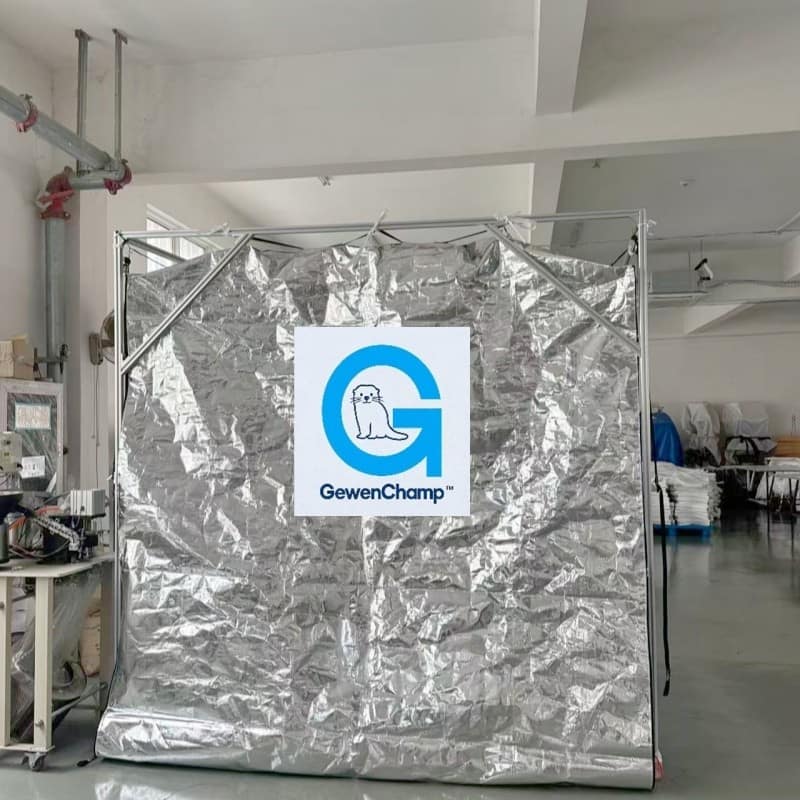
Specify Your Container Liner Sample Requirements
A sample request that only says “send 2 square meters of liner” tells the supplier nothing about your real operating conditions and gives you nothing actionable to evaluate. The request must reflect your actual cargo.
Start by providing the full cargo profile: product name and form (powder, pellet, granule, liquid), bulk density if known, typical loading temperature, and any moisture sensitivity. For thermal shipments, specify the route, expected ambient temperature range, and maximum acceptable internal temperature deviation. Also confirm the container type (20GP, 40GP, 40HQ) and filling and discharge method (top load, pneumatic, gravity discharge). With these parameters, the supplier can select the correct liner grade and produce a sample that matches your use case.
Also request, as part of the sample package, the complete technical data sheet for the liner grade being proposed, the current valid certifications (FDA, LFGB, EU 10/2011, REACH, RoHS, ISO 9001 certificate), and the test reports corresponding to the exact material lot. Ask for two sample sets: one cut from current production stock without any extra handling, and a second set that represents the proposed liner construction with all seals and features (loading spout, discharge port, lifting loops if relevant). This dual request reveals whether the supplier is willing to let you see production reality, not a hand-picked swatch.
Test the Physical Properties of Container Liner Samples
Once samples arrive, a structured test sequence separates reliable liners from well-presented unknowns.
Begin with a visual inspection under good lighting. The surface should be free of pinholes, thin spots, and uneven lamination. Seams must be continuously bonded, particularly around spouts and borders. For woven liners, check that the weave is uniform without pulled threads; for PE film liners, the film should show consistent clarity or opacity as specified.
Then move to quantitative checks with simple tools:
- Thickness: Use a calibrated micrometer. For a standard PE film bulk liner, thickness typically ranges from 120 to 160 microns depending on cargo weight and abrasion risk. A woven HDPE liner for dry bulk might be 140 gsm with a tensile strength over 1,800 N/5cm warp and 1,500 N/5cm weft, which is what our DBL-W01 standard delivers. Measure at five points across the sample and reject if the variation exceeds ±10% of the nominal value.
- Tensile and tear strength: A hand-held force gauge on a strip sample can give a comparative reading. If the value falls significantly below published spec (for instance, well under 1,500 N/5cm for a woven dry bulk liner), the material may be under-specified or recycled content may have degraded mechanical integrity.
- Moisture barrier: A simple water column test can approximate hydrostatic resistance. For liners that must block condensation, such as those used on humid routes, check the moisture vapor transmission rate claim from the data sheet. A thermal liner with an EPE foam core, like our TL-02, delivers a moisture vapor transmission rate ≤0.033 g/(m²·h·kPa), which effectively prevents container rain. For dry bulk liners, a PE-laminated fabric should show no seepage after 24 hours under a static water head of at least 500 mm.
- Thermal performance: If the sample is a reflective thermal liner, examine the aluminum foil or MPET layer uniformity. Discoloration or thinning reduces reflectivity. A reliable foil lamination reflects 95–97% of radiant heat. For foam-core liners, measure the foam thickness; 3 mm EPE foam with a density around 25 kg/m³ gives reasonable thermal resistance.
A comparative table helps organize the tests:
| Test | Important for | Acceptable benchmark | Red flag |
|---|---|---|---|
| Thickness uniformity | All liner types | ±10% of nominal across five points | >±15%, or single spot below minimum |
| Tensile strength | Woven dry bulk liners | ≥1,800 N/5cm warp, ≥1,500 N/5cm weft | Below 1,200 N/5cm with no explanation |
| Water column seepage | Moisture-sensitive cargo | No seepage after 24h at 500 mm head | Seepage within 2 hours |
| Foil reflectivity | Thermal liners | ≥92% radiant heat reflection | Visible foil thinning or oxidation |
| Certification currency | Food-grade, REACH, FDA | Valid and within renewal date | Expired or generic certificate without lot traceability |
Interpret Container Liner Sample Test Reports
A test report is only as meaningful as its traceability to the sample in your hand.
Check that the report references the exact product grade, batch number, and production date matching the sample label. An ISO/IEC 17025-accredited lab report carries more weight than an in-house summary without raw data. For food-contact liners, verify that migration test results refer to the same simulant conditions your product requires. An overall migration limit is not enough; you need to see the specific test conditions.
If you observe discrepancies between the measured figures and the supplier’s published spec, ask for clarification in writing. A gap in one parameter, such as slightly lower tear resistance, can sometimes be explained by a variation in fabric weight or coating thickness. But a supplier who cannot explain the deviation or dismisses it without evidence is a reliability risk in larger shipments.
For products handled by Giant Flexpack, every sample shipment includes the current certification package with traceable lot numbers, so that evaluation is anchored in documented data rather than claims.
Assess Production Capability Through Container Liner Samples
A single sample tells you what a supplier wants you to see. It does not confirm what will arrive in a 40-foot container three months later.
We recommend requesting at least two additional sample sets from different production batches if the initial sample passes testing. This is a deliberate test of process control. If the second set shows a significantly different thickness profile or seal quality, the supplier’s production consistency is weak. In contrast, when three samples from three batches measure within a tight tolerance band, you have a reasonable basis to trust batch-to-batch repeatability.
Also ask how the factory manages quality checks on the production floor. A responsible operation will have defined in-process inspection points, documented reject limits, and retain samples for each shift. Factory visits or a live video walkthrough of the production line are legitimate requests before a bulk order. We have seen cases where a “golden sample” was produced on a dedicated line with tighter controls, while regular production ran on older equipment with looser tolerances. The only way to surface that difference is to test multiple sets and compare them statistically.
Manage Container Liner Sample Logistics and Costs
Sample logistics can create hidden friction if not negotiated upfront.
Courier shipment of a few liner sections typically takes 3–7 business days internationally, depending on destination customs. Air freight offers the fastest handover but costs more per kilogram and may not justify the speed unless the buyer’s timeline is aggressive. Ocean freight of a sample pack is generally used only when inclusion with a larger consignment makes sense.
Request a clear breakdown of sample preparation cost, freight charge, and any duties. Many manufacturers offer free-of-charge samples with the freight collected by the buyer. Confirm whether the sample cost is creditable against a future bulk order; this is a common practice that reflects confidence. At Giant Flexpack, sample freight and preparation costs are fully transparent, and we routinely provide FOC samples for evaluation so that buyers can test liners under their own loading conditions without hidden expenses.
If your cargo requires specialized certification testing beyond the standard package, agree on who bears the third-party lab cost before the sample is produced. Avoid agreements where you pay for testing that the supplier then cannot guarantee to meet.
Convert Container Liner Sample Approval into a Bulk Order
Once samples pass all technical checks, the final step is to lock the approved specification into a clear purchase agreement.
Draft a “sample reference standard” that lists all measured parameters and the associated acceptable tolerance range. This document becomes the benchmark for future inspection. Include a clause that confirms the bulk production must use the same material grade, construction method, and quality control protocol as the approved sample.
Agree on an Acceptable Quality Limit (AQL) for pre-shipment inspection. For container liners, an AQL of 2.5 for major defects and 4.0 for minor defects is common, but adjust based on your cargo risk. For food-grade or pharmaceutical grade bulk liners, a stricter AQL may be appropriate. We also recommend a pre-shipment sample check where the supplier sends a small cut from the actual production lot before loading, allowing a final confirmation against the reference sample.
If your program involves tricky moisture conditions, high-temperature routes, or compliance requirements that vary by destination, talk to the supplier before locking the specification. Small adjustments in liner construction, such as upgrading to a double-bubble thermal composite or adding a sift-proof sealed seam for fine powders, can avoid costly rework later.
Practical Questions About Container Liner Samples
How many container liner samples should I request?
Request at least three sample sets: one from the batch the supplier chooses to send initially, and two additional sets from different production runs after the first passes evaluation. One sample is a snapshot, three samples give you a trend.
What certifications must accompany a container liner sample?
For food contact applications, the liner should carry FDA 21 CFR and EU LFGB or Regulation (EC) 1935/2004 documentation. For general industrial use, REACH and RoHS certifications confirm chemical safety. The ISO 9001 certificate demonstrates that the factory operates a recognized quality management system. Always request up-to-date certificates with lot traceability.
Can sample costs be deducted from the bulk order?
This is a standard practice among experienced manufacturers. Before the sample is produced, confirm in writing that the sample preparation cost is creditable against the first bulk order, provided the order meets a minimum volume. If the supplier is unwilling to credit sample costs, consider it a signal of low confidence in securing the business.
How should I handle a supplier that refuses to provide genuine production samples?
A refusal to provide production-line samples, not handpicked swatches, is a strong predictor of future quality disputes. If a supplier insists on sending only a glorified cut without batch traceability, treat that as a disqualifying criterion. Reliable container liner manufacturers understand that sample evaluation is a procurement necessity and will provide what you need.
If your next container liner evaluation demands more than a visual check against a brochure, share your cargo conditions and performance targets with our team. We prepare full technical documentation along with production-representative samples so that you can test with confidence. Reach Daniel Wu and the Giant Flexpack team at [email protected] or +86 523 87683880.
 English
  German
  Spanish