
Seaborne cargo that arrives spotted with mold, caked into a solid block, or rusted beyond acceptance represents an entirely preventable loss. Moisture damage prevention for export goods begins with understanding that condensation inside a shipping container is not a random event—it follows predictable physics that can be interrupted at the material level. Over fifteen years of working with bulk shippers across polymer, food, and chemical supply chains, I have seen that the most reliable defense combines a low moisture vapor transmission barrier with thermal insulation, and that the right container liner specification makes the difference between a claim-free delivery and a rejected shipment.
What Causes Moisture Damage in Shipping Containers
Moisture-related cargo damage occurs when warm, humid air trapped inside a container condenses on the coolest surface available. During a typical ocean voyage, ambient temperatures can swing by 20°C or more between day and night, especially on routes passing through tropical and temperate zones. The air inside the container holds moisture absorbed from the cargo itself—hygroscopic materials like cocoa beans, sugar, or starch release water vapor—and from the ambient atmosphere loaded at the port of origin. When the container walls cool at night, the relative humidity near the surface quickly reaches 100%, and liquid water forms. This is the container rain effect.
That water drips onto cargo, soaking cardboard packaging, initiating mold growth, or triggering corrosion on metal components. Even without visible dripping, sustained high humidity above 70% can cause bulk powders like titanium dioxide or PVC resin to absorb moisture and form hard lumps that are unusable. The key metric for evaluating protection is the dew point temperature inside the container, not just relative humidity, because the moment any surface drops below the dew point, condensation is inevitable regardless of the humidity percentage.
How Thermal Container Liners Stop Condensation at the Wall
A thermal container liner changes the thermal and vapor dynamics inside the container by creating a physical barrier with two critical functions: reflecting radiant heat and limiting moisture vapor transmission. When the container walls cool, the liner’s internal surface does not reach the dew point as quickly because the insulation layer slows heat transfer from the cargo space to the cold steel. Consequently, water vapor condenses on the liner’s outer surface, against the container wall, where it cannot contact the cargo. This principle works regardless of whether the liner uses aluminized film, EPE foam, or bubble wrap; what matters is the combination of thermal resistance and vapor barrier integrity.
The second mechanism is moisture vapor transmission rate (MVTR). Even a liner that physically separates cargo from the steel wall must have a sufficiently low MVTR to prevent water vapor from permeating through the material over weeks at sea. Our measurements on GewenChamp™ TL-02 EPE foam liners show an MVTR of ≤0.033 g/(m²·h·kPa), meaning that under sustained high-humidity conditions, the amount of moisture actually crossing the liner into the cargo space remains below levels that would raise internal humidity above safe thresholds. This is not a magical elimination of moisture—some vapor transfer always occurs—but the rate is low enough that condensation does not accumulate.
Comparing Container Liner Materials for Moisture Barrier Performance
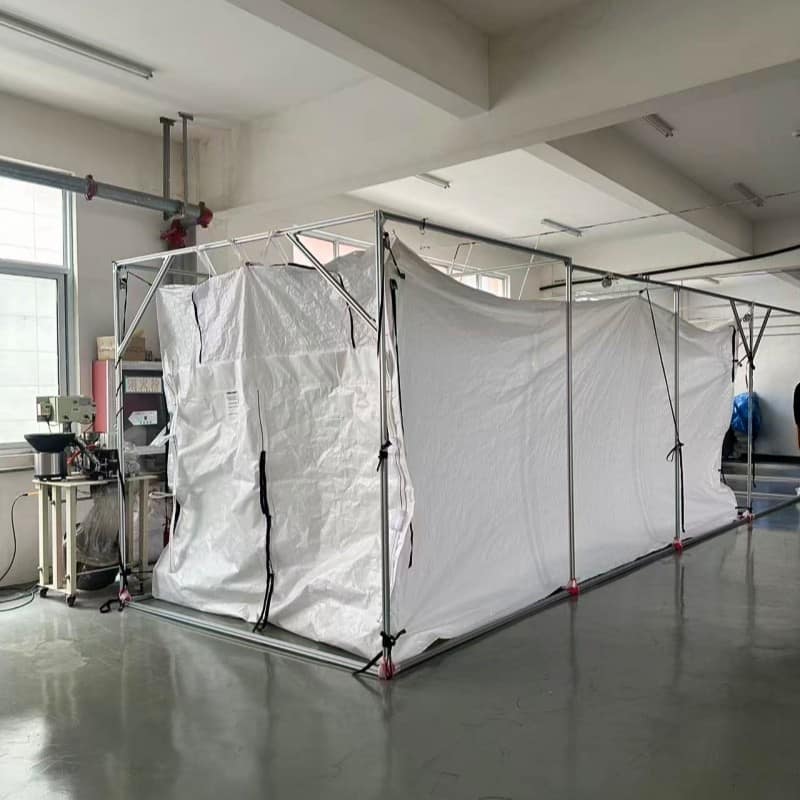
Not all liners perform equally as moisture barriers. The following comparison draws on the GewenChamp™ TL series to illustrate how material structure drives protection levels, because the difference between a basic PE film and a multi-layer aluminized composite is measurable.
| Material Type | Core Moisture Barrier | MVTR (g/(m²·h·kPa) | Thermal Reflectivity | Typical Use Case |
|---|---|---|---|---|
| PE Film (DBL-F01 standard) | Single-layer LDPE film, 140μm | ~0.1–0.2 | None; passive film only | Short-haul dry bulk where moisture sensitivity is low |
| Woven Thermal Fabric (TL-01) | Woven PE + double-sided PE aluminum foil lamination | ~0.05–0.1 | 95–97% radiant heat reflection | Dry bulk commodities needing moderate thermal and moisture protection |
| EPE Foam (TL-02) | 4-layer: PET aluminum foil / woven PE / 3mm EPE foam / PET aluminum foil | ≤0.033 | ≥95% reflection; conductive resistance via foam core | High-value food, pharma, or chemical cargoes on long-haul tropical routes |
| MPET/Double Bubble/MPET (TL-03) | 4-layer: MPET outer, double bubble core, PET MPET inner | ~0.04–0.06 | Up to 98% reflection | Frozen and fresh foods, biologics, where thermal stability is critical |
| MPET/PE Composite Film (TL-04) | Metallized PET + PE film, 62–175μm standard | ~0.1 | ≥92% reflection | Cost-sensitive shipments where moderate temperature control suffices |
The table highlights a point that generic guides rarely address: thermal insulation is not separate from moisture protection. The foam core in TL‑02 and the double bubble layer in TL‑03 function as both conductive thermal breaks and vapor diffusion barriers. A liner that only reflects heat without insulating bulk reduces radiant gain but still allows the inner surface temperature to drop once the container steel cools; condensation then forms on the liner interior. That is why material selection must consider the full pathway of heat and moisture, not just reflectivity.
Selecting the Right Liner Based on Cargo Sensitivity and Route
A liner specification that works perfectly for PE resin pellets on a China-to-Europe winter route may fail completely for cocoa beans transiting the Panama Canal in August. The decision starts with three questions: how hygroscopic is the cargo, how long is the transit, and what is the maximum ambient temperature and humidity along the route. Food commodities like sugar, coffee, and cocoa have critical moisture thresholds (e.g., cocoa beans above 8% moisture content risk mold and free fatty acid development), so they demand both low MVTR and thermal buffering against diurnal temperature swings. For such cargoes, a liner like TL‑02 with ≤0.033 MVTR and a 3mm EPE foam core covering all six container walls is the baseline I recommend.
Chemical powders present a different challenge. Materials like titanium dioxide or kaolin clay are less mold-sensitive but highly susceptible to caking if moisture absorption reaches even 1–2%. A 140μm PE film liner with sealed seams (like DBL‑F01) may be sufficient on short, temperate routes, but on trans-Pacific voyages with wide temperature fluctuations, the addition of an aluminized outer layer (as in TL‑01) blocks radiant heat that drives container wall sweating.
For shipments where cost is the primary constraint and the cargo is not highly moisture-sensitive—PVC resin, for example—a MPET/PE composite film liner (TL‑04) provides >92% reflectivity and adequate vapor blocking for moderate conditions. The key is matching the liner’s MVTR and thermal resistance to the predicted worst-case dew point during the voyage, not simply buying the highest-spec product. If your program involves mixed cargo types or multiple routes, it is worth confirming the material comparison with technical data specific to your lanes—reach out at [email protected].
Installation Practices That Determine Whether the Liner Works
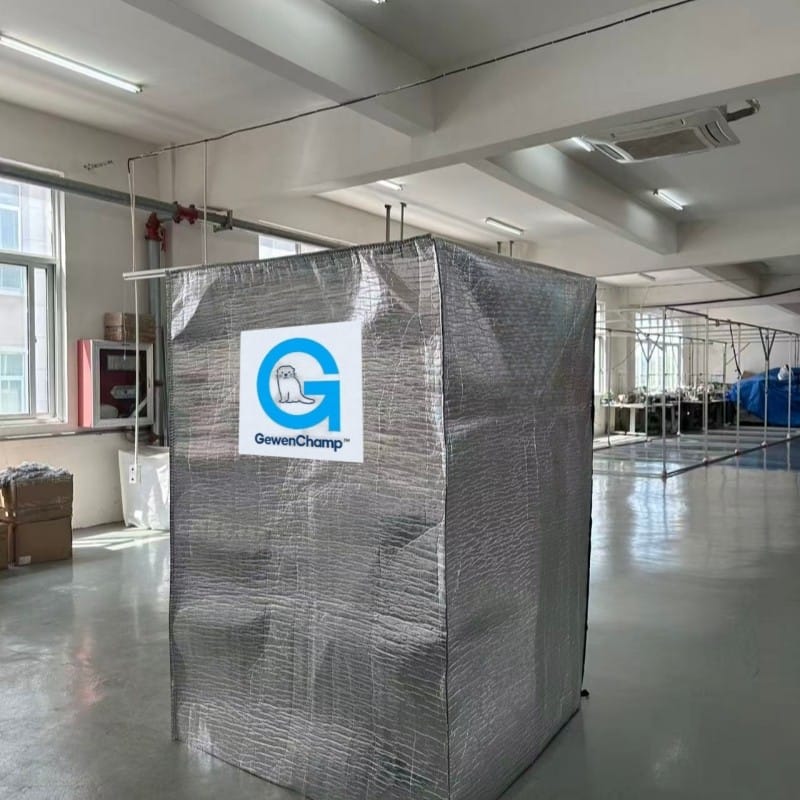
A liner with laboratory-grade MVTR figures will fail if it is installed with gaps or if the container door seals allow humid air to bypass the barrier. The entire purpose of a six-wall liner is to encase the cargo in a controlled microclimate, and any breach creates a short circuit for moisture. When teams at Giant Flexpack support first-time adopters of thermal liners, we walk through three non-negotiable steps.
First, the container itself must be inspected for roof holes, door gasket damage, and floor contamination. I have seen a single poorly sealed door grommet on a 40ft container cause enough humid air ingress to saturate the cargo within ten days. Second, the liner must be affixed flush against all six walls using the supplied adhesive strips or hook-and-loop fasteners, with no sagging that creates an air gap between the liner and the container ceiling. An air gap encourages convection currents that carry moisture-laden air to the top of the liner where it condenses and drips back down. Third, after loading, the liner’s loading spout must be sealed tightly, and the ventilation openings on the container (if any) must be closed or covered to prevent ambient air exchange.
The installation time for a typical 40ft container liner is 10–15 minutes with two people. That small labor investment is the difference between a liner that performs to spec and one that acts as a wet blanket.
What A Shipper’s Guide Cannot Tell You Until the Cargo Arrives
No liner is a guarantee against all moisture events, because real-world conditions include factors no specification sheet can encode: a container stowed on deck with direct sun exposure, a port delay that extends transit from 30 to 45 days, or cargo loaded with an internal temperature 15°C above ambient that triggers immediate condensation before the liner stabilizes. In these edge cases, even a TL‑02 liner with MVTR ≤0.033 can be pushed to its limit.
The practical remedy is to pair the liner with desiccants when the voyage involves known risk multipliers—transits exceeding four weeks, monsoon-season sailings, or cargo with a moisture content near the upper acceptable limit. A 40ft container carrying cocoa beans on a China-to-Europe route in July might carry 8–12 kg of calcium chloride desiccant bags suspended from the container ceiling in addition to a full thermal liner. The desiccants absorb the moisture that inevitably enters during loading and the small amount that permeates the liner over the long voyage, keeping the dew point inside the cargo space safely above the condensation threshold.
This layered approach—thermal liner as primary barrier, desiccants as backup moisture scavengers—has become our standard recommendation for shippers moving high-value, hygroscopic goods on routes with documented condensation risk. It is not over-engineering; it is tailoring the protection to the statistical reality of ocean freight weather.
Common Questions About Moisture Damage Prevention for Bulk Cargo
Are desiccants enough on their own, or do I need a container liner?
Desiccants alone absorb moisture from the air but do nothing to stop new moisture from entering or to prevent container wall condensation from dripping onto cargo. For short shipments of moderately dry goods, a sufficient quantity of desiccant can manage internal humidity. On any voyage exceeding two weeks with an external temperature swing above 15°C, a liner is necessary because the container wall will repeatedly drop below the dew point regardless of how much desiccant is present. We recommend liners as the primary defense and desiccants as supplementary protection for the moisture that inevitably enters during loading.
How do I know which liner MVTR is sufficient for my cargo?
Target the cargo’s maximum safe moisture content and work backward. If cocoa beans must stay below 8% moisture, calculate the permissible moisture gain over the voyage duration given the cargo mass. Then compare this to the liner’s MVTR: a lower MVTR means less water vapor can cross the barrier per hour per square meter. For most hygroscopic food and chemical cargoes on routes under 40 days, an MVTR ≤0.05 g/(m²·h·kPa) provides adequate headroom. For sensitive pharma or long transits in high-humidity zones, target ≤0.033. If you send your cargo type and route to [email protected], we can provide a customized moisture budget calculation and liner recommendation.
 English
  German
  Spanish