
Selecting the right container liner is rarely just about price or material—the container size itself fundamentally changes the liner’s specifications, handling, cost-per-ton, and even the thermal performance of a cargo shipment. At Giant Flexpack, we see logistics and procurement teams make the same mistake: ordering the same liner style for a 20ft container as they would for a 40ft, only to discover that loading, discharge, or temperature control behaves differently on the water.
This article clarifies exactly what changes between a 20ft and a 40ft container liner—across dry bulk liners and thermal insulation liners—so you can match specification to real operational needs, not just container availability.
How Container Dimensions Impact Liner Design
The ISO container sizes most liners are built for are straightforward:
- 20ft General Purpose (20GP): internal length ~5.9 m, width ~2.35 m, height ~2.39 m
- 40ft General Purpose (40GP): internal length ~12.03 m, width ~2.35 m, height ~2.39 m
- 40ft High Cube (40HQ): same footprint, but height ~2.69 m
A container liner must cover the entire interior—walls, floor, and often ceiling—so a liner for a 40ft container is literally double the surface area of a 20ft liner. That single fact cascades into material usage, weight, installation time, thermal mass, and cost.
Key Specification Changes from 20ft to 40ft
Depending on the liner type, the differences are not just dimensional. Here is what changes on the spec sheet when you move up in container size.
Weight and Handling
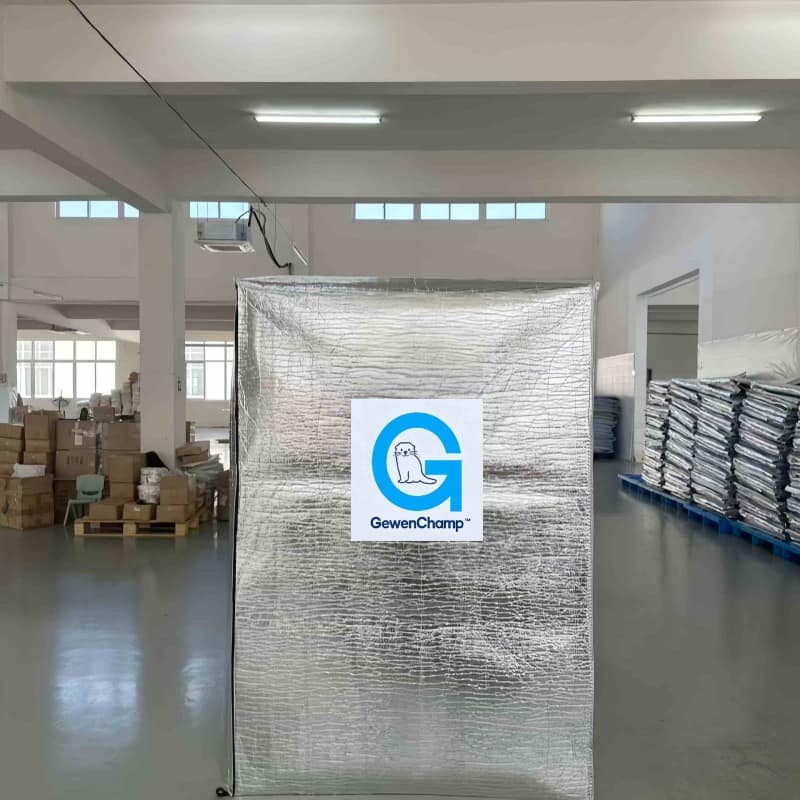
A 20ft dry bulk liner for powder or granules typically weighs 10–20 kg. Its 40ft equivalent may weigh 25–40 kg. For thermal liners, the difference is even more pronounced. A TL-01 woven thermal fabric liner for a 20ft container might weigh around 15–18 kg, while the 40ft version (which often uses about double the reflective material) can exceed 30 kg. This impacts shipping costs of the liner itself and the physical effort needed during installation.
Load Capacity and Volume
Container liners do not carry the load—the container walls do—but the liner’s structural loops, seams, and discharge spouts must handle the weight of the bulk material pressing against them. For dry bulk liners:
- 20ft configurations typically handle 10–20 tonnes, depending on the bulk density and fill method.
- 40ft configurations routinely handle 20–30 tonnes, and in some lightweight commodities even up to 35 tonnes.
A liner’s testing and certification often reflect these differences. Our DBL-W01 standard woven dry bulk liner, for example, is rated to 30 tonnes in a 40ft container but is commonly used at 15–20 tonnes in a 20ft container. The same weaving weight may serve both, but the number of lifting loops and their attachment points differ to distribute the higher load in the larger container.
Installation Time and Crew Requirements
Installing a six-wall thermal liner in a 20ft container typically takes 10–12 minutes for an experienced two-person team. The same style in a 40ft container can take 18–25 minutes. If the liner is a full-insulation system with ceiling coverage, the extra height of a 40HQ adds more time. Neglecting this in planning can cause delays at busy loading docks.
Thermal Container Liners: Performance Differences by Size
It is easy to assume that a 20ft and 40ft thermal liner made of the same material provide identical insulation. In practice, the larger air volume inside a 40ft container means a greater thermal load, and the liner itself becomes a larger thermal mass to heat or cool. While the material’s R-value does not change, the rate of temperature shift can differ.
For example, a TL-03 MPET/Double Bubble/MPET thermal liner might maintain an internal temperature within ±5°C of the starting point for 48 hours in a 20ft container, but only 36–42 hours in a 40ft container under identical external conditions—simply because more surface area transfers heat. Shippers of temperature-sensitive cargo need to account for this, especially on long-haul routes.
Conversely, the larger air buffer in a 40ft container can sometimes reduce hot‑spot concentration if the cargo is not filling the entire space, but that is cargo‑specific and not a guarantee.
The practical takeaway: if you are shipping high‑value pharmaceuticals or chocolate over 30 days from Southeast Asia to Northern Europe, the choice between 20ft and 40ft may influence which GewenChamp thermal liner model you select, or whether additional passive protection is needed.
Dry Bulk Container Liners: Volume, Discharge, and Stability
For dry flowable cargo—plastic pellets, grains, cement—the size decision is often dictated by order quantity. But there are specification traps:
- Discharge spout placement: In a 20ft container, a single bottom discharge spout is usually sufficient to empty the load quickly. In a 40ft container, some materials may require two or even three spouts spaced along the length to ensure complete evacuation without leaving dead zones.
- Baffles and stability: A fully loaded 40ft liner has more room for cargo to shift during transport. Woven liners with internal baffles (sometimes called barless or anti-surge designs) become more important in the larger size to prevent sudden load movement that can strain the container walls.
- Filling method: Top-loading a 20ft container via a single spout is straightforward. For a 40ft container, especially when filling plastic pellets or powders at high speed, multiple filling spouts may be needed to achieve even distribution and avoid liner stress. Our DBL-F02 30ft liner was developed specifically for European plastic pellet transport with multiple top filling ports—a concept that scales up to 40ft configurations as well.
Cost and Shipping Economics
A 40ft liner is more expensive per unit, but the cost per tonne of cargo is often lower. However, that equation assumes you can fill a 40ft container with a single product and that the consignee can handle the volume. Where partial loads are common, purchasing 20ft liners may avoid waste, even if the unit price is proportionally higher.
There is also a logistics angle: 20ft containers are easier to reposition and can access tighter loading docks. In countries where road restrictions limit truck weight, a fully loaded 40ft container may be overweight, forcing the shipper to use a 20ft container. In those cases, the liner selection follows the container size dictated by regulation, not by preference.
How to Choose: 20ft or 40ft Container Liner
The right answer depends more on your operation than on the liner itself. Consider these factors:
- Shipment size and frequency: Consistent 20‑tonne orders fit a 20ft container. Above 20–25 tonnes, a 40ft becomes more economical, assuming no road weight limits.
- Product homogeneity: If you ship multiple grades of resin or food powder in small batches, 20ft containers allow you to isolate different lots without cross‑contamination risk that could occur if splitting a 40ft container load.
- Thermal risk on long journeys: For sensitive cargo, a 20ft container with a high‑performance thermal liner may provide a more stable temperature envelope because the smaller volume responds slower to external swings, despite the surface‑to‑volume ratio. Discuss this with your liner manufacturer based on actual route data.
- Installation resources: If your loading team is small or time is critical, multiple 20ft liners may cause less strain than handling heavy 40ft liners.
- Discharge infrastructure: The consignee’s ability to receive a full 40ft bulk discharge must be confirmed. Many granular material receivers use 20ft container‑sized hopper pits.
When the Real Difference Is Not the Liner But the Container
A common misconception is that liner quality varies significantly between 20ft and 40ft versions. With a reputable manufacturer, material specifications—tensile strength, barrier properties, thermal reflectivity—should be identical or scaled proportionally. What changes is the engineering of the liner system: the number of securing loops, the spacing of spouts, the reinforcement points. These details are what prevent container liner failure during ocean transit.
At Giant Flexpack, every GewenChamp thermal liner and dry bulk liner is designed with container‑size‑specific engineering, not simply a larger cut of the same roll. That includes appropriate tension distribution, anti‑slip base panels on the floor, and seam welding tested for the exact load profile the container will experience.

Making the Right Container Liner Decision
Choosing between a 20ft and 40ft container liner is not a commodity decision. It touches your cost per tonne shipped, your cargo safety over weeks at sea, and your operational efficiency at both the origin and destination. The liner you select must be designed for the container size, the loading method, and the real stresses of your transport route.
If you are evaluating options—or if you simply want to confirm that the liner specifications you are being offered match what your 20ft or 40ft operation actually needs—our team at Giant Flexpack can walk through the technical details without the sales pressure. We build liners for both sizes every day and understand where the hidden problems usually appear.
Contact our engineering team to discuss your next shipment’s requirements, or request a sample of a 20ft or 40ft liner in the material and style that fits your cargo.
 English
  German
  Spanish