
When a container loaded with bulk API powder, granulated excipients, or palletized finished medicine crosses the equator, the outside temperature may read 32°C. The container walls, however, can exceed 70°C under solar load. Inside the box, daily temperature swings often pass the dew point more than once, causing condensation to form and drip onto cargo. For pharmaceutical shippers, this is not simply a handling issue; it becomes a deviation record, a possible stability failure, and a quality complaint. The right container liner changes the thermal and moisture environment inside the container. This article explains the liner requirements that matter most in pharmaceutical bulk shipping.
The Real Risk: Heat, Humidity, and Condensation
Most pharmaceutical products are stable within a defined temperature band, often 15–25°C for room-temperature storage or 2–8°C for cold chain materials. Bulk sea freight containers, however, are uninsulated steel boxes. Solar radiation heats the roof and side walls, creating an internal environment that can reach 55–70°C on long voyages through tropical or desert routes. Cold weather routes present the opposite risk: product may freeze or become brittle, and internal temperature fluctuations accelerate cargo sweating.
The moisture risk is equally serious. When warm air inside the container contacts cold steel walls at night, condensation forms. This is the container rain effect. For hygroscopic pharmaceutical materials such as lactose, starch, povidone, microcrystalline cellulose, and many granulated APIs, moisture absorption leads to caking, microbial growth, reduced flowability, and chemical degradation. Hydrolysis, oxidation, and discoloration can make an entire batch unusable.
For temperature-sensitive pharmaceutical cargo, the goal of a liner is not to create a reefer. It is to flatten temperature peaks, slow heat transfer, and block condensation. This reduces mean kinetic temperature, which often matters more for product stability than a single peak reading.
What a Pharmaceutical-Grade Liner Must Deliver
A liner used in pharmaceutical bulk shipping must perform more than a basic moisture barrier. Buyers should evaluate these requirements before specification:
- Food-contact and pharmaceutical material safety: FDA 21 CFR 177.1520 for polyethylene, EU Regulation 10/2011, European Pharmacopoeia 3.1, or USP <661> depending on market and regulatory filing. If the liner directly contacts API or excipient, ask for migration or extractables data.
- Controlled cleanliness: low particle load, no fabric fibers, no silicone or mold release residues, and no strong odor. For higher-risk cargo, liners should be produced from virgin resin and handled under controlled factory conditions.
- Seal integrity: heat-sealed seams, no pinholes, and no stitching holes that allow powder leakage or moisture ingress.
- Traceability: batch/lot traceability, incoming resin certification, and documented change control if a supplier changes material source.
- Physical strength: sufficient tensile and tear resistance for loading, transit vibration, and discharge.
Not all liners marketed as food-grade are automatically acceptable for pharmaceutical use. The buyer must verify that the specific material, thickness, and batch meet the requirements of the regulatory market and the product’s drug master file or stability protocol.
Matching the Liner to the Pharmaceutical Load
Pharmaceutical bulk shipments generally fall into three load profiles.
Dry Bulk APIs and Excipients
For powders, granules, and crystalline raw materials shipped loose in 20ft or 40ft containers, a dry bulk container liner provides the primary containment barrier. The liner isolates the product from the container floor and walls, prevents contamination, and controls moisture. For fine powders, a sift-proof liner is essential.
The DBL-W06 Woven Sift-Proof Container Liner is designed for powdered materials. It combines 140 gsm HDPE woven fabric, double-sided PE coating, and PU tape-sealed seams. All stitched seams are sealed to achieve 100% sift-proof performance for particles ≥50 mesh, preventing leakage and dust emission during loading and unloading.
For products where a lighter, more economical containment barrier is acceptable, a DBL-F01 PE Film Container Liner made from 140-micron LDPE film provides a 100% moisture and dust barrier with a smooth surface that prevents cargo adhesion.
If the powder is temperature-sensitive, combine the dry bulk liner with an outer thermal insulation liner. The thermal liner reduces heat gain and condensation, while the product-contact PE liner ensures hygiene and containment.
Palletized Finished Pharmaceutical Products
For finished dosage forms shipped on pallets, the packaging unit is different. Here, a thermal pallet cover is often the more practical solution. The TP-02 Thermal Pallet Cover uses a four-layer MPET film / woven PE / 3mm EPE foam / MPET film composite. It combines thermal insulation, shock absorption, moisture resistance, and dust protection, with a drawstring bottom closure and optional zipper or Velcro side fastening. For products requiring additional protection, ice packs can be placed inside the cover to extend hold time.
Temperature-Sensitive Raw Materials in Bulk
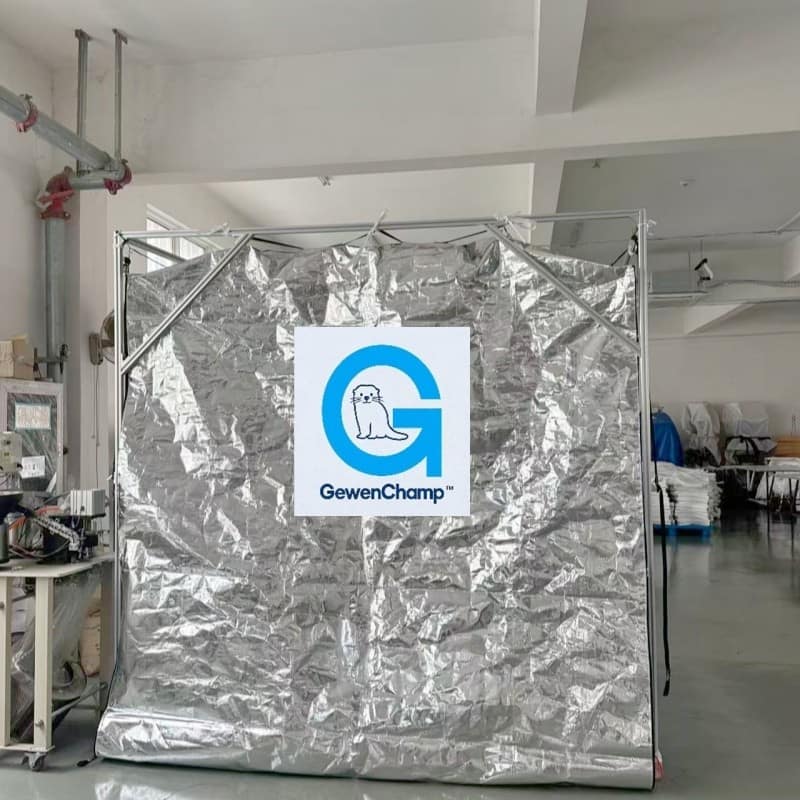
When the cargo itself is heat-sensitive but loaded as bulk, the thermal container liner becomes the primary climate protection layer. The TL-02 Thermal Container Liner is the most common specification for long-haul pharmaceutical routes. Its four-layer construction — PET aluminum foil, woven PE, 3mm EPE foam, and PET aluminum foil — delivers thermal conductivity ≤0.038 W/(m·K) and moisture vapor transmission rate ≤0.033 g/(m²·h·kPa). It operates from -50°C to 80°C and effectively reduces condensation inside the container.
For less demanding routes, the TL-01 Thermal Container Liner uses woven PE with double-sided PE aluminum foil lamination, reflecting 95–97% of radiant heat. It maintains internal temperatures between -20°C and 60°C with variance controlled within ±5°C and installs in 10–15 minutes without tools.
For frozen products, vaccines, biologics, and high-value temperature-sensitive materials, the TL-03 Thermal Container Liner offers a four-layer MPET / double bubble / PET MPET design. The outer and inner MPET layers reflect up to 98% of radiant heat, while the double bubble cushion traps static air as a secondary thermal barrier.
Thermal Liner Performance You Should Ask Suppliers to Prove
Do not rely on marketing claims. Request test data for the exact gauge and structure being quoted. The following table summarizes the thermal liner options and their practical fit for pharmaceutical use.
| Liner Type | Material Structure | Key Thermal or Barrier Performance | Best Suited To |
|---|---|---|---|
| TL-01 Thermal Container Liner | Woven PE + double-sided PE aluminum foil lamination | Reflects 95–97% radiant heat; -20°C to 60°C, ±5°C | Moderate climates, cost-sensitive pharma routes |
| TL-02 Thermal Container Liner | PET foil / woven PE / 3mm EPE foam / PET foil | Thermal conductivity ≤0.038 W/(m·K); -50°C to 80°C | Long-haul, extreme heat or cold, condensation-prone routes |
| TL-03 Thermal Container Liner | MPET / double bubble / PET MPET | Reflects up to 98% radiant heat; 5mm bubble layer | Frozen, fresh, vaccines, biologics, electronics |
| TP-02 Thermal Pallet Cover | MPET / woven PE / 3mm EPE foam / MPET | Tensile strength ≥1,500 N/5cm; shock absorption | Palletized finished medicine, cold chain consolidation |
For a supplier response to be meaningful, it should include MVTR, thermal conductivity, tensile strength, and temperature maintenance data from independent or third-party testing — not only material datasheets but also full-container or chamber simulations.
Qualifying a Liner Supplier for Pharmaceutical Cargo
Supplier qualification is often the weakest point in liner procurement. A low-cost liner that fails during shipment creates costs far beyond the liner price. Use this minimum checklist:
- Certifications: ISO 9001, FDA, LFGB, REACH, and RoHS where applicable. Request actual certificates, not summary statements.
- Material test reports: For the specific PE, EPE foam, MPET, or woven structure being quoted. Check thickness, tensile strength, tear resistance, and elongation.
- Dimension verification: Confirm fit for 20GP, 40GP, or 40HQ containers, including six-wall coverage and spout placement.
- Cleanliness and odor: Request factory hygiene procedures, use of virgin resin, and evidence of controlled production.
- Extractables and migration data: If the liner directly contacts API or excipient, require supplier willingness to provide migration testing or a letter of qualification.
- Batch traceability and change control: The supplier must track incoming resin lots and notify you before changing any material source or formulation.
- Sample testing: Before buying, conduct a trial fill and discharge with actual product. Check powder flow, dust escape, liner tearing, and cleanliness after unloading.
At Giant Flexpack, the GewenChamp™️ thermal liner range and dry bulk liner systems are produced under ISO 9001 quality management, with FDA, LFGB, REACH, and RoHS certifications where applicable. This allows pharmaceutical and food shippers to use one supplier for both thermal and containment liners, reducing specification complexity.
Loading and Installation Practices That Protect Quality
Even the best liner fails when installed poorly. For pharmaceutical bulk containers, follow these practices:
- Inspect the container before liner installation. Remove nails, sharp edges, rust flakes, and odorous residues.
- Confirm the container is dry. Sweep or wipe excess moisture before placing the liner.
- Install the liner with six-wall coverage where specified. For thermal liners, ensure the roof and side walls are fully covered; gaps create condensation pathways.
- Use a loading spout to fill powder cargo. Keep the spout sealed between batches to prevent contamination and moisture ingress.
- Do not overfill. Leave adequate headspace for bulk cargo displacement and temperature expansion.
- Protect the liner from forklift damage, sharp pallet edges, and contact with container doors during closing.
- For palletized pharma, place ice packs inside the thermal pallet cover only if the product can tolerate local cold spots. Distribute ice packs to avoid direct contact with cartons.
- Record container temperature, relative humidity, and product temperature at loading. This baseline is required for later deviation analysis.
Temperature Monitoring and Release Decisions
Passive liners are not active temperature control. They reduce heat gain and slow temperature change, but they cannot maintain 2–8°C without phase change materials or ice packs. For critical products, always use calibrated temperature data loggers.
Place at least three loggers inside the container: one near the floor, one at mid-cargo, and one near the top or door. For palletized cargo, place loggers inside the pallet cover or between inner cartons, not only on the outside of the wrapping. For bulk powder, secure loggers inside the cargo mass if possible, or position them at the top and bottom discharge area.
When a temperature excursion occurs, review the product’s stability data and mean kinetic temperature, not only the single peak. A passive thermal liner often reduces the duration and amplitude of excursions, which can keep the product within its stability budget. The liner’s performance data then becomes part of the release justification.
Passive Liners vs Reefer: A More Realistic Cost-Benefit View
Reefer containers provide active cooling but are expensive, consume energy, require genset availability at ports, and may be unavailable on certain routes. Passive thermal liners cost a fraction of reefer freight and work without external power. For products with moderate temperature tolerance, a thermal liner plus a well-insulated container can be sufficient.
The decision should be based on product stability data, route duration, season, and the cost of a rejected batch. For products that absolutely require 2–8°C, use a reefer. For APIs, excipients, and cosmetics that tolerate 15–30°C with short deviations, a passive thermal liner often provides the best balance of cost and protection.
Frequently Asked Questions
Do pharmaceutical bulk shipments always require reefer containers?
No. Many pharmaceutical raw materials and finished products tolerate controlled ambient temperature if temperature excursions are limited. Thermal container liners reduce heat gain and condensation, making non-reefer transport possible for qualified products. Use stability data and route risk assessment to decide.
Are thermal container liners pharmaceutical-grade?
Not automatically. Some liners are certified to FDA, LFGB, and EU food contact standards, which is a strong starting point. For direct pharmaceutical contact, you must verify the specific material and request migration or extractables data as required by your regulatory filing.
Which liner is best for bulk API powder?
For fine API powders, use a sift-proof dry bulk liner such as a woven HDPE liner with double-sided PE coating and PU tape-sealed seams. If the API is temperature-sensitive, combine it with an outer thermal insulation liner to manage temperature and condensation.
How long can a passive thermal liner maintain temperature?
It depends on material structure and ambient conditions. For example, the TL-04 composite film liner maintains -10°C to 30°C for 24–48 hours at ambient 25°C and can extend to 72 hours with ice packs. Thicker EPE foam liners provide more stable temperature control over longer voyages. Always validate with a trial shipment and temperature loggers.
Can thermal liners be reused for pharmaceutical shipments?
Some thermal liners are designed for reuse 3–5 times. For pharmaceutical cargo, reuse requires a documented cleaning, inspection, and risk assessment process. If direct product contact is involved, single-use hygiene liners are often preferred.
What documents should I request before purchasing?
Request ISO 9001, FDA, LFGB, REACH, and RoHS certificates if applicable, material test reports for the exact liner structure, MVTR and thermal conductivity data, batch traceability records, and a signed statement on change control.
Next Step
If you are specifying container liners for bulk pharmaceutical raw materials, APIs, excipients, or palletized medicine, Giant Flexpack can support the qualification with technical datasheets, test reports, and sample liners for trial loading. Contact [email protected] or call +86 523 87683880 to discuss your route, temperature range, and containment requirements.
 English
  German
  Spanish