
Understanding the real cost of a container liner goes far beyond the unit price on an invoice. For procurement managers, logistics directors, and international traders moving bulk cargo across climate zones, the liner is a relatively small line item that carries an outsized influence on total landed cost. A liner that fails due to moisture ingress, temperature excursion, or tearing can destroy an entire container load—costing tens of thousands of dollars in product loss, insurance claims, and supply chain delay. Conversely, overspending on advanced thermal protection for non-temperature-sensitive freight wastes capital that could be invested elsewhere.
This cost-performance breakdown examines the most widely used container liner types from a practical, buyer-oriented perspective. Rather than a generic price list, we focus on the trade-offs between material construction, protective performance, reusability, and long-term value. Every recommendation is based on the technical specifications and field performance of the GewenChamp™ liner series manufactured by Giant Flexpack (Taixing) Co., Ltd., but the principles apply universally to any well-engineered liner system.
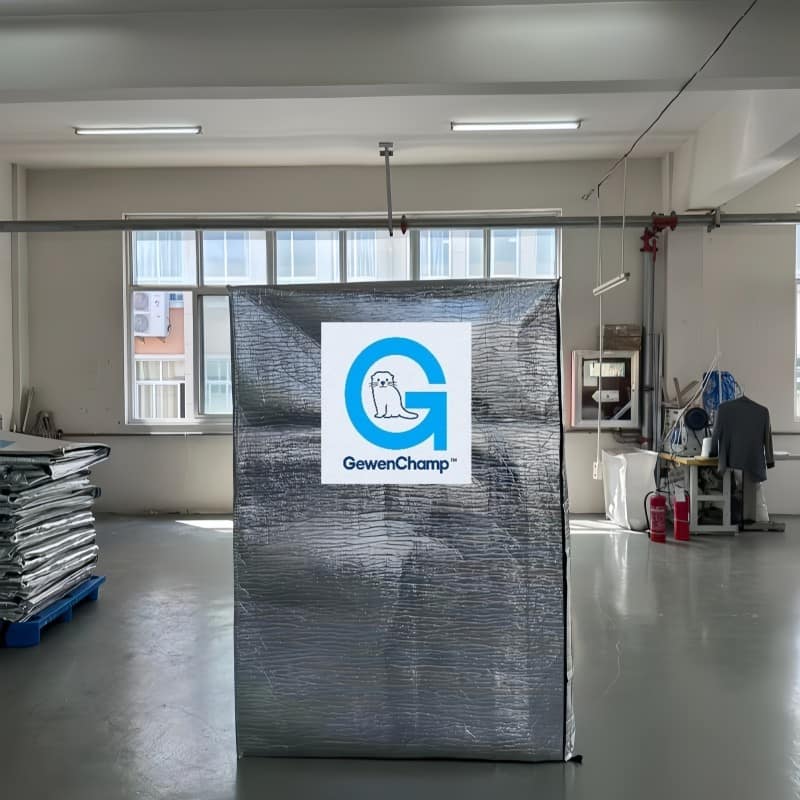
What drives container liner costs
Four primary variables determine the per-unit cost of a container liner – and each has a direct performance counterpart that makes it worth the investment or not.
Material substrate and grammage
Container liners begin as either woven polypropylene (PP) or high-density polyethylene (HDPE) fabric, or as blown polyethylene (PE) film. Woven fabrics typically range from 100 to 200 gsm (grams per square metre); heavier fabrics increase puncture resistance and tensile strength, but also add weight and material cost. PE film liners are specified by micron thickness (typically 100–300μm). A 140μm LDPE film liner is among the cheapest options, while a 140 gsm woven HDPE liner with double-sided PE coating sits at a moderate cost level. Going up to 200 gsm with additional heat-welded seam sealing—as in our sift-proof DBL-W06 liner—increases cost but eliminates leakage for fine powders below 50 mesh.
Thermal insulation layers
Thermal liners add anywhere from 20% to over 200% to the baseline cost of an uninsulated dry bulk liner, depending on the insulation technology. The simplest reflective options, such as a TL-04 MPET/PE composite film liner, use a single metallized PET layer to reflect ≥92% of radiant heat with minimal added thickness (62–175μm). Moving up to a TL-01 woven thermal fabric liner introduces a full woven PE core with double-sided PE aluminum foil lamination, which dramatically improves tear resistance while reflecting 95–97% of radiant heat and allowing 3–5 reuses. The highest cost tier is occupied by EPE foam composite liners like the TL-02, whose 3mm closed-cell foam core achieves thermal conductivity ≤0.038 W/(m·K) and suppresses condensation to a moisture vapor transmission rate below 0.033 g/(m²·h·kPa).
Specialty configurations
Any departure from a standard top-fill/bottom-discharge design adds manufacturing steps. Multiple loading spouts for European pellet-filling equipment (as in the DBL-F02 30FT PE liner, PU-tape-sealed seams for zero dust emission, anti-static additives, or felt inner layers for hide protection (DBL-W03) all raise unit cost in proportion to their complexity. Custom sizing for non-standard containers or rail wagons likewise increases engineering and cutting expenses.
Regulatory compliance and testing
Certifications such as FDA, LFGB, REACH, RoHS, and ISO 22000 add raw material and auditing costs. A food-grade LDPE film liner suitable for bulk wine transport is typically 15–30% more expensive than its industrial-grade equivalent, due to the higher purity resin and documentation required. For temperature-sensitive organic foods, manufacturers performing third-party migration testing and heavy-metal analysis must amortize these costs across production volumes.
Type-by-type cost and performance comparison
The table below summarises the key cost and performance characteristics of the four dominant container liner categories available in today’s market. The cost ratings are qualitative benchmarks based on typical 20FT container volumes of 1,000–5,000 units per order.
| Liner category | Relative unit cost | Typical reuses | Moisture protection | Temperature control | Best suited for |
|---|---|---|---|---|---|
| Standard woven PP/PE dry bulk liner (e.g., DBL-W01 | Low | Single-use (some re-use 1–2×) | Good (≥98% moisture resistance with coated versions) | None (ambient) | Grains, plastic pellets, fertilizers, non-sensitive minerals |
| PE film liner (e.g., DBL-F01 | Lowest | Single-use (recycling possible) | Excellent (100% moisture/dust barrier) | None (ambient) | Food powders, sugar, chemicals, PE resin; price-sensitive moisture barriers |
| Reflective thermal liner (e.g., TL-01 | Medium | 3–5 | Good–Very good (built-in vapor barrier in aluminum foil lamination) | Moderate (reflects 95–97% radiant heat; reduces internal swing by 10–15°C) | Pharmaceuticals, electronics, heat-sensitive resins, moderate climate routes |
| EPE foam thermal liner (e.g., TL-02 | High | 3–5 | Superior (MVTR ≤0.033 g/(m²·h·kPa); anti-condensation) | High (reduces temperature swing up to 20°C; operating range –50°C to 80°C) | Chocolate, dairy ingredients, vaccines, precision chemicals on extreme climate routes |
| MPET/Double Bubble/MPET liner (e.g., TL-03 | Medium-High | 3–5 (thickened variant up to 8) | Excellent (100% waterproof) | High (reflects up to 98% radiant heat; double bubble air cushion adds insulation) | Frozen food, biologics, shock-sensitive cargo needing both thermal and mechanical protection |
Note on PE film liner reusability: While technically possible to clean and reuse PE film liners, the thin material often suffers abrasion during unloading. The economics of single-use liners frequently outweigh the labor and inspection costs of attempting reuse, unless the liner is part of a closed-loop system between the same shipper and receiver.
When a higher-cost thermal liner pays for itself
One of the most frequent questions from new buyers is: “Why should I pay three times the cost of a standard dry liner for a thermal one?” The answer becomes clear when you calculate the cost of a single spoiled shipment.
Take a 20FT container of cocoa beans travelling from West Africa to Europe during the hot season. A standard woven liner would provide no protection against the 60°C+ interior temperatures that a container can reach under equatorial sun at sea, where the steel box acts as a solar oven. At these temperatures, cocoa butter migrates to the bean surface (“bloom”), and condensation from diurnal cooling wets the cargo, triggering mold. The financial loss: roughly $40,000–$60,000 for a full container of premium beans, plus rejection by the buyer.
A TL-02 EPE foam thermal liner, adding perhaps $300–$400 to the container cost, keeps internal temperatures within a safe 25–40°C band throughout the voyage and eliminates condensation through its multi-layer vapor barrier. The liner pays for itself more than 100 times over in this one trip. Even for less extreme routes, the reduced cargo insurance premiums and seller confidence often offset the liner premium.
Similar logic applies to shipments of PVC resin, where moisture contamination causes clumping that forces the receiver to dry and regrind—adding $50–$100 per ton in handling costs. A simple PE film liner for $50–$100 per container eliminates the problem entirely.
Conversely, a dry bulk shipment of kaolin clay from Europe to Asia in winter might not need any thermal protection. A standard 140 gsm woven liner delivers everything needed: containment, dust control, and good moisture resistance at the lowest possible unit cost. Over-specifying here would waste money with zero return.
Total cost of ownership beyond the liner price
Focusing only on liner unit price misses three critical cost components that experienced buyers factor into their supplier selection:
Installation time and labor
A well-designed liner with clear loading spout positioning and adequate lifting loops can be installed by two workers in 10–15 minutes for a 20FT container. A poorly designed liner that requires excessive strapping, does not align with container corners, or demands manual cutting during installation can take 45 minutes or longer. At warehouse labor rates of $20–$30 per hour in OECD countries, the time saved per container over a year’s volume can exceed the cost difference between an engineered liner and a basic one.
Cargo loss and claims reduction
The direct cost of a container liner failure is not the liner itself, but the cargo. A $100 liner failure on a $50,000 load of titanium dioxide yields a 500x loss multiple. Choosing a liner with a proven contamination barrier and seam integrity—backed by third-party testing and consistent manufacturing—is an insurance policy. Our DBL-W06 sift-proof liner addresses this for fine powders; the PU tape sealed seams prevent the slow dust leakage that can contaminate adjacent container bays or violate environmental regulations at destination ports.
Reusability and waste disposal
Liners rated for 3–5 reuses, such as the TL-01 and TL-02, deliver a lower “per-trip” cost when a return logistics loop is feasible. A TL-01 thermal liner costing $150 and used four times effectively costs $37.50 per shipment—competitive with a disposable liner while providing thermal protection. Additionally, reducing single-use plastic waste is becoming a regulatory and corporate governance requirement in regions such as the EU. A reusable insulated liner can contribute to sustainability goals and help avoid future packaging taxes.
Common mistakes when comparing liner costs
Mistake 1: Comparing only liner price without performance spec
Two quotes at $80 and $110 per liner tell you nothing until you compare the grammage, coating type, tensile strength, and moisture transmission data. The cheaper liner may tear under the shear forces of a 30‑ton load shifting at sea, while the slightly more expensive one survives.
Mistake 2: Ignoring discharge performance
A liner that empties cleanly and quickly not only reduces unloading time but also prevents cargo retention. Smooth PE film liners are nearly self-discharging, whereas uncoated woven fabric can trap powder in its texture, requiring manual scraping that may damage the liner and contaminate the product.
Mistake 3: Assuming all “thermal” liners are equal
A thin reflective MPET film liner (TL-04) is excellent for blocking solar radiation during short-haul summer transport, but it provides negligible insulation against sustained high ambient temperatures over a 30-day ocean voyage. For long-distance cold-chain protection, the closed-cell foam of a TL-02 is required. Choosing the wrong grade of thermal liner wastes money on overspec or results in temperature damage from underspec.
Mistake 4: Neglecting regulatory compliance costs
Using a non-compliant liner on a food shipment to the EU or US can result in rejected containers, destruction of cargo, and fines. The incremental cost of an FDA- and LFGB-compliant liner is a fraction of the regulatory non-compliance penalty.
How to select the right liner cost-performance balance for your cargo
Step 1: Map your thermal and moisture risk
Identify the most extreme temperature and humidity your container will encounter on the entire route. A liner that works for a Mediterranean voyage may fail in the Arabian Gulf summer. Use historical route data or ask your logistics provider for temperature profiles. If the container external surface can exceed 70°C, you need a thermal liner with foam insulation; if the main risk is condensation from nighttime cooling, a reflective foil liner may suffice.
Step 2: Define your contaminant tolerance
For commodity chemicals like uncoated plastic pellets, a standard woven liner is adequate. For food powders, you need a 100% moisture-proof film liner with food-grade certification. For micronized powders that escape through stitch holes, a sift-proof liner with taped seams is mandatory.
Step 3: Calculate true per-shipment cost
Estimated liner cost per shipment = (Unit price × Number of liners needed per year) ÷ Number of annual shipments, adjusted for reusability. Compare this against the potential cargo loss cost multiplied by the probability of failure based on the liner’s technical specs.
Step 4: Engage the manufacturer early
A reputable manufacturer with in-house design capability can often propose a hybrid specification that optimises cost. For example, we have worked with resin exporters to design a PP woven liner with a laminated moisture barrier that costs only 20% more than a standard woven option while eliminating 100% of moisture claims. Such custom solutions are only possible when the buyer shares transparent cargo and route data.
Frequently Asked Questions
Can I use a PE film liner for hot liquid cargo?
No. Standard PE film liners are rated for dry bulk and some non-hazardous liquids, but they are not designed for hot filling. For liquid food products, specialised flexitank or ISO tank containers should be used.
How much does a 20FT thermal container liner cost compared to a reefer container?
A typical 20FT thermal container liner costs between $100 and $500 depending on insulation grade, while a reefer container rental adds $1,000–$3,000+ per trip depending on route and duration. The thermal liner route is clearly more economical when passive insulation is sufficient. Our detailed Reefer Container vs Insulated Container Liner analysis walks through the full calculation.
Are reusable liners always cheaper per trip?
Only if you can reliably recover and inspect them cost-effectively. For intercontinental single-direction trades where empty container repositioning is not guaranteed, disposable liners are usually the simpler economic choice.
How do I verify the insulation performance before buying?
Request actual test reports from the manufacturer, ideally from an independent lab, showing internal temperature curves over a 24–48 hour test in a climate chamber. Merely stating “reduces temperature by up to 20°C” without defined test conditions is not sufficient.
Get a liner specification and quotation matched to your real costs
The cheapest liner quote rarely yields the lowest total cost. Rather than comparing generic prices, let our technical team at Giant Flexpack recommend the exact liner construction—woven, film, or thermal—that balances your route risk, cargo value, and budget. We support global clients with food-grade, REACH‑compliant, and thermally optimised solutions from our ISO 9001‑certified factory in Jiangsu, China.
Contact Daniel Wu and the engineering support team at [email protected] or call +86 523 87683880 to request a technical data sheet, arrange a sample shipment, or receive a configuration-pricing matrix tailored to your commodity and shipping lane.
 English
  German
  Spanish