
When shipping bulk liquids internationally, the choice between a container liner (flexitank) and an isotank often determines total landed cost, cargo quality, and operational risk. While both systems move large volumes inside standard ISO containers, they differ fundamentally in design, materials, and the way they interact with your liquid product. Understanding these differences is key for procurement managers, logistics directors, and exporters who need to balance performance and budget.
This article explains what each solution is, when it performs best, and how to make a sound decision based on cargo type, transport frequency, and product sensitivity. We also examine how passive thermal protection can improve outcome reliability for both approaches.
What Is a Container Liner for Bulk Liquid?
In the context of liquid transport, a container liner refers to a flexitank — a large, flexible bag made from multiple layers of polyethylene (PE) and polypropylene (PP) with a barrier film. The flexitank is placed inside a standard 20-foot dry container, filled with up to 24,000 litres of non-hazardous liquid, and secured with a bulkhead. At the destination, the liquid is discharged via a valve, and the flexitank is disposed of or recycled.
Flexitanks turn a general-purpose container into a dedicated liquid carrier for a single trip. They are cost-effective for one-way shipments of products like wines, edible oils, base chemicals, and industrial fluids where the return of empty equipment is uneconomical.
What Is an Isotank?
An isotank (also called ISO tank container or tank container) is a cylindrical stainless steel vessel mounted within a rigid ISO frame. Designed for intermodal transport, isotanks handle 14,000 to 26,000 litres of liquid, including hazardous chemicals, high-purity products, and temperature-sensitive cargo. Depending on the specification, isotanks can be insulated, heated, or equipped with refrigeration.
Unlike flexitanks, isotanks are reusable assets that return to a depot for cleaning and re-certification. They offer robust containment, compatibility with a wider range of chemicals, and precise temperature management capabilities.
Key Differences at a Glance
| Factor | Container Liner (Flexitank) | Isotank |
|---|---|---|
| Maximum capacity per 20 ft | 24,000 litres | 21,000–26,000 litres |
| Material contact | Multi-layer PE/PP film | Stainless steel (grade 304 or 316) |
| Suitability for hazardous cargo | Only non-hazardous | Wide range of hazardous and non-hazardous |
| Reusability | Single-use | Reusable (25+ years with maintenance) |
| Typical cost per shipment | Lower upfront, no repositioning cost | Higher freight but lower per-use cost for round trips |
| Temperature control | Passive via container insulation only | Active heating/cooling possible with built-in jackets |
| Cleaning responsibility | None (disposed) | Shipper or depot cleaning required |
| Risk of contamination | Very low (virgin film) | Low if cleaned to standard |
When to Use a Container Liner (Flexitank)
A flexitank is the preferred solution when:
- You ship one-way to a destination with no practical isotope return legs. The unit cost of a flexitank plus freight is often significantly lower than an isotank when reverse logistics are unavailable or expensive.
- Cargo is non-hazardous and compatible with food-grade PE and PP films. Typical products include base oils, wines, fruit juices, latex, glycerine, and some mild chemicals.
- Volume fits within 24,000 litres per 20-foot container. For smaller batches, a flexitank still offers decent economies of scale compared to IBCs or drums.
- Speed and simplicity are priorities. Loading and unloading require only a pump and standard hoses; no tank cleaning or return scheduling is needed.
However, flexitanks are not suited for flammable liquids, strong oxidising agents, or products that require precise heating or cooling during transit unless the container itself is thermally lined.
When to Choose an Isotank
Isotanks are the right tool when:
- You transport hazardous or corrosive chemicals classified under IMDG Code regulations. Stainless steel construction provides the required containment integrity.
- Temperature control is mandatory. Isotanks equipped with steam jackets or electric heating can maintain product temperature from loading to delivery — essential for molten sulphur, heated fats, or certain pharma intermediates.
- Product purity demands metal surfaces. Some food-grade or high-purity chemicals must not contact plastic films.
- You have consistent round-trip volumes. When freight flows in both directions, isotopic repositioning costs are neutralised, making the per-trip cost very competitive over time.
- You need maximum protection against physical damage or leakage. The stainless steel vessel adds a layer of safety that flexitanks cannot match.
The Hidden Challenge: Temperature Sensitivity
Whether you choose a flexitank or an isotank, many bulk liquids suffer when exposed to temperature swings during ocean transit. Wines can oxidise prematurely; edible oils can thicken or develop off-flavours; latex can coagulate in high heat; and chemical emulsions can separate. Even isotanks without active heating or cooling rely only on their modest insulation and the thermal mass of the liquid to buffer ambient changes.
This is where passive thermal container liners add value across both modes. When a flexitank is used, installing a high-performance insulation liner inside the container — such as GewenChamp™ TL-01 woven thermal fabric or TL-02 EPE foam composite — creates a stable thermal envelope around the flexitank. The aluminium foil laminated layers reflect up to 95 % of radiant heat, while the foam core resists conductive heat transfer. Temperature variance can be reduced to ±5 °C over long-haul routes, protecting the liquid cargo without any external power source.
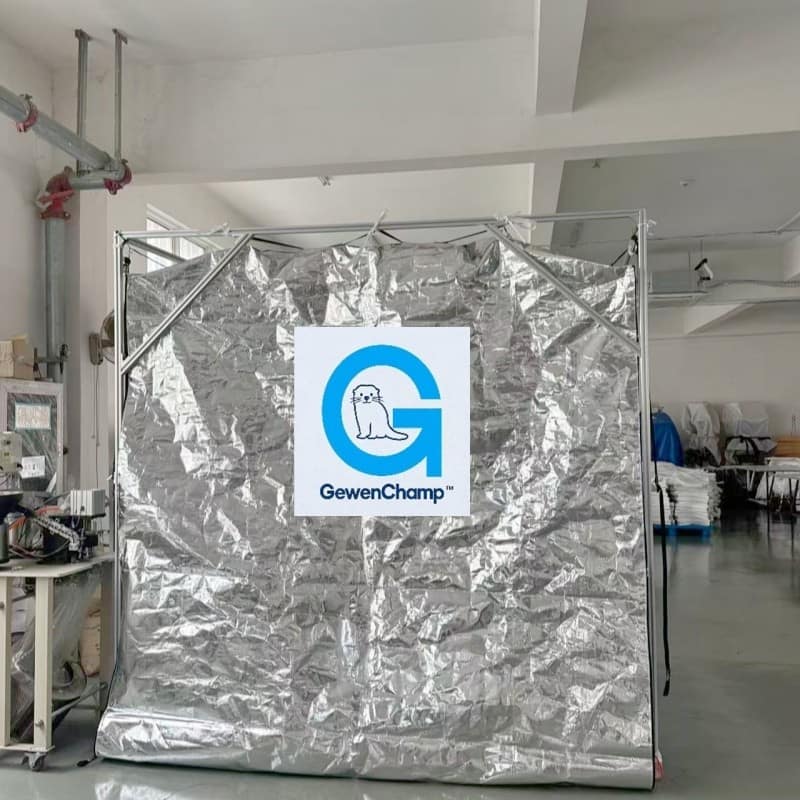
For isotank operators, similar insulation principles can be applied at the container level to supplement the tank’s built-in jacket, particularly when the isotank does not have active temperature control or when ambient conditions are extreme. Although the installation details differ, the physics remain the same: a reflective, low-emissivity barrier minimises the radiative heat exchange that drives most temperature excursions.
Cost and Performance Trade-offs
From a pure per-shipment perspective, a flexitank plus dry container freight is typically cheaper than an isotank. However, total landed cost should account for:
- Product loss: Inefficient discharge or flexitank failure can lead to 0.2–0.5 % loss, while isotank valves and design minimise heel.
- Cleaning and handling: Isotanks involve depot fees, washout certificates, and logistics coordination. Flexitanks consume almost no post-delivery time.
- Insurance: Flexitanks are generally insurable for non-hazardous liquids, but insurers may demand proven installation procedures and burst testing. Isotanks are well-established with lower risk profiles for hazardous goods.
- Carbon footprint: A one-way flexitank requires disposal, but if recycled, its footprint is low. An isotank, reused hundreds of times, has a lower per-trip material footprint. The total equation depends on repositioning distances.
Integrating Thermal Management for Higher Cargo Integrity
For companies shipping high-value liquids such as premium wine, specialty oils, or reactive chemicals, the small cost of a thermal insulation container liner often pays for itself by preventing spoilage claims and maintaining product specifications. These liners—available in multiple configurations—also reduce the risk of container condensation, which can corrode isotank frames or lead to labelling damage on flexitank fittings.
Many buyers now specify passive insulation as part of their freight tenders to extend the shelf life of temperature-sensitive cargo and to avoid the expense of reefers. As a practical example, a GewenChamp™ TL-01 thermal container liner can be reused for 3–5 trips, bringing the insulation cost per trip below $100 in many trade lanes. This makes it a straightforward risk-reduction investment.
Decision Checklist for Buyers
- Is the product classified as hazardous? If yes, isotank almost always.
- Is the route one-way with no realistic repositioning? Flexitank likely wins.
- Does the liquid need heating or precise temperature control during transport? Isotank with active jacket.
- Is maximum payload per container critical? Both approaches range 21,000–26,000 L; check flexitank maximum rating and isotank model.
- Are there food contact compliance requirements? Flexitank films must meet FDA or EU regulations; isotanks must be cleaned to food-grade standards.
- Is budget sensitivity high for trial shipments? Flexitank allows low-commitment entry into new markets.
The Expert Perspective
In more than 15 years of supporting global logistics with thermal packaging, I’ve seen that the flexitank-vs-isotank decision often masks a larger challenge: protecting liquid cargo from invisible thermal stress. Even when the “right” container system is chosen, product degradation due to temperature fluctuation continues to be one of the leading causes of claims. The integration of a tested insulation liner into the container — before installing the flexitank or loading the isotank — can dramatically reduce these risks. It is a small addition that safeguards months of supply chain work.
At Giant Flexpack, we regularly help liquid cargo owners, freight forwarders, and commodity traders design thermal protection strategies that work hand-in-hand with their chosen bulk transport method. We know that the choice between a liner and an isotank is never one-size-fits-all. What never changes is that stable internal conditions protect your brand and your bottom line.
This article was written by Daniel Wu, thermal packaging and industrial logistics specialist at Giant Flexpack (Taixing) Co., Ltd. For more information on passive temperature management for bulk shipments, contact our team at [email protected].
 English
  German
  Spanish