
Packaging Insights
Container Liner Specifications: What Importers Must Check
When importers compare container liners, the conversation often starts with price per unit. The more important question is whether the liner specification matches the cargo, the route, and the loading method. A liner that is too light for a 25-ton granular load, too moisture-permeable for hygroscopic powder, or too thin for a high-temperature trans-Pacific crossing will fail long before arrival. Specification review is therefore not a purchasing formality; it is the difference between cargo arriving intact and a contamination or moisture claim.

Why Container Liner Specifications Matter More Than Price
A container liner is not a generic plastic sheet. It is a structural barrier system that must survive filling pressure, cargo movement, puncture risk, thermal stress, and humidity cycles during ocean and overland transport. When importers treat liners as interchangeable, the savings are usually recovered many times over through cargo spoilage, discharge delays, or rejected shipments.
The most underrated risk is condensation. Warm air trapped inside a closed ISO container cools during transit, especially on routes with day-to-night temperature swings. Moisture can condense on the container wall, run down, and contaminate bulk powders, pellets, or food commodities. The right liner specification — barrier layer, sealant layer, or thermal reflective layer — determines whether that water stays inside the liner film or reaches the cargo.
Specifications also determine compatibility with handling equipment. A liner with the wrong spout placement, insufficient lifting loops, or seam strength below the discharge force will slow unloading and raise the risk of rupture. The purpose of a specification sheet is to verify these variables before the liner enters a container, not after a failure.
Core Specifications: Material, Construction, and Barrier Performance
Importers should begin with the liner material system, because that sets the baseline for strength, flexibility, moisture resistance, and contamination control.
The table below shows the main construction categories and the specification values buyers commonly verify.
| Liner Type | Typical Construction | Key Specifications to Verify | Common Bulk Cargo |
|---|---|---|---|
| Uncoated woven PP dry bulk liner | Woven PP, barless design | 110–140 gsm fabric, breathability 80–120 L/m²·s, tensile strength ≥1,800 N/5cm for heavier fabrics | Soybeans, corn, coffee beans, granular agricultural products |
| Coated woven HDPE dry bulk liner | Woven HDPE with PE coating or PU-taped seams | 140 gsm fabric, tensile strength warp ≥1,800 N/5cm and weft ≥1,600 N/5cm, moisture resistance ≥98%, sift-proof performance ≥50 mesh | Cement, talc, lime powder, pigments, plastic powder |
| PE blown film liner | LDPE film | 120–160 μm thickness, tensile strength warp ≥1,500 N/5cm and weft ≥1,300 N/5cm, elongation 30–35%, 100% moisture and dust barrier | Food powders, salt, sugar, plastic pellets, non-corrosive chemicals |
| Thermal woven composite liner | Woven PE with aluminum foil lamination | Aluminum foil radiant reflectivity 95–97%, woven PE strength layer, operating range -20°C to 60°C | Temperature-sensitive food, beverage, chemical, and pharmaceutical cargo |
| EPE foam thermal liner | Aluminum foil / woven PE / EPE foam / aluminum foil | 3 mm EPE core, density 25 kg/m³, thermal conductivity ≤0.038 W/(m·K), moisture vapor transmission rate ≤0.033 g/(m²·h·kPa) | High-value temperature-sensitive goods, long-haul sea freight |
| MPET double-bubble thermal liner | MPET / double bubble / PET MPET | MPET reflectivity up to 98%, total bubble thickness 5 mm, bubble diameter 10–15 mm | Frozen and fresh food, vaccines, biologics, electronics |

Barrier performance should be reviewed in the same step as material selection. For dry bulk powders, the critical specification is often sift-proof sealing. For hygroscopic cargo, moisture vapor transmission rate and seam sealing matter more than fabric weight. For food contact, the specification must also confirm that the food-contact layer is made from compliant polymer and meets the relevant national or regional standard.
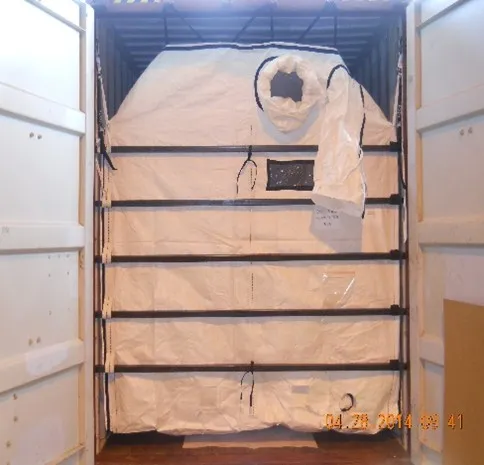
Coated woven liners address two failure modes at once: moisture ingress and dust escape. A liner can have a high fabric weight but still leak fine powder through needle holes if the seams are not sealed. <Woven Dry Bulk Container Liner covers the difference between sift-proof, barless, and moisture-barrier constructions for granular and powder cargo.>
Thermal Liner Specifications: Radiant Heat, R-Value, and Operating Range
Thermal liners are specified differently from standard dry bulk liners. The performance discussion moves from fabric weight to radiant heat reflection, conductive and convective heat transfer, and the temperature range a liner can hold over a defined time window.
Radiant heat reflection is not the same as insulation. A metalized or foil surface reflects incoming solar or radiant heat away from the cargo, while an insulating core such as EPE foam reduces heat transfer through conduction. A meaningful thermal specification should state both the reflective layer and the insulation core, not only the surface material.
For example, a four-layer thermal liner with a 3 mm EPE foam core and aluminum foil faces — the GewenChamp™ TL-02 configuration — is specified at a thermal conductivity of ≤0.038 W/(m·K) and a moisture vapor transmission rate of ≤0.033 g/(m²·h·kPa). That combination is relevant for shipments where both heat damage and condensation damage are present in the same route profile.

When comparing thermal liners, importers should ask for the operating temperature range, the R-value or thermal conductivity, the radiant reflectivity percentage, and the expected temperature-holding time under a stated ambient condition. A liner that maintains -10°C to 30°C for 24–48 hours at 25°C ambient is not automatically suitable for a 60°C Middle East port stay unless the full route profile has been matched to the material stack.
Not every thermal specification is equally important for a given shipment. If you are comparing liners for heat- or cold-sensitive cargo, send your destination climate data and current specification sheet to [email protected]. A technical review should confirm whether radiant heat reflection, foam core thickness, or moisture vapor transmission rate is the controlling variable for your route.
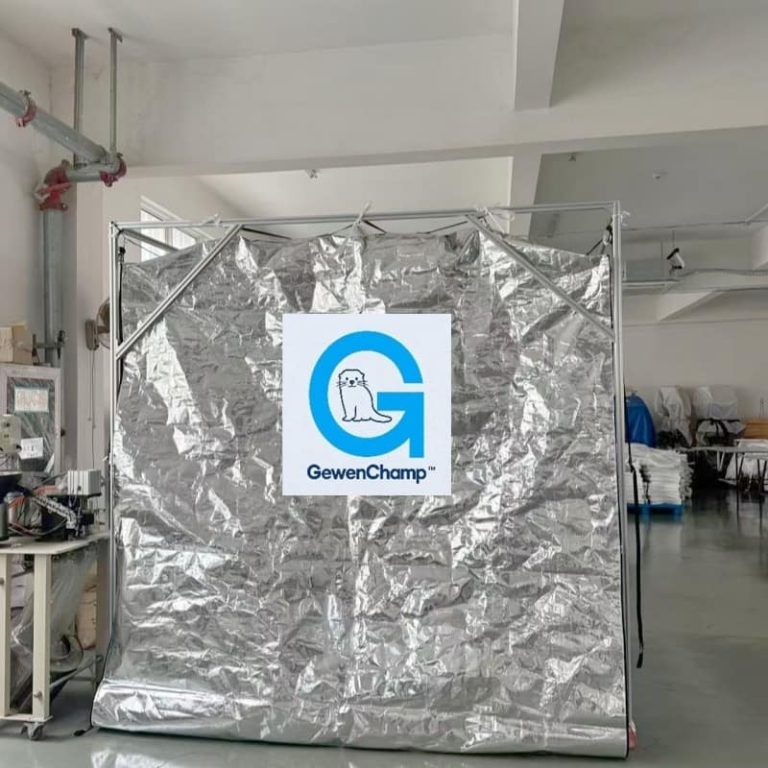
Thermal performance does not remove the need for moisture control. <TL-02 Thermal Container Liner covers the four-layer EPE foam structure, thermal conductivity, and moisture vapor transmission values importers use to compare thermal liners.>
Container Sizing, Spout Positions, and Bulk Weight Limits
Nominal 20 ft and 40 ft ISO container dimensions are defined by ISO 668 [1], while general cargo container structural testing and load-rating methods are covered by ISO 1496-1 [2]. Importers should still confirm liner cut length, panel set, and spout positions against the actual container internal dimensions and door opening before purchase. A liner with lifting loops in the wrong position or a discharge spout that cannot reach the unloading hopper will slow discharge and increase contamination risk.
Bulk liners are commonly specified by payload range. Depending on fabric, seam construction, and coating, dry bulk liners may be rated for 10–30 tons, 15–35 tons, or 20–40 tons. These figures must be matched to the actual cargo weight per container, not to the container maximum payload alone. A liner rated for 20 tons will not necessarily survive a 28-ton plastic pellet load if the spout pressure and discharge method are outside the tested envelope.

Spout and loop specifications are equally important. A standard dry bulk liner may include a top loading spout, bottom discharge spout, and four to eight lifting loops, each rated to at least 5 tons. Importers should confirm the spout diameter, position, and closure method before confirming an order, especially when discharge will use pneumatic or auger equipment rather than gravity tipping.
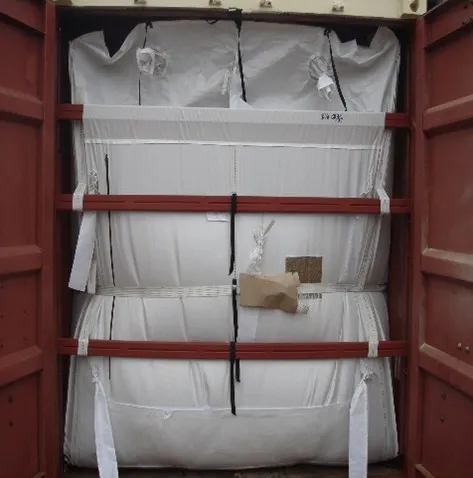
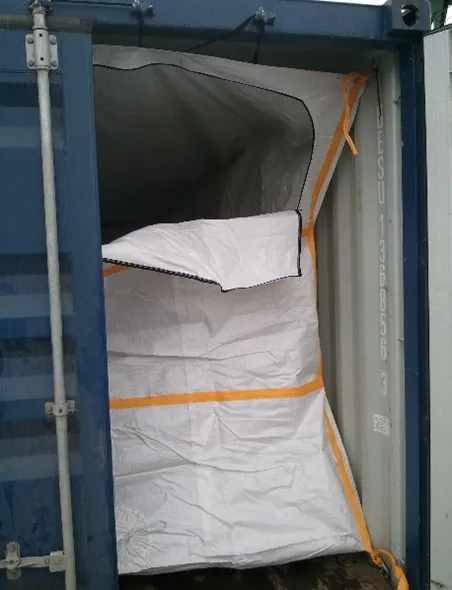
Bulk weight limits only work when the fill and discharge path is part of the original specification review. <PE Film Container Liner covers the spout, film thickness, and barrier options importers check for food-grade and non-corrosive dry commodities.>
Compliance, Certification, and Testing Specifications
Quality management system certification such as ISO 9001:2015 [3] signals process control, but it is not a substitute for product-level compliance documents. Food-contact bulk liners should be supported by FDA 21 CFR Part 177 [4] or LFGB [5] documentation for polymers and finished articles. European chemical compliance is demonstrated through REACH [6] and, for restricted substances in electrical and electronic equipment applications, RoHS [7].
Importers should ask for documentation that matches the cargo category. For food and pharmaceutical goods, the correct request is a certificate of compliance, food-contact declaration, and third-party migration or sensory test report where applicable. For chemical or industrial powders, a REACH statement, RoHS declaration, and anti-static or sift-proof test report may be more relevant.

Certifications should also be traceable to the actual liner model. A factory-level ISO 9001 certificate is useful, but the importer still needs model-specific compliance for the fabric, coating, lamination, and any adhesive or sealant used in the finished liner. If the documentation is not model-specific, it does not reduce the importer’s regulatory exposure.
Request Container Liner Specifications That Match Your Cargo
Before ordering, request the following from any manufacturer:
- Full material structure, layer order, and fabric or film weight for the exact liner model
- Tensile strength, elongation, moisture vapor transmission rate, and test method references
- Spout, lifting loop, and panel drawings for your 20 ft, 40 ft, or 40 ft high-cube container
- Model-specific compliance documents for FDA, LFGB, ISO 9001, REACH, and RoHS as applicable
- Third-party test reports for the failure modes relevant to your cargo, such as sift-proof seal performance or migration testing
To request a specification sheet, sample, or quotation from Giant Flexpack, contact the technical team:
- Email: [email protected]
- Phone: +86 523 87683880; WhatsApp: +86 15601876977
- Website: www.bulkliner.cn
Frequently Asked Questions About Container Liner Specifications
Are food-grade and industrial container liners the same?
No. Food-grade liners use polymer materials and additives that comply with food-contact regulations such as FDA 21 CFR Part 177 or LFGB. Industrial liners may use the same base fabric but may include additives, coatings, or recycled content that are not approved for direct food contact. Importers should verify model-specific food-contact documentation for any food, beverage, or pharmaceutical cargo.
What does “140 gsm” mean in a woven container liner specification?
GSM means grams per square meter, the basis weight of the fabric or film. A 140 gsm HDPE woven fabric is heavier and generally stronger than a 110 gsm fabric, but it is not automatically more puncture resistant. The fabric weave, coating, seam construction, and tensile strength values should be reviewed together, not just the basis weight.
How do I know if I need a thermal liner or a moisture-barrier liner?
The decision depends on the failure risk. If the cargo is hygroscopic, prone to caking, or sensitive to condensation, a moisture-barrier liner with controlled moisture vapor transmission is the priority. If the cargo is temperature-sensitive and the route includes high heat or freezing exposure, a thermal liner with reflective and insulating layers is required. Many high-value shipments need both thermal control and moisture protection in the same liner.
Can one container liner fit both 20 ft and 40 ft containers?
No. Liners are cut and paneled for specific container internal dimensions. A 20 ft liner will not provide full six-wall coverage in a 40 ft container, and a 40 ft liner cannot be properly secured in a 20 ft container. The correct approach is to confirm the exact container series — 20GP, 40GP, or 40HQ — before production.
What documents should I request before accepting a container liner batch?
Request the model-specific specification sheet, certificate of compliance, food-contact or REACH/RoHS declarations where applicable, third-party test reports, and a pre-shipment inspection report covering fabric weight, seam strength, spout position, and packaging condition. All documents should reference the same liner model and batch number that appear on the commercial invoice and packing list.
References
[1] ISO 668:2020, Series 1 freight containers — Classification, dimensions and ratings, International Organization for Standardization, Geneva, Switzerland, 2020.
[2] ISO 1496-1:2013, Series 1 freight containers — Specification and testing — Part 1: General cargo containers, International Organization for Standardization, Geneva, Switzerland, 2013.
[3] ISO 9001:2015, Quality management systems — Requirements, International Organization for Standardization, Geneva, Switzerland, 2015.
[4] U.S. Food and Drug Administration, Code of Federal Regulations Title 21, Part 177 — Indirect Food Additives: Polymers, U.S. Government Publishing Office, Washington, DC.
[5] Lebensmittel-, Bedarfsgegenstände- und Futtermittelgesetzbuch (LFGB), Federal Republic of Germany, Berlin, Germany.
[6] Regulation (EC) No 1907/2006 of the European Parliament and of the Council concerning the Registration, Evaluation, Authorisation and Restriction of Chemicals (REACH), Official Journal of the European Union, Brussels, Belgium, 2006.
[7] Directive 2011/65/EU of the European Parliament and of the Council on the restriction of the use of certain hazardous substances in electrical and electronic equipment (RoHS), Official Journal of the European Union, Brussels, Belgium, 2011.
From insight to product selection
Related products
Explore these packaging options, then confirm suitability for your cargo, dimensions and shipping conditions.
Tell us about your shipment
Discuss your packaging requirements
Tell us what you ship and how you ship it. Add the container or pallet size, route and any moisture or temperature concerns so we can discuss an appropriate packaging option.