Packaging Insights
Chemical Industry Bulk Transport: Container Liner Solutions
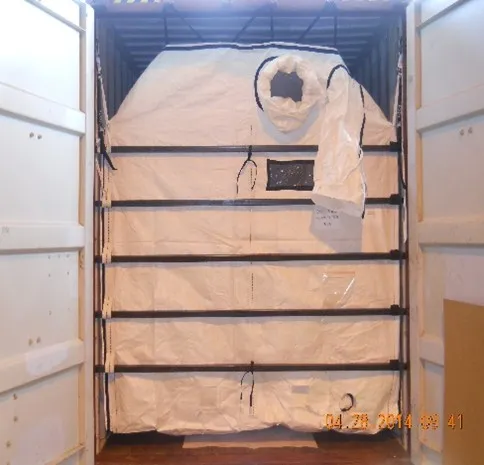
Bulk chemical shipping inside ISO containers presents a specific set of risks: moisture contamination, powder leakage, cross-contamination between batches, static discharge, and regulatory non-compliance. A properly specified container liner addresses all of these at once — but only when the liner material, construction, and certification match the chemical being shipped.
This guide covers the practical decisions chemical exporters, importers, and logistics providers face when selecting and using container liners for dry bulk chemical transport.
Understanding the Stakes in Chemical Bulk Transport
Chemicals shipped in bulk include PE and PVC resin granules, titanium dioxide pigment, polycarbonate resin, kaolin clay, crumb rubber, soda ash, and a wide range of fine powders. These cargoes share common vulnerabilities:
- Moisture absorption causes powders to cake, resins to degrade, and titanium dioxide to lose pigment performance
- Dust emission during loading creates workplace hazards and can breach environmental regulations
- Cross-contamination from residual material in an unlined container ruins entire batches
- Chemical compatibility issues can cause liner film degradation, puncture, or reaction with the cargo
A dedicated container liner creates a sealed interface between the chemical and the steel container walls, eliminating contact with previous cargo residues and blocking atmospheric moisture during long sea voyages.
PE Film Liners: The Workhorse for Chemical Resin and Powder Transport
For most dry bulk chemicals, low-density polyethylene (LDPE) film liners are the default choice. LDPE is chemically inert, fully waterproof, and available in thicknesses matched to cargo weight.
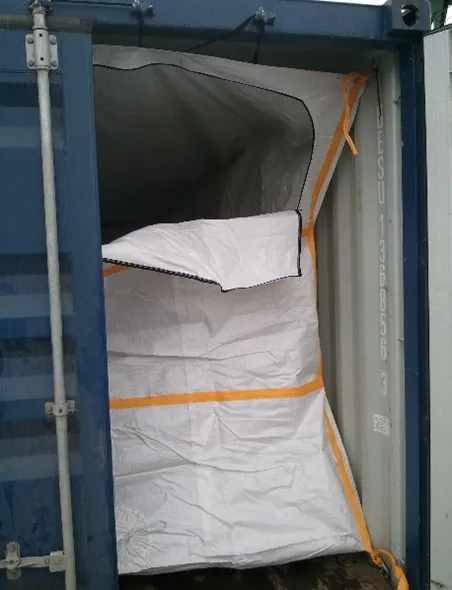
The DBL-F01 PE film container liner uses 140-micron LDPE film with tensile strength of at least 1,500 N/5cm in the warp direction and 1,300 N/5cm in the weft direction. Its smooth surface prevents chemical granule adhesion, so unloading leaves minimal residual product — a critical factor when switching chemical batches.
Key selection parameters for PE film liners in chemical service:
| Parameter | Typical Range | Why It Matters |
|---|---|---|
| Film thickness | 120–160 micron | Heavier cargo needs thicker film to resist tearing during loading |
| Tensile strength | 1,300–1,800 N/5cm | Prevents seam failure under bulk load |
| Surface smoothness | Low friction | Reduces product retention and cross-contamination |
| Anti-static option | Optional | Required for flammable powders and explosive dust environments |
| Food-grade certification | FDA optional | Needed only when chemical enters food contact supply chain |
For European plastic pellet transport, the DBL-F02 30FT PE film liner is precision-fitted to 30FT containers with four European-standard top filling spouts and REACH/RoHS compliance already in place.
Woven Liners: Strength for Heavy and Abrasive Chemical Cargo
Woven polypropylene or HDPE container liners offer higher mechanical strength than film liners, making them suitable for abrasive minerals, dense powders, and loads above 20 tons.
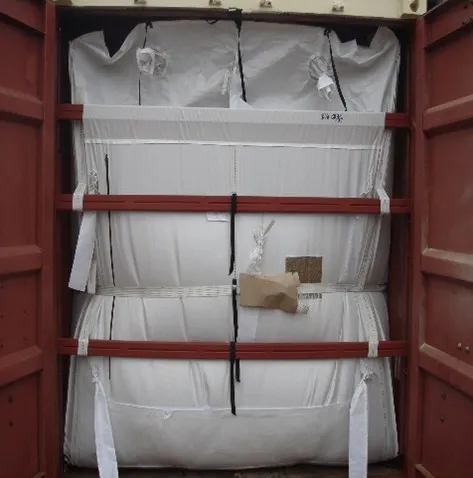
The DBL-W01 dry bulk liner uses 140 gsm HDPE woven fabric with warp tensile strength of 1,800 N/5cm. Four to eight lifting loops, each rated above 5 tons, allow direct mechanical handling. This liner is widely used for plastic pellets, soda ash, and industrial minerals.
Sift-Proof Construction for Fine Powders
The most demanding chemical powder applications — cement, lime powder, talc, pigment powder — require a liner that prevents particle escape through needle holes and seams. Standard stitched liners can leak dust at the seam line, causing contamination, product loss, and environmental violations.
The DBL-W06 sift-proof powdered chemical liner solves this with double-sided PE coating plus high-adhesion PU tape sealing on every sewn seam. The result is 100% sift-proof performance down to 50-mesh particle size. Tensile strength reaches 1,800 N/5cm warp and 1,600 N/5cm weft, with load capacity of 20–40 tons.
Important limitation: this liner is engineered for neutral and alkaline powders. Strong acids and strong alkalis still require specialized chemical-resistant linings. Always disclose the full chemical specification to the liner manufacturer before ordering.
Anti-Static Liners: When They Are Necessary
Static electricity accumulates when fine powders flow at high speed through loading spouts. For combustible dusts — many organic pigments, certain resins, and fine metal powders — a static discharge can ignite an explosion. In these applications, anti-static liners with conductive film layers or anti-static additives are a safety requirement, not an option.
Specify anti-static performance only when the chemical’s MSDS indicates dust explosion risk. Unnecessary anti-static treatment adds cost without benefit; missing it where required creates a serious safety hazard.
Chemical Compatibility: What to Verify Before Ordering
LDPE and woven PP liners resist most neutral and alkaline dry chemicals, but compatibility must be confirmed for:
- Strong oxidizing agents
- Strong acids (even in solid form, acid dust is aggressive)
- Solvents present in minor quantities
- Chemicals that generate heat during transit
- Substances with sharp crystalline structures
A reliable manufacturer will ask for the exact chemical name, CAS number, particle size, moisture content, and loading temperature before recommending a liner construction. If a supplier does not request this data, treat that as a warning sign.
Certifications and Compliance for Chemical Container Liners
Chemical shipments crossing international borders face regulatory scrutiny that varies by destination market. The primary certifications to verify:
ISO 9001 confirms the manufacturer operates a documented quality management system covering raw material traceability, production control, and final inspection. For chemical liner production, this is the baseline requirement.
REACH is the EU regulation governing chemical substances. A REACH-compliant liner means the film or woven fabric does not contain restricted substances above permitted limits. Essential for any shipment entering the European Economic Area.
RoHS restricts hazardous substances including lead, cadmium, mercury, and certain phthalates. While originally written for electronics, RoHS testing is now expected for many industrial packaging materials.
FDA / LFGB certification is only required when the transported chemical enters food, beverage, pharmaceutical, or cosmetic supply chains. For purely industrial chemicals, these certifications add cost without regulatory necessity.
Loading and Discharge Practices That Protect Chemical Cargo
Even the best liner fails if loading procedures are wrong. Common operational errors include:
- Overfilling beyond the liner’s rated capacity, which stresses seams and lifting loops
- Loading with sharp-edged auger equipment that punctures the film
- Insufficient securing of the liner, allowing it to shift and tear during ocean transit
- Discharging through the wrong port for the chemical’s flow characteristics
For free-flowing granules like PE resin and PVC, top loading spouts with gravity discharge work well. For fine cohesive powders, pneumatic discharge through a bottom spout is often faster and generates less dust.
Always confirm the discharge method — gravity, pneumatic, or manual — before specifying the liner port configuration.
Evaluating a Chemical Container Liner Supplier
Chemical shippers should evaluate potential liner suppliers on these criteria:
- Experience with your chemical category — ask for case references with similar cargo types
- Documented tensile and sift-proof test reports — not just marketing claims
- REACH and RoHS compliance documentation — current, not expired
- Customization capability — spout sizes, discharge port placement, anti-static options, and thickness controls
- Quality consistency across batches — request AQL inspection data or third-party test certificates
- Technical support after delivery — installation guidance, failure analysis, and replacement policies
Giant Flexpack (Taixing) Co., Ltd. has manufactured container liners since 2004 inside a Sino-American joint venture structure. Our chemical-grade liners hold ISO 9001, REACH, and RoHS certifications, with optional FDA and LFGB compliance for food-contact chemical applications. The woven dry bulk liner range and PE film liner range cover the full spectrum of dry chemical bulk transport requirements.
FAQ
What is the minimum order quantity for chemical container liners?
MOQ varies by liner type and customization. Standard PE film liners typically start at 200–500 units per order; custom-specified woven liners may require 500–1,000 units. Contact the manufacturer with your annual shipping volume for accurate pricing tiers.
Can the same container liner be reused for different chemical products?
No. Even if the liner remains physically sound, residual chemical traces make cross-product reuse unacceptable for quality and compliance reasons. Liners should be treated as single-use for chemical transport.
How do I know if my chemical needs an anti-static liner?
Check the MSDS for the minimum ignition energy (MIE) of the powder. If MIE is below 3 mJ or the dust is classified as combustible under local regulations, specify anti-static treatment.
What thickness PE film liner do I need for 25-ton resin loads?
For standard PE or PVC resin in 20FT or 40FT containers, 140-micron LDPE film is sufficient. Heavier loads above 30 tons or chemicals with sharp crystalline particles may require 160-micron or custom reinforced film.
Do chemical container liners need temperature protection?
Most dry chemicals tolerate ambient temperature fluctuation, but temperature-sensitive chemicals and heat-sensitive polymerization risks may require a thermal liner. The TL-02 EPE foam thermal liner provides the necessary thermal insulation layer for such cargo.
Make a Container Liner Decision That Protects Your Chemical Cargo
Selecting the right liner is a decision about risk management, not just packaging cost. Moisture damage, powder leakage, and regulatory non-compliance each create costs that dwarf liner prices. By matching liner construction to your specific chemical, verifying certifications before shipment, and confirming loading procedures with your team, you protect cargo integrity and supply chain credibility.
To discuss your chemical bulk transport requirements with a technical specialist, contact Giant Flexpack at [email protected] or +86 523 87683880.
From insight to product selection
Related products
Explore these packaging options, then confirm suitability for your cargo, dimensions and shipping conditions.
Tell us about your shipment
Discuss your packaging requirements
Tell us what you ship and how you ship it. Add the container or pallet size, route and any moisture or temperature concerns so we can discuss an appropriate packaging option.