
Packaging Insights
Cold Chain Container Liners: How They Work — and Their Limits
Cold chain shipping does not always require a reefer container. For many temperature-sensitive bulk and packaged loads, a passive thermal container liner can maintain an acceptable temperature window by blocking radiant heat, slowing conducted heat, and reducing condensation. But the technology has boundaries that are often oversold in commercial discussions. Knowing exactly how these liners work, and where they stop working, is the difference between cargo arriving in specification and a costly rejection.

How a Cold Chain Container Liner Works
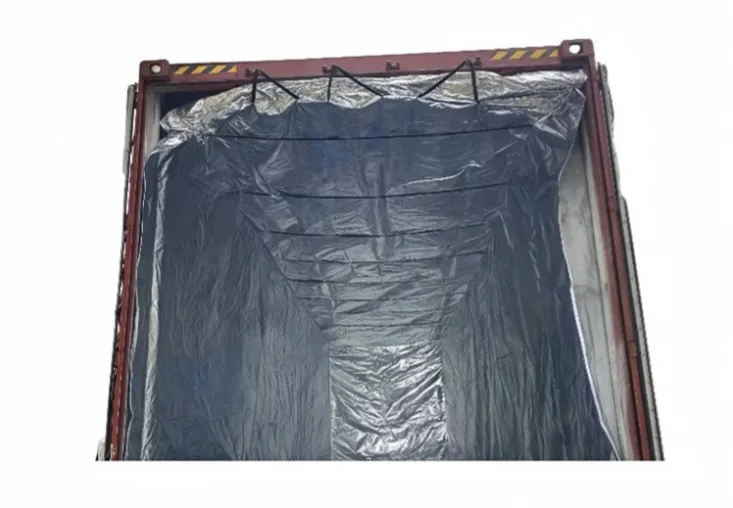
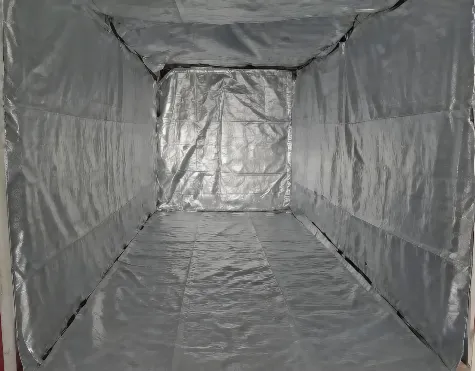
A thermal container liner is an engineered six-wall insulating envelope fitted inside a standard ISO container. It usually covers the floor, side walls, front wall, door area, and ceiling. It does not generate cold. It works as a passive barrier — one that delays heat transfer and separates the cargo space from the sun-heated steel shell. Standards such as ISO 1496-1 define the outer container dimensions and structural assumptions; the liner changes the internal microclimate without altering the container itself [5].
The liner manages three heat-transfer paths:
- Radiant heat: Metallized or aluminum-foil outer layers reflect a large share of solar radiation instead of absorbing it.
- Conductive heat: Foam or entrapped-air layers slow heat moving from the hot steel wall to the cargo area.
- Convection and air infiltration: A well-sealed liner limits warm outside air from circulating around the cargo.
That combination is why a correctly installed thermal liner can keep cargo within a useful temperature band for hours or even days. It is not cooling, but it is meaningful thermal protection.
Material Layers and the Four Common Liner Types
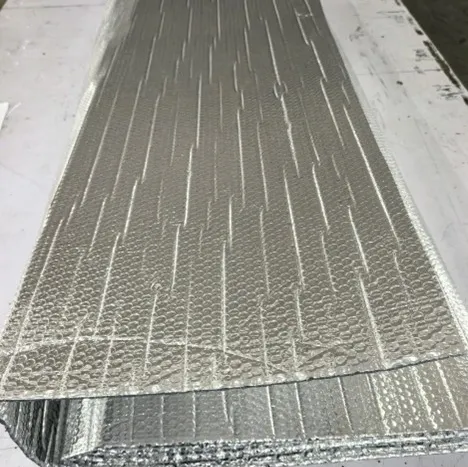
The performance difference between a low-cost radiant barrier and a true thermal liner comes from the material stack. At Giant Flexpack, the TL-01 Thermal Container Liner uses a woven PE core with double-sided aluminum-foil lamination, while the TL-02 Thermal Container Liner adds a 3 mm EPE foam core. The TL-03 Thermal Container Liner uses MPET and double-bubble cushioning, and the TL-04 Thermal Container Liner is a lightweight MPET/PE composite film. Each combination shifts a different balance of insulation, moisture resistance, durability, and installed cost.
| Liner | Layer structure | Thermal characteristic | Practical holding behavior |
|---|---|---|---|
| TL-01 | Woven PE + double-sided PE aluminum foil lamination | 95–97% radiant heat reflection | Maintains -20°C to +60°C with ±5°C variance; reusable 3–5 times |
| TL-02 | PET aluminum foil / woven PE / 3 mm EPE foam / PET aluminum foil | Thermal conductivity ≤0.038 W/(m·K) | Operating range -50°C to 80°C; strong condensation resistance |
| TL-03 | MPET / double bubble cushion / PET MPET | Up to 98% radiant reflection; 5 mm air cushion | Adds shock absorption; suited to frozen and fresh food, vaccines, biologics |
| TL-04 | Metallized PET film + polyethylene film | ≥92% radiant reflection | 24–48 hours at ambient 25°C; up to 72 hours with ice packs |

Performance in a Real Transit Cycle
Thermal liners do not hold a setpoint the way a reefer does; they reduce the rate of change and narrow the excursion band. A foam-core liner may keep pre-cooled cargo within a few degrees of the loading temperature for 24–48 hours depending on ambient temperature, door-sealing quality, and thermal mass. Light reflective films tend to perform over shorter windows unless supported by phase-change materials or ice packs, which is why validating the route with a controlled test such as ISTA 7D is important [4].
For pharmaceutical cargo, WHO guidance and USP <1079> distinguish active systems from passive systems by whether the system can restore temperature after a deviation. A passive liner cannot remove heat from cargo that was not properly pre-cooled before loading [2][3]. That distinction matters more than any reflectivity percentage.

Food-Grade and Regulatory Boundaries
Any liner contacting food must be manufactured from compliant polymers and avoid harmful migration. In the United States, polyolefin materials are evaluated under 21 CFR 177.1520; in the European Union, plastic food-contact materials fall under Regulation (EU) No 10/2011 [6][7]. Additional frameworks such as FDA GMP, LFGB, REACH, and RoHS matter for pharmaceutical, chemical, and electronic cargo. Certification reduces risk, but it does not replace route validation or proper installation.
Where the Limits Are — and How to Test Them
The most important part of selecting a cold chain liner is understanding what it cannot do.
First, a passive liner cannot actively remove heat. If cargo is loaded at 28°C and the target is 15°C, the liner simply holds that 28°C heat in. Second, any gap in the door seal, a tear during loading, or poor floor coverage creates a bypass path for outside air. Third, every door opening resets the protected environment. Fourth, a single reflective layer is not the same as a multi-layer foam core, especially on long high-delta routes.
For strict pharmaceutical distribution, a passive liner may be acceptable only after documented qualification of the full route, season, packaging configuration, and product thermal mass. FDA GMP expectations for storage and distribution also assume that the chosen system can maintain the required conditions, not merely delay the excursion [1][3]. The failure mode is usually not the film; it is the assumption that an unpowered liner can rescue a poorly prepared shipment.

Selecting the Right Liner for the Route
The right liner choice depends on measured route inputs rather than marketing language:
- Outbound and arrival ambient temperatures
- Longest door-to-door transit time
- Cargo temperature sensitivity and loading temperature
- Required food-grade or pharmaceutical certifications
- Container size and loading method
- Expected reuse cycle
- Humidity and condensation risk
If the route parameters are fixed, a short technical review is often enough to avoid under-specified or over-specified products. For a specific recommendation, contact Giant Flexpack at [email protected] or +86 523 87683880 and include the inquiry list below. For additional options across thermal liners and pallet covers, see the thermal insulation container liner and thermal insulation pallet cover categories.

Plan Your Passive Cold Chain Program
Before requesting a quote, prepare the following:
- Cargo name, form, and weight
- Required temperature band
- Expected minimum and maximum ambient temperatures
- Longest door-to-door transit time
- Which regulatory certificates apply
- Container size and loading/discharge method
- Whether the liner will be reused
Email these details to [email protected] or call +86 523 87683880. A technically matched liner costs less than a conservative reefer choice and protects more effectively than a generic radiant barrier.
Frequently Asked Questions
Do cold chain container liners replace reefer containers?
Not in every case. For pre-cooled cargo with a modest temperature tolerance and a well-characterized route, a passive liner is often sufficient. For strict 2–8°C biopharmaceutical loads on long, high-temperature routes, an active reefer or qualified active packaging remains necessary. WHO guidance treats passive systems as valid only when the route and configuration are qualified [3].
How long can a thermal container liner hold temperature?
That depends on the material stack, ambient conditions, cargo thermal mass, and installation quality. Many foam and bubble liners maintain a useful window for 24–48 hours, and some extend to roughly 72 hours with ice packs or phase-change materials. This is not a setpoint guarantee, and warm loading or poor door sealing will shorten the hold time significantly.
What does R-value tell me?
R-value helps compare conductive resistance between materials, but it does not capture radiant reflection, air infiltration, or installation quality. Reflective foil and air-cushion layers work partly by blocking radiation, so a high R-value alone does not guarantee real-world performance. Request full thermal data and, where possible, an ISTA 7D test report [4].
Are thermal container liners reusable?
Many are reusable three to five times or more depending on the material and handling. Before reuse, inspect for tears, delamination, contamination, and seam failure. Food-contact reuse also requires the liner to remain compliant and clean. Damaged liners should be retired, because even a small gap can overwhelm the insulation effect.
Which is better: foam-core or reflective-only?
Foam-core liners generally perform better on longer, higher-temperature-difference routes. Reflective-only liners are lighter and lower in cost and work best for short, mild routes or lower-sensitivity cargo. For frozen food, vaccines, or pharmaceutical products, a multi-layer MPET/bubble or foam stack is usually the safer choice.
What is the biggest reason passive liners fail?
Installation and expectation. Warm loading, torn film, poor door sealing, and unrealistic duration claims cause more failures than material defects. A passive liner must be treated as a protective barrier, not as a cooling system.
References
[1] U.S. Food and Drug Administration. 21 CFR Part 211 — Current Good Manufacturing Practice for Finished Pharmaceuticals. https://www.ecfr.gov/current/title-21/chapter-I/subchapter-C/part-211
[2] United States Pharmacopeia. USP <1079> Good Storage and Distribution Practices for Drug Products.
[3] World Health Organization. Model guidance for the storage and transport of time- and temperature-sensitive pharmaceutical products. WHO Technical Report Series, No. 961, 2011. https://www.who.int/publications/m/item/trs961-annex9
[4] International Safe Transit Association. ISTA 7D: Temperature Test for Transport Packaging. https://ista.org/test_procedures/7D.pdf
[5] International Organization for Standardization. ISO 1496-1:2013 Series 1 freight containers — Specification and testing — Part 1: General cargo containers.
[6] U.S. Food and Drug Administration. 21 CFR 177.1520 Olefin polymers. https://www.ecfr.gov/current/title-21/chapter-I/subchapter-B/part-177/subpart-B/section-177.1520
[7] European Commission. Commission Regulation (EU) No 10/2011 on plastic materials and articles intended to come into contact with food. https://eur-lex.europa.eu/eli/reg/2011/10/oj
From insight to product selection
Related products
Explore these packaging options, then confirm suitability for your cargo, dimensions and shipping conditions.
Tell us about your shipment
Discuss your packaging requirements
Tell us what you ship and how you ship it. Add the container or pallet size, route and any moisture or temperature concerns so we can discuss an appropriate packaging option.