
Packaging Insights
Energy Sector Bulk Shipping: Container Liner Solutions for Chemicals & Compounds
Energy-sector bulk supply chains move chemical compounds that are often fine, hygroscopic, static-sensitive, or thermally reactive in long-haul container environments. A standard dry container is only a steel enclosure; it does not isolate cargo from humidity, dust migration, cross-contamination, or temperature swing. Container liners turn that enclosure into a sealed, controlled transport system.
This guide covers the failure risks that matter for chemical and compound cargo, liner types, compliance requirements, powder handling, loading and discharge practice, thermal control, and the supplier checks that reduce shipment loss.

Why Energy-Sector Chemicals and Compounds Fail in Transit
Energy-sector bulk shipments include mineral fillers, drilling-fluid additives, catalysts, resins, polymer pellets, sulfur, lime, soda ash, petcoke, and specialty compounds. Many of these materials are non-hazardous in normal storage but become operationally unstable when moisture enters, fines escape, or temperature changes too quickly.
The main failure patterns are predictable:
- Moisture absorption and caking in hygroscopic powders such as lime, soda ash, and some catalyst carriers.
- Dust emission and sift loss from fine compounds with small particle size.
- Cross-contamination when residue from a previous load remains inside the container.
- Static accumulation with non-conductive polymer powders.
- Temperature excursion when heat-sensitive additives or coated compounds degrade, agglomerate, or separate.
- Regulatory non-compliance when packing is not aligned with transport codes or chemical registration requirements.
For shipments classified under dangerous goods transport rules, packing compatibility, segregation, and documentation duties apply under the International Maritime Dangerous Goods Code [1]. Container structural fitness and cargo restraint expectations are addressed in ISO 1496-1 [2].
Container Liner Types for Energy-Sector Bulk Chemical Movements
The correct liner is determined by particle size, moisture sensitivity, discharge method, and temperature requirement. The main categories include:
| Liner type | Best use in energy-sector bulk shipping | Key design feature |
|---|---|---|
| Woven sift-proof liner | Fine powdered chemicals, cement-like powders, pigments, additives | PU tape-sealed seams and coated fabric |
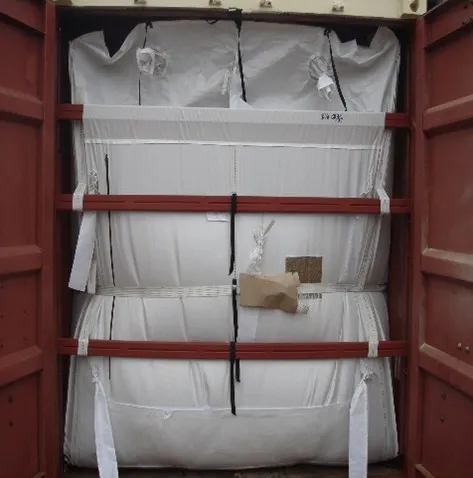
| Standard woven bulk liner | Granular compounds, pellets, mineral aggregates | High-tensile HDPE woven structure |
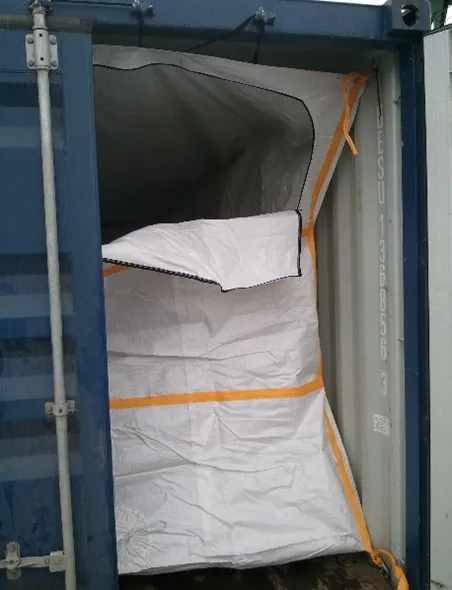
| PE film liner | Polymer pellets, compound resins, moisture-sensitive granules | Continuous film moisture and dust barrier |
| Thermal container liner | Temperature-sensitive catalysts, additives, coated compounds | Reflective foil or foam composite |
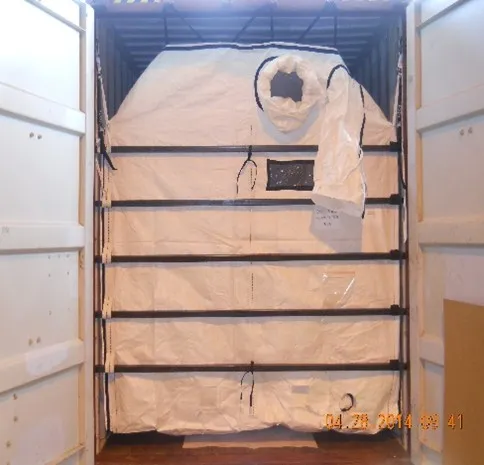
A DBL-W06 Woven Sift-Proof Container Liner is engineered for powdery chemical compounds because its sewn seams are sealed with PU tape and combined with a double-sided PE coating. A DBL-W01 Dry Bulk Container Liner is suitable for heavier granular or mineral loads. For polymer pellets and moisture-sensitive compound resins, a DBL-F01 PE Film Container Liner provides a smooth, low-adhesion surface and continuous moisture barrier.

Material Compatibility and Certification Requirements
Chemical cargo does not need to be food-grade for every application, but regional chemical and packaging regulations still apply. European shipments commonly require compliance with REACH for chemical substances and with RoHS where electrical or electronic goods are later involved [3][4]. Quality system control is addressed through ISO 9001 [5]. Where liners may touch food-contact substances indirectly, EU food-contact plastic rules and U.S. FDA olefin polymer requirements provide relevant reference points [6][7].
A reliable liner for chemical transport should have documentation covering material composition, migration risk where applicable, heavy-metal restrictions, and batch-level quality records. Certification labels alone are not sufficient; the supporting test reports and scope documents matter more.
Sift-Proof Seams, Dust Control, and Static Safety
Fine chemical powders fail most often at seams. A conventional stitched seam can allow fines to escape or moisture to enter. Sift-proof liners reduce this risk by sealing seams with an impermeable tape and by using coated fabric to create a continuous barrier.
For powdery compounds, key selection factors include:
- Particle size at the lower end of the shipment range.
- Discharge pressure and pneumatic handling.
- Static accumulation risk during filling and discharge.
- Whether the powder reacts with moisture or alkalis.
- Whether sift loss creates a dust hazard for handlers or equipment.
Manufacturer-rated sift-proof performance for particle sizes at or above 50 mesh is available in the DBL-W06 Woven Sift-Proof Container Liner, with tensile strength of warp ≥1,800 N/5cm and weft ≥1,600 N/5cm. Anti-static variants can be specified for non-conductive polymer powders.

Loading, Filling Spout, and Discharge Practice
Most energy-sector bulk chemical loads use top filling and bottom discharge. A properly positioned filling spout reduces dust escape and uneven loading. The discharge spout should match the receiver’s gravity, pneumatic, or mechanical system.
Best practice before departure includes:
- Confirm the liner is free of pinholes, seam gaps, and contamination.
- Check spout orientation against the loading equipment.
- Remove residual moisture and debris from the container floor.
- Secure the liner to the container lashing points according to the manufacturer’s pattern.
- Control filling speed to avoid air entrapment and liner shifting.
- Close and seal all openings before container movement.
Container restraint and loading forces should follow the structural expectations in ISO 1496-1 [2]. A pre-shipment inspection that records liner installation, seam condition, and spout closure gives the shipper a defensible quality record if a claim arises.

Thermal and Moisture Control for Sensitive Energy-Sector Loads
Some energy-sector chemicals are more sensitive to temperature than they appear. Coated additives can soften, catalysts can lose activity, and resins can agglomerate when the container interior climbs during a summer sailing or sits on an exposed terminal.
Passive thermal liners provide a practical alternative when a reefer is not required or not cost-justified. A TL-02 Thermal Container Liner combines a 3mm EPE foam core with reflective aluminum foil layers. Its manufacturer-specified thermal conductivity is ≤0.038 W/(m·K), and its moisture vapor transmission rate is ≤0.033 g/(m²·h·kPa). That combination reduces both radiant heat gain and condensation formation inside the container.
Thermal liners do not make a standard container a temperature-controlled unit; they slow heat transfer and stabilize the internal envelope. For long-haul or high-risk routes, temperature monitoring should still be used.
Need a Specification Check Before You Book the Container?
If your energy-sector shipment includes fine powders, hygroscopic compounds, or temperature-sensitive catalysts, liner selection should be confirmed before the container is booked. Send the cargo name, particle size, loading and discharge equipment, route, and container type to [email protected].
The technical team can respond with a material recommendation, seam treatment, spout configuration, static-control option, and the compliance documents required for quotation. The goal is not to sell the most expensive liner, but to match the liner to the failure mode that actually threatens the shipment.
Supplier Evaluation for Energy-Sector Chemical Liners
Chemical buyers should evaluate a liner supplier with the same discipline used for raw material suppliers. The supplier should provide:
- ISO 9001 quality system documentation and audit status [5].
- Batch production records for fabric weight, tensile strength, and seam integrity.
- Coating or lamination inspection results where moisture resistance is critical.
- Sift-proof test evidence for powdered compounds.
- Static-control confirmation where required.
- Compatibility guidance for the specific chemical being shipped.
- Clear installation and discharge instructions, not a generic one-page sheet.
A supplier that asks for cargo chemistry before recommending a liner is doing the right thing. Chemical compatibility cannot be assumed from container size alone.
Specify Your Energy-Sector Container Liner with Giant Flexpack
Giant Flexpack (Taixing) Co., Ltd. supplies woven dry bulk liners, PE film liners, and thermal container liner systems for energy-sector chemicals and compounds. The product range includes sift-proof woven liners for fine powders, PE film liners for polymer pellets, and passive thermal liners for temperature-sensitive chemical cargo.
To place a bulk order or request pre-production samples, contact the team at [email protected] with the cargo description, particle size, target route, and container type. The team can provide specifications, compliance documentation, installation guidance, and lead-time details before quotation.
FAQ
Are energy-sector chemicals always dangerous goods for container liner selection?
Not always. Many mineral fillers, polymer pellets, and dry compounds are shipped as non-dangerous cargo. However, classified substances require packing, segregation, and documentation compliance under the IMDG Code [1]. The liner must be compatible with the chemical and meet the transport code applicable to the shipment.
Which liner should I use for fine chemical powders?
A woven sift-proof liner with sealed seams is usually the safest choice. The sealed seams and coated fabric prevent fine particles from escaping and reduce moisture ingress. For extremely fine powders or static-sensitive materials, an anti-static variant should be evaluated.
Can a container liner stop moisture damage for hygroscopic compounds?
A liner made from coated film or laminated woven fabric can create a strong moisture barrier, but it does not remove moisture already present in the cargo or trapped inside the liner during filling. For hygroscopic compounds, combine the liner with dry loading conditions, short open-air exposure, and, where appropriate, desiccants.
Do thermal liners replace reefer containers for temperature-sensitive chemicals?
Thermal liners slow heat transfer and reduce temperature swing, but they are not mechanically refrigerated systems. They are suitable when the cargo tolerance is compatible with passive protection and when route conditions have been assessed. Temperature monitoring is still recommended.
What certifications should a chemical-grade container liner have?
The relevant minimum set depends on destination and application. ISO 9001 covers the quality system [5]. REACH and RoHS documentation are common for European shipments [3][4]. Where food-contact or pharmaceutical-adjacent materials are involved, EU food-contact plastic requirements and FDA olefin polymer requirements provide additional assurance [6][7].
How can I check seam strength and sift-proof performance before ordering?
Request a pre-production sample, batch tensile test results, and the sift-proof test method used for seams. Ask the supplier to confirm the minimum particle size at which the liner is rated and whether the test was performed on a sealed seam, not only on the base fabric.
References
[1] International Maritime Organization. International Maritime Dangerous Goods (IMDG) Code.
[2] ISO 1496-1:2013. Series 1 freight containers — Specification and testing — Part 1: General cargo containers for general purposes.
[3] Regulation (EC) No 1907/2006 concerning the Registration, Evaluation, Authorisation and Restriction of Chemicals (REACH).
[4] Directive 2011/65/EU on the restriction of the use of certain hazardous substances in electrical and electronic equipment (RoHS).
[5] ISO 9001:2015. Quality management systems — Requirements.
[6] Regulation (EU) No 10/2011 on plastic materials and articles intended to come into contact with food.
[7] U.S. Food and Drug Administration. 21 CFR 177.1520 — Olefin polymers.
From insight to product selection
Related products
Explore these packaging options, then confirm suitability for your cargo, dimensions and shipping conditions.
Tell us about your shipment
Discuss your packaging requirements
Tell us what you ship and how you ship it. Add the container or pallet size, route and any moisture or temperature concerns so we can discuss an appropriate packaging option.