
Packaging Insights
Bulk Packaging Essentials for Export Companies in 2025
Export companies entering 2025 face a packaging environment that no longer rewards the old default settings. Container freight rates remain volatile, EU and US regulators are tightening packaging waste and food-contact rules, and climate-driven temperature swings are turning ordinary sea freight into a thermal management problem. Bulk commodities—resin pellets, food powders, minerals, cocoa beans, sugar—move through this system every day, and the difference between a shipment arriving in specification and arriving with condensation damage, caking, or contamination often comes down to the liner protecting it.
This guide sets out the bulk packaging decisions that matter most for export companies in 2025: which liner formats to use, how to match packaging to cargo, which certifications are now non-negotiable, and how to evaluate a supplier before committing volume.
The Core Bulk Packaging Formats
Exporters working with dry bulk cargo currently rely on three primary container liner families, each with a distinct engineering purpose.
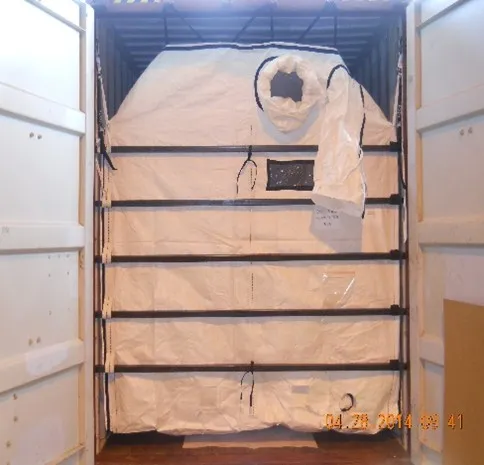
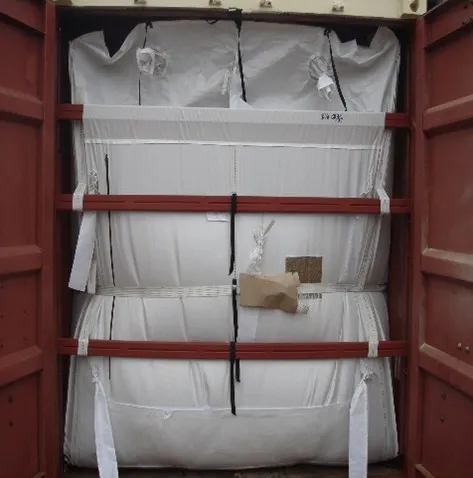
Dry bulk container liners form the baseline for free-flowing solids. Manufactured from woven polypropylene (PP) or high-density polyethylene (HDPE) fabric—or from low-density polyethylene (LDPE) blown film—these liners convert a standard 20ft or 40ft ISO container into a sealed bulk transport vessel. The DBL-W01 standard dry bulk liner uses 140 gsm HDPE woven fabric with tensile strength of 1,800 N/5cm in the warp direction, built to carry 10–30 tons of granular cargo. For powdery materials that leak through ordinary seams—cement, talcum powder, pigment powder—the DBL-W06 sift-proof liner seals every stitched seam with PU tape combined with double-sided PE coating, achieving zero leakage for particle sizes down to 50 mesh.
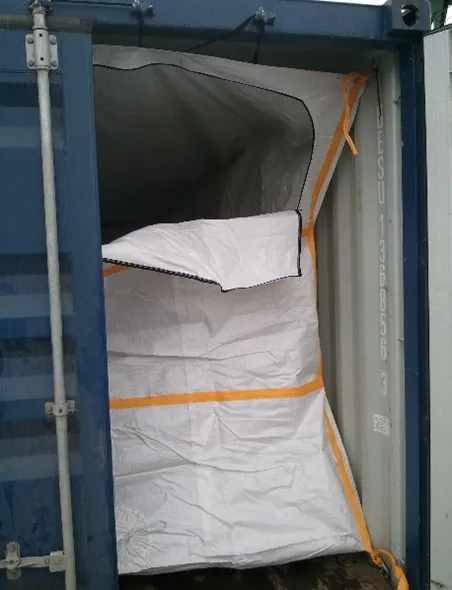
PE film container liners represent the most economical option when moisture and dust barrier performance is the priority. The DBL-F01 PE film liner uses 140-micron LDPE film to deliver 100% moisture and dust protection, with a smooth surface that prevents cargo adhesion during unloading. European plastic pellet shippers have a dedicated solution in the DBL-F02 30ft liner, precision-fitted to 30FT standard containers and equipped with four European-standard top filling spouts for compatibility with EU loading equipment.
Thermal insulation container liners address the temperature dimension that standard liners cannot. These are the GewenChamp™ series products engineered for cargo that degrades, solidifies, or spoils outside a narrow temperature window during long-distance sea freight.
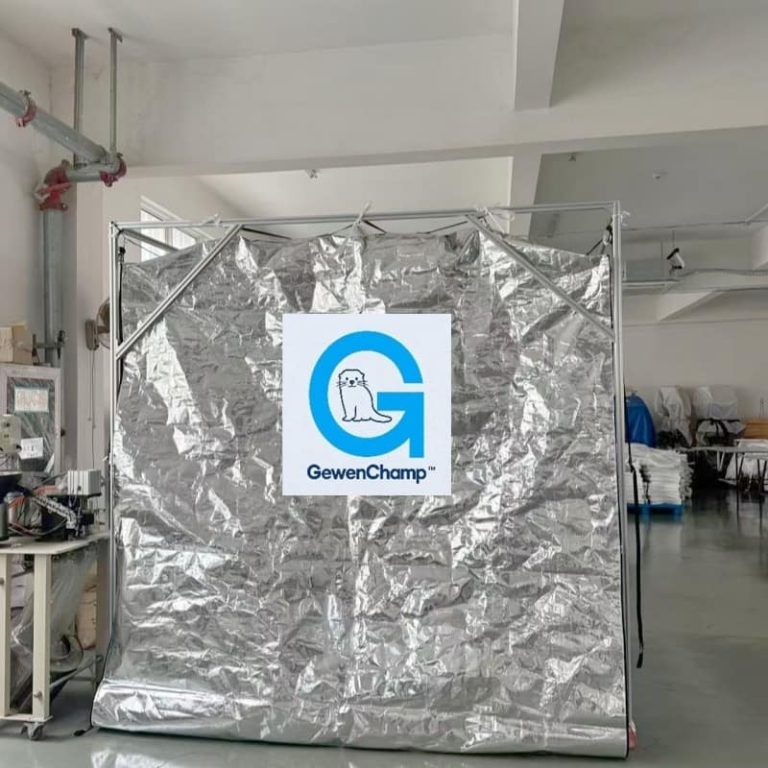
The TL-01 woven thermal liner combines woven PE with double-sided aluminum foil lamination, reflecting 95–97% of radiant heat while the woven layer supplies tear resistance. The TL-02 EPE foam liner adds a 3mm EPE foam core with thermal conductivity at or below 0.038 W/(m·K), cutting conductive and convective heat transfer in addition to radiation. The TL-03 MPET double-bubble liner uses a four-layer MPET/double-bubble/MPET structure to reflect up to 98% of radiant heat while the 5mm bubble layer traps static air as a secondary barrier. For light cargo that does not require extreme insulation, the TL-04 MPET/PE composite film liner offers the lightest and most cost-efficient entry point in the TL series.

Thermal pallet covers extend the same passive temperature protection to palletized cargo that travels on standard flat racks or inside ambient containers. The TP-01 woven thermal pallet cover uses a five-layer MPET/LDPE/woven-PE/LDPE/MPET composite achieving tensile strength at or above 25 N/15mm. The TP-02 EPE foam pallet cover combines insulation with shock absorption, while the TP-03 bubble-wrap pallet cover provides the lightest pallet-level option. The TP-04 aluminum foil pallet cover uses genuine aluminum foil—not metallized film—for higher radiant heat reflection at minimal weight.
Comparison Table: Container Liner Families
| Liner Family | Primary Material | Best For | Typical Load | Reusable? |
|---|---|---|---|---|
| Woven dry bulk liner | HDPE/PP woven fabric | Granular solids, agriculture, chemicals | 10–30 tons | No |
| Sift-proof woven liner | HDPE woven + PE coating + PU tape seals | Powders, cement, pigments | 20–40 tons | No |
| PE film liner | LDPE blown film | Food powders, pellets, moisture-sensitive solids | 15–35 tons | No |
| Thermal insulation liner (TL-01 to TL-04) | Foil/foam/bubble/woven composites | Temperature-sensitive cargo | Varies | Yes, 3–5 uses |
| Thermal pallet cover (TP-01 to TP-04) | Foil/foam/bubble/woven composites | Palletized temperature-sensitive cargo | N/A | Yes, 3–12 uses |

Matching Packaging to Cargo: A Decision Framework
One of the most expensive mistakes an export company can make in 2025 is treating bulk packaging as a generic purchase. A liner that works for soybean shippers will fail for titanium dioxide powder. The selection starts with the cargo’s physical properties and its failure modes.
Dry, free-flowing granules — soybeans, corn, plastic pellets, fertilizer — generally move well in woven dry bulk container liners. For agricultural products that need breathability to prevent mold, uncoated woven PP in the DBL-W05 barless design provides 80–120 L/m²·s air permeability while the smooth internal surface prevents small granules from jamming. Polymer pellets in Europe, however, benefit from the DBL-F02 30FT PE film liner because the smooth film surface eliminates pellet entrapment and the four filling spouts match EU loading equipment.
Powdery materials — cement, lime powder, plastic powder, pigment powder — require sift-proof construction. The DBL-W06 liner with PU-tape-sealed seams and double-sided PE coating is the reliable choice here; standard stitched liners will leak fine particles through needle holes.
Food commodities — sugar, flour, cocoa beans, coffee beans, salt, milk powder — demand food-grade certification and moisture control. Sugar, for instance, absorbs ambient moisture quickly, leading to caking and weight gain claims. A food-grade PE film container liner with a sealed moisture barrier prevents this. Cocoa beans require a balance: breathable enough to avoid mold, but sealed enough to prevent moisture ingress. The correct liner depends on the origin climate and voyage length.
Malt and brewing ingredients — barley malt, wheat malt — have a dedicated solution in the DBL-W02 malt-grade liner, which uses 110 gsm HDPE woven fabric with double-sided food-grade LDPE lamination. One 40HQ liner replaces roughly 1,000–1,500 × 25kg malt bags and cuts loading time from 8–12 hours of manual bagging to 30–60 minutes of pneumatic or auger loading.
Temperature-sensitive cargo — chocolate, pharmaceuticals, certain chemicals, resins with narrow processing windows — drives volume to thermal insulation container liners. The TL-02 EPE foam liner holds operating range from -50°C to 80°C with an interior variance controlled within ±5°C, sufficient for most passive cold chain requirements.

Compliance Essentials for Exporters
Compliance is no longer optional for bulk packaging in 2025; it is a market access requirement.
For food-contact applications, exporters shipping to the US need FDA-compliant liners. Exporters shipping to the EU need LFGB compliance and, increasingly, evidence of migration testing for plastic food-contact materials under Regulation (EU) 10/2011. The relevant Giant Flexpack product lines carry FDA and LFGB certifications as standard across food-grade variants, with ISO 9001 underpinning manufacturing quality systems.
For chemical and general industrial cargo, REACH and RoHS compliance confirm that the packaging materials do not introduce restricted substances into the supply chain. REACH (EU Regulation 1907/2006) matters for any liner entering the European market, while RoHS addresses hazardous substance restrictions in electrical and electronic contexts but has become a benchmark for broader material safety.
The practical rule for export companies: if your cargo is destined for food or pharmaceutical applications, require migration testing documentation from the liner manufacturer—not just a compliance declaration. If your cargo is food-grade but destined for the Middle East or Southeast Asia, Halal or Kosher certification may be required depending on buyer specifications. If your cargo enters the EU, confirm REACH registration and LFGB/FDA status as applicable.
Request third-party test reports from SGS, TÜV, or equivalent accredited laboratories. A manufacturer that cannot produce current SGS test reports for tensile strength, moisture vapor transmission rate (MVTR), and food-contact migration should be treated with caution.
Moisture Control: The Hidden Profit Leak
Moisture damage remains the most under-reported cost in bulk container shipping. The mechanism is straightforward: sealed containers experience daily temperature swings during sea voyages—especially through equatorial waters, high-humidity routes, and day-night transitions. Warm air inside the container holds moisture; as temperature drops, that moisture condenses on the coldest surfaces. For bulk cargo against the steel walls or roof, this condensation saturates the outer cargo layer, triggering caking, mold growth, rust on metal components, and weight gain or loss disputes between shipper and receiver.
The phenomenon known as “container rain” or “cargo sweating” is entirely preventable with a properly specified barrier. Thermal container liners with aluminum foil or MPET layers suppress radiant heat gain and slow thermal transfer, reducing the amplitude of temperature swings inside the container. Simultaneously, the liner’s moisture barrier—whether PE film, woven fabric with lamination, or the four-layer TL-02 construction with moisture vapor transmission rate at or below 0.033 g/(m²·h·kPa)—prevents internal condensation from directly contacting cargo.
For high-humidity routes, the combination approach matters most: a thermal liner for temperature stabilization plus desiccant strips for residual moisture absorption. For dry cargo in ambient conditions, a basic PE film liner may be sufficient, but the exposure time and route humidity profile should decide.
Passive Thermal Protection: Reframing the Cost Equation
The most significant packaging shift for export companies in 2025 is the wider adoption of passive thermal protection as an alternative to active refrigeration. Reefer containers remain essential for frozen cargo, but for many temperature-sensitive shipments—chocolate, pharmaceuticals with 15–25°C stability windows, resins that degrade above 40°C, cosmetics—a properly specified thermal container liner achieves the required temperature stability at a fraction of reefer freight costs.
A reefer container can cost two to three times the freight rate of a standard dry container on the same route, before fuel surcharges and maintenance charges. The GewenChamp™ thermal liners are reusable three to five times, which means the amortized per-trip cost falls dramatically for repeat exporters. The TL-03 MPET double-bubble liner maintains an interior temperature differential of up to 20°C versus ambient swings, which is sufficient for a broad range of industrial and food-grade cargo.

The trade-off is honest: passive thermal liners do not actively cool. They slow heat transfer and reflect radiant energy, which keeps cargo stable over a typical 20–40 day sea voyage in moderate climates. For frozen goods, vaccines requiring strict 2–8°C holding, or cargo moving through extreme summer heat in the Middle East or Australia, reefer containers remain the only reliable choice. Export companies should evaluate route climatology, voyage duration, and cargo temperature tolerance before selecting passive thermal protection—and they should test with a pilot shipment.
Supplier Evaluation Framework
Once the liner format is clear, supplier quality determines whether the solution works in practice. An export company committing volume in 2025 should evaluate five areas before signing a supply agreement.
MOQ, lead time, and pricing transparency. Bulk container liner orders typically involve minimum order quantities that reflect factory production efficiency. Standard woven liners may carry MOQs of 500–1,000 units, while custom sizes or configurations shift the threshold. Ask for a complete breakdown: unit price, tooling or setup charges for custom dimensions, packaging, and inland freight. Lead times for standard liners generally run 15–30 days from order confirmation, while custom thermal liners may take 25–45 days depending on material availability and seasonal demand.
Sample evaluation before ordering. A reliable manufacturer will supply samples for physical inspection before bulk commitment. Evaluate the liner’s tensile strength by hand (try to tear it along the seam), check seam construction under magnification for uniformity and seal integrity, weigh the liner against the stated GSM or thickness specification, and—for thermal liners—request the R-value or thermal conductivity test data. For food-grade applications, request migration test certificates and verify the certification number with the issuing body.
Factory production capacity. Capacity determines whether a supplier can scale with your export volume and meet seasonal peaks. A manufacturer producing 500,000 liners annually cannot absorb a sudden 100,000-unit requirement without delays, but one producing 2 million liners can. Ask about production lines, raw material sourcing (virgin vs. recycled polymer), quality control points per shift, and ISO 9001 audit findings.
After-sales technical support. Container liner installation requires training for loading teams. Request installation guides in advance, ask if the supplier provides on-site or remote installation training for your loading staff, and confirm their defect-handling policy. A manufacturer that supplies liners but offers no installation guidance will transfer failure risk to you.
Certification alignment. Verify that the supplier’s certifications match your destination markets. FDA for US food cargo, LFGB for EU food cargo, REACH for EU chemical cargo, RoHS if applicable, and ISO 9001 as the baseline manufacturing quality standard. Request current copies—certifications lapse, and a three-year-old ISO certificate may no longer be valid.
Cost Planning for 2025
Bulk packaging cost is best understood as total cost of ownership, not unit price per liner.
Material cost drivers. Woven fabric liners cost more than PE film liners because woven fabric requires additional manufacturing steps and higher raw material input. Thermal liners cost more than both due to multi-layer composite construction—aluminum foil, EPE foam, MPET film layers add material cost and manufacturing complexity. The TL-04 MPET/PE composite film liner was designed as the most cost-efficient thermal option for shippers who do not need the full TL-02’s foam-core performance.
Duty and freight costs. A 40ft container of bulk liners ships as relatively low-density cargo, and freight cost per liner drops with volume. Export companies placing larger consolidated orders amortize freight more efficiently. Duty rates vary by destination country and material classification; woven PP liners and PE film liners may fall under different HS codes.
The damaged-cargo comparison. The most persuasive cost argument is comparative: a thermal liner costing USD 300–600 per trip, reusable three to five times, versus a single reefer surcharge of USD 1,500–3,000 per trip, or versus a moisture-damage claim of USD 20,000 for one contaminated polymer resin load. When the cost of failure is factored, the packaging investment is small relative to the cargo value it protects.
Common Mistakes Export Companies Make
Choosing by price alone. The cheapest liner is almost never the cheapest solution when cargo value, destination compliance, and contamination risk are considered. A liner that tears during loading costs more in cargo loss than the savings from selecting a sub-spec product.
Ignoring discharge method compatibility. The liner must match the discharge system—gravity, pneumatic, or manual. A liner without a bottom discharge spout, or a spout sized incompatibly with your unloading equipment, creates downtime at the destination. Specify discharge requirements at quotation stage.
Overlooking food-contact compliance. Exporters shipping sugar, flour, or malt into the EU have been rejected at port because the liner carried only a manufacturer’s “food-grade” claim without LFGB or EU 10/2011 migration documentation. Compliance must be documented, not assumed.
Using the wrong liner thickness. GSM and micron ratings matter. A 100 gsm woven liner may be adequate for light-density granules but will fail under the static load of 25 tons of dense mineral cargo.
From insight to product selection
Related products
Explore these packaging options, then confirm suitability for your cargo, dimensions and shipping conditions.
Tell us about your shipment
Discuss your packaging requirements
Tell us what you ship and how you ship it. Add the container or pallet size, route and any moisture or temperature concerns so we can discuss an appropriate packaging option.