
Packaging Insights
Container Liner Selection Guide for Rubber Bulk Transport
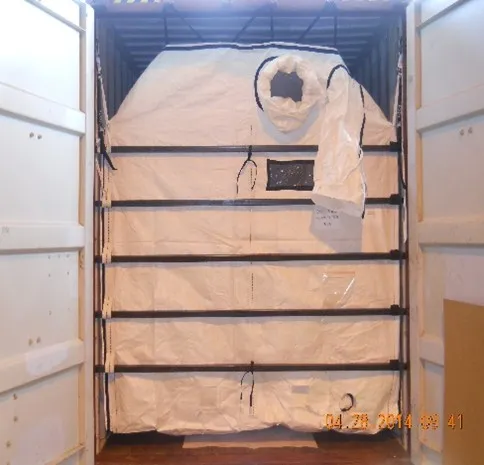
Why Rubber Cargo Demands a Specific Liner Approach
Rubber is not a single material. In bulk transport, the term covers crumb rubber from tire recycling, compounded rubber stock mixed with carbon black and process oils, natural rubber in technical specification blocks, and a range of synthetic rubber pellets. Each behaves differently inside a shipping container.
Three factors drive liner selection more than anything else:
- Contamination sensitivity. Rubber compounds, especially those destined for precision molded or extruded parts, cannot tolerate foreign particles. A single stray fiber from a low-grade liner or ambient dust pulled in through a poor seal becomes a visible and mechanical defect in the finished product.
- Presence of oils and plasticizers. Many rubber compounds contain process oils (aromatic, naphthenic, paraffinic) and plasticizers. These can interact with low-grade polyethylene films over time, softening them and compromising liner integrity.
- Moisture behavior. Natural rubber absorbs moisture and can develop mold. Uncured compounds can bloom or harden unevenly if humidity penetrates. Powdered rubber chemicals — including sulfur, accelerators, and carbon black masterbatch — must stay dry to remain free-flowing and to prevent pre-vulcanization or agglomeration.
First, Classify What You Are Shipping
Crumb Rubber (Recycled Rubber Granulate)
Crumb rubber ranges from fine powder (below 0.8 mm) to coarse granulate (up to 10 mm). Depending on the source — whole-tire crumb, buffing dust, or cryogenic ground material — it may contain trace steel and textile fibers. It is moderately dusty and can be slightly oily.
Liner priority: abrasion resistance, dust containment, and prevention of cross-contamination between product batches. A woven HDPE liner with PE coating (140 gsm or higher) handles the abrasive character of crumb rubber better than thin single-film liners. For fine crumb that generates visible dust during loading, a sift-proof liner with tape-sealed seams is the safer route.
Rubber Compounds and Masterbatch
Compounded rubber already contains fillers, plasticizers, process oils, and curatives. Carbon black-filled compounds are extremely dusty and can create electrostatic buildup. Unvulcanized (green) compounds soften with heat and can block into a single mass if pressed for weeks inside a hot container.
Liner priority: oil resistance, anti-static properties where needed, and a sealed system that prevents carbon black dust from escaping through stitching. For highly dusty compounds, a 140 gsm HDPE woven liner with double-sided PE coating and PU-taped seams provides 100% sift-proof performance for particle sizes ≥50 mesh — which covers virtually all carbon black masterbatch and fine fillers.
Natural Rubber (TSR / SMR Blocks)
Technically Specified Rubber (TSR) and Standard Malaysian Rubber (SMR) ship as compact blocks weighing 33–35 kg each, typically bagged or film-wrapped before container loading. In bulk or semi-bulk configurations, liners are used alongside loose blocks.
Liner priority: moisture exclusion and physical protection against scuffing. Natural rubber blocks are dense and can abrade film interiors during transit. A woven liner with an inner PE film layer balances tear resistance with moisture barrier.
Synthetic Rubber Pellets (SBR, BR, EPDM, NBR)
Synthetic rubbers mostly ship as free-flowing pellets or small bales. They are less tacky than natural rubber but can still soften and deform under stack pressure in hot climates.
Liner priority: smooth interior surface to prevent pellet adhesion, plus adequate puncture resistance. A 140-micron LDPE film liner offers a smooth, non-stick surface and 100% moisture barrier at lower cost than woven alternatives. For higher stacking loads, upgrade to a woven liner with inner PE lamination.
Woven PP vs PE Film Liner: A Practical Comparison for Rubber
| Factor | Woven HDPE/PP Liner (with PE coating) | PE Film Liner (LDPE) |
|---|---|---|
| Tear and puncture resistance | High; warp tensile ≥1,800 N/5cm typical | Moderate; ≥1,500 N/5cm typical |
| Contamination control | Excellent when seams are tape-sealed | Good; heat-welded seams available |
| Abrasion resistance | High — suitable for crumb rubber | Lower — best for pellets and smooth granules |
| Oil interaction | Requires PE coating for oil resistance | LDPE naturally resists process oils |
| Sift-proof for fine powder | 100% possible with PU-taped seams | Best with heat-welded seams and proper spout closure |
| Reusability | Usually single-trip for rubber | Single-trip |
| Relative cost | Higher | Lower |
The choice is rarely about one material being superior. It is about matching the liner to the exact rubber form and the failure mode you cannot afford. Abrasive crumb rubber justifies a heavy woven liner. Pelletized synthetic rubber often runs well in a 140-micron LDPE film liner. Fine carbon black masterbatch needs sift-proof woven construction.
Thickness and GSM: What the Numbers Mean
GSM (grams per square meter) applies to woven liners. Mil or micron applies to film liners. Higher numbers mean more material, more puncture resistance, and more cost.
- 110 gsm woven — suitable for light, non-abrasive granular rubber pellets in clean loading conditions.
- 140 gsm woven — the standard for crumb rubber, rubber compounds, and general industrial bulk. This is the basis for woven dry bulk container liner solutions rated to 10–30 tons per container.
- 150–200 gsm woven — heavy-duty for high-density rubber bales or when stacking pressure is extreme.
- 120–160 micron PE film (140 micron recommended) — the workhorse for synthetic rubber pellets and free-flowing compounds. A PE film container liner with 140-micron LDPE provides complete moisture exclusion at the lowest cost.
Anti-Static Liners: When Required
Fine rubber powders and carbon black-filled compounds generate static during pneumatic transfer. In enclosed liner environments, static discharge can cause dust ignition hazards (documented in powder handling sectors) and cause product to cling to liner walls, leaving residue and reducing discharge efficiency.
Specify an anti-static treated liner when:
- You pneumatically load fine rubber powder or carbon black masterbatch
- Your compound contains high carbon black loading (typical in tire compounds)
- You handle rubber chemicals (accelerators, sulfur, zinc oxide) in dusty form
- Your facility has an explosive dust classification (ATEX / NFPA 652 context)
Anti-static treatment is a customization on woven HDPE liners; it is not standard. Confirm surface resistivity and charge decay time with your manufacturer before ordering.
Certifications That Matter for Rubber Transport
Rubber is not automatically food-grade, so the certification burden is lower than for food commodities — but not zero.
- REACH and RoHS — relevant for rubber destined to the EU, particularly for consumer goods, automotive, and medical applications. The liner itself must not introduce restricted substances (plasticizers, heavy metals in pigments) into the rubber.
- FDA compliance — required only when the rubber will contact food or pharmaceutical surfaces. If your rubber supplies the food-contact sector, insist on FDA-compliant film or coating on the liner.
- ISO 9001 — a baseline process quality certification. It does not guarantee liner performance, but it signals controlled production, incoming material checks, and batch traceability.
- Third-party testing — for oil migration, extractables, or specific metal content, request actual test reports rather than relying on PDF certificates. A legitimate manufacturer should provide SGS, TÜV, or equivalent documentation on request.
Installation and Discharge: What Rubber Shippers Often Overlook
Loading
- For crumb rubber and pellets, use a top loading spout and pneumatic or belt loading. The spout must be secured to prevent dust escape during loading. Even small dust leaks contaminate the container exterior and create disposal issues at destination.
- For rubber blocks and bales, loading is typically forklift-based. The liner must be positioned and strapped before the first block enters. Torn liners from forklift contact are the most common failure mode.
Discharge
Choose the discharge method before ordering, because it determines liner design:
- Bottom discharge spout — fastest for free-flowing crumb rubber and pellets. Requires a compatible discharge station or tipper.
- Rear discharge (full-opening) — preferred for blocks, bales, or semi-bulk applications where the liner is cut open and product is removed manually or with grabs.
- Pneumatic vacuum discharge — clean but requires strengthened spout construction to resist collapse under vacuum.
Venting
Rubber compounds containing volatile processing aids can off-gas slightly during long transit. A properly vented liner — or at least a breathable upper section — prevents ballooning pressure inside the container. However, over-venting defeats moisture control. Specify venting only when the manufacturer confirms it is compatible with your compound’s volatility profile.
Common Mistakes in Rubber Liner Selection
- Selecting by price alone. A liner that saves USD 20 per unit but permits contamination in a USD 40,000 rubber shipment is a false economy.
- Ignoring particle size. A liner rated for pellets is not automatically adequate for fine carbon black powder. Sift-proof requirements must be stated at the RFQ stage.
- Assuming all PE film is oil-resistant. Low-grade recycled-content films can soften with aromatic oils.
- Skipping the spout compatibility check. A liner optimized for European pellet filling equipment will not match your existing loading gear unless you specify it.
- Not asking about seam construction. Stitched seams leak fine powder. For dusty rubber materials, heat-welded or PU-taped seams are mandatory. Our sift-proof liner uses double-sided PE coating with PU-taped seams for 100% dust containment.
- Overlooking stack pressure in hot climates. Rubber blocks and dense compounds settle during transit. On a tropical route, internal temperatures can reach 55–65°C. Liner puncture resistance under sustained load must be specified for the worst-case route, not the average one.
- Reusing liners without cleaning validation. Most rubber liners are single-trip. Reuse without documented cleaning risks cross-contamination between rubber batches — a defect liability that outweighs any recovered liner cost.
Temperature Considerations (When to Think Thermal)
Most dry rubber cargo travels fine at ambient container temperatures. The exception is compounded rubber with temperature-sensitive curatives or blends that soften below typical container peak temperatures.
If you ship:
- Uncured rubber compounds with fast-acting curatives that can begin scorching above 40°C
- Pre-blended masterbatch that must remain pellet-free-flowing for automated dosing at the receiving plant
- Rubber compounds for medical or food-contact applications where temperature history must be controlled
…then a thermal insulation container liner deserves evaluation. A reflective thermal liner reduces internal temperature swings and prevents the interior from tracking ambient peak temperatures as aggressively as an unlined container would. The economics versus reefer transport are attractive on lanes where your product is only vulnerable for part of the year.
Supplier Evaluation Checklist for Rubber Liner Purchases
Before placing an order, confirm:
- The manufacturer can provide the liner type (woven, PE film, sift-proof) suited to your specific rubber form
- Tensile strength and puncture resistance figures are provided in N/5cm — not just “heavy duty” descriptors
- Seam construction method is specified (stitched, heat-welded, or PU-taped) and matches your particle size
- Anti-static option is available and documented with test data if required
- Coatings are food-grade (FDA) if your rubber enters food-contact applications
- REACH / RoHS compliance is current and verifiable
- Production capacity matches your order volume and lead time expectations
- Samples are available for a real-loading trial before committed volume
- Installation guides and loading/discharge instructions are provided in your language
Frequently Asked Questions
Can one container liner handle both pellet and crumb rubber?
Not safely. Crumb rubber’s abrasiveness and dust profile differ significantly from pellets. A heavy woven liner works for both in theory, but you sacrifice the cost advantage of PE film for the pellet-only portion. Segment by rubber form.
What is the minimum liner thickness for crumb rubber?
For woven HDPE, specify 140 gsm as the baseline. Below that, puncture risk from sharp rubber granules rises quickly. For PE film crumb rubber applications, use at least 160 micron and preferably a woven-internal hybrid.
Do rubber shipments need food-grade liners?
Only if the rubber itself supplies food-contact or medical markets. Otherwise, REACH and RoHS are the relevant bases, not FDA or LFGB.
Is a sift-proof liner necessary for rubber pellets?
No — pellets have minimal fine particle content if properly screened before loading. Sift-proof liners matter for fine rubber powder, carbon black masterbatch, and dusty compounding ingredients.
How much does a rubber-grade container liner cost versus a standard one?
An anti-static, sift-proof, 140 gsm woven liner for dusty rubber compounds typically costs 20–40% more than a standard woven liner. The premium reflects PE coating, PU-taped seams, and surface treatment. Against a rejected shipment, that difference is negligible.
Get a Liner Recommendation Matched to Your Rubber Product
Container liner selection for rubber is a specification-driven decision, not a commodity purchase. The liner that works for TSR blocks is not the liner that works for carbon black masterbatch — and getting it wrong shows up as contamination, dust leakage, or blocked discharge at the destination.
Giant Flexpack manufactures woven HDPE and PE film container liners for crumb rubber, compounded rubber, natural rubber blocks, and synthetic rubber pellets. Every liner is produced under ISO 9001-controlled processes, with FDA, REACH, and RoHS compliance where required.
Contact our engineering team at [email protected] with your rubber form, particle size, loading method, and destination route. We will recommend a liner specification with test data — not a generic quote.
From insight to product selection
Related products
Explore these packaging options, then confirm suitability for your cargo, dimensions and shipping conditions.
Tell us about your shipment
Discuss your packaging requirements
Tell us what you ship and how you ship it. Add the container or pallet size, route and any moisture or temperature concerns so we can discuss an appropriate packaging option.