
Packaging Insights
Crumb Rubber Bulk Shipping: How Container Liners Control Contamination
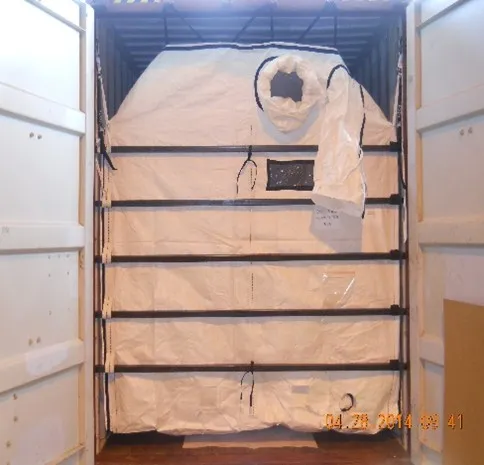
Crumb rubber is the granular material produced by shredding and grinding end-of-life tires. Most commercial grades fall between 0.5 mm and 6 mm, and the material is commonly moved in 20ft and 40ft ISO containers for use in rubberized asphalt, molded goods, sports surfaces, and civil engineering fillers. In bulk form, crumb rubber behaves like a semi-free-flowing granular cargo with a significant dust and fine fraction, residual steel and textile fiber content, and a tendency to pick up moisture from container condensation. Without a proper barrier, those characteristics turn ordinary ocean freight into a contamination and cargo-loss problem.
What Contaminates Crumb Rubber in a Container
Crumb rubber shipments fail quality inspection when foreign material enters the cargo or when fine rubber particles escape into the container corridor. The most common contamination sources include:
- Residual cargo from the previous shipment, including cement, chemicals, food residue, or oils
- Rust and scale peeling from unlined steel container walls and floors
- Moisture from condensation, roof leaks, or high-humidity loading conditions
- Cross-contamination from wood dunnage, paint chips, or packaging debris
- Silica, soil, or metal dust introduced during open-door loading
The consequences are commercial as well as physical. Off-spec rubber is rejected by asphalt binder and molded product manufacturers. Residual steel wire in crumb rubber can corrode when condensation forms, creating rust streaks through the rubber. Moisture causes clumping and can interfere with downstream processing. Fine rubber dust escaping through unsealed seams creates cleanup costs, cargo loss, and contamination risks for the next container load.
The Role of a Bulk Container Liner in Contamination Control
A correctly specified bulk container liner creates a continuous physical barrier between crumb rubber and the container interior. The liner also controls dust release and reduces moisture contact with cargo. It is more than a large bag: it is a contamination-control system with specific functional features.
- Top loading spout directs crumb rubber into the liner without exposure to open doors or ambient contamination
- Bottom discharge spout enables contained gravity or pneumatic discharge at the destination
- Sealed seams prevent fine rubber particles from escaping through needle holes
- Lifting loops and securing points hold the liner in place during loading and transit
- Barrier material resists moisture migration from container walls and floor
For crumb rubber, the most decisive choice is not the presence of a liner, but the construction of the liner’s seams and coating. That choice determines whether the liner contains dust or simply holds the bulk while fine particles leak out.
Liner Options for Crumb Rubber: Standard vs Sift-Proof
Not all crumb rubber is the same. Coarse crumb with low dust can be shipped effectively in a standard woven HDPE liner. Fine crumb and rubber powder demand a sift-proof construction with sealed seams and a PE coating.
| Characteristic | Standard Woven Dry Bulk Liner | Sift-Proof Woven Container Liner |
|---|---|---|
| Base material | 140 gsm HDPE woven fabric | 140 gsm HDPE woven fabric with double-sided PE coating |
| Seam construction | Sewn seams | Sewn seams fully sealed with high-adhesion PU tape |
| Dust containment | Good for granular crumb above 2 mm | 100% sift-proof for fines ≥50 mesh (approximately 0.3 mm) |
| Moisture resistance | ≥98% | Full barrier with PE coating on both sides |
| Load capacity | 10–30 tons per container | 20–40 tons per container |
| Best use case | Coarse crumb, low dust fraction, shorter routes | Fine crumb or rubber powder, high dust, long sea freight, strict buyer specifications |
At Giant Flexpack, the standard 140 gsm HDPE woven dry bulk container liner covers most crumb rubber shipments where particle size stays above 2 mm and dust content is controlled. When the material includes a significant fraction of fine crumb or rubber powder, the woven sift-proof container liner with PU-taped seams and double-sided PE coating is the safer specification.
Moisture, Condensation, and the Risk of Rust
Crumb rubber often contains fine steel wire fragments left from tire processing. If the rubber carries residual surface moisture or if condensation forms inside an unlined container, those metal fragments can oxidize. The result is rust discoloration that spreads through the cargo and creates immediate quality rejection.
A PE-coated liner reduces direct moisture migration from the container wall and floor, but it cannot dry already-wet rubber. The practical rule is simple: load only dry crumb rubber, keep container doors closed during loading, and avoid open-top operations during rain or high humidity. If the shipping route passes through equatorial or high-humidity zones, specify a PE-coated or laminated liner rather than a standard uncoated woven fabric.
Loading and Discharge Controls That Protect Crumb Rubber
Even the best liner cannot compensate for careless handling. The following practices reduce contamination and dust escape throughout the shipment.
Loading
– Inspect the liner for tears, seam gaps, and port security before installation.
– Install the liner to cover all six container surfaces and secure it with the provided lifting loops and straps.
– Load through the top spout using an auger, pneumatic system, or enclosed conveyor.
– Use dust extraction at the loading point if the crumb rubber has a high fine fraction.
– Avoid manual shovel loading through open doors when contamination control is a requirement.
Discharge
– Discharge by gravity or pneumatic system through the bottom spout.
– Keep the discharge area clean and protected from wind or rain.
– Use a contained transfer to the receiving silo or hopper.
– After unloading, remove the liner carefully and inspect for tears or leakage points that may indicate seam failure.
Compliance and Material Safety for Crumb Rubber Liners
Crumb rubber itself faces regulatory scrutiny in some markets, particularly the EU where REACH restrictions on polycyclic aromatic hydrocarbons (PAHs) apply to rubber granules used in consumer-facing surfaces. A liner with REACH and RoHS compliance does not solve cargo chemistry issues, but it prevents the packaging itself from introducing restricted substances into the shipment.
For industrial and non-food crumb rubber shipments, ISO 9001 manufacturing quality plus REACH and RoHS material certificates are the practical baseline. Food-grade certification is generally not required for crumb rubber, but the liner should be produced from clean virgin resin and should not introduce oils, plasticizers, or recycled post-consumer material of unknown origin.
Specification Checklist for Crumb Rubber Buyers
Suppliers need the following data to recommend the correct liner.
- Particle size distribution, including the percentage below 0.3 mm
- Residual steel and fiber content
- Moisture content at loading
- Container size and loading method
- Transit route duration and expected humidity exposure
- Buyer quality limits for foreign matter
- Dust control requirements at discharge
A complete specification reduces the risk of choosing a liner that is either overbuilt for the cargo or insufficient for the dust fraction.
FAQ
Can I reuse a crumb rubber container liner?
Most woven PE liners are single-trip to preserve the contamination barrier. Reuse risks carrying residual rubber and dust into the next shipment. For contamination-sensitive crumb rubber, a single-use HDPE liner is standard practice.
What GSM thickness do I need for crumb rubber?
140 gsm HDPE woven is typical for 20–30 ton loads. Higher tonnage or highly abrasive fine rubber may justify 160–200 gsm material or a PE-coated version. Request tensile and elongation data from the supplier before approving the specification.
Does crumb rubber need a food-grade liner?
Not normally. But if the downstream use includes consumer or children’s surfaces under strict chemical limits, ensure the liner material has REACH and RoHS compliance and does not introduce unknown recycled resin.
Can a liner stop condensation completely?
A PE-coated sift-proof liner blocks moisture from the container walls and floor, but it cannot remove moisture already present in the rubber. Load dry cargo and monitor ambient conditions during packing.
What is the most common liner mistake for crumb rubber?
Using a general grain liner with unsealed stitched seams. Fine rubber particles escape through needle holes and contaminate the container. Sift-proof construction or PU tape seam sealing is required whenever the material contains a dust fraction.
Source a Liner Matched to Your Crumb Rubber Cargo
Giant Flexpack manufactures HDPE woven dry bulk container liners in standard and sift-proof configurations, with top loading and bottom discharge options, certified to ISO 9001, REACH, and RoHS. Before ordering, share your particle size distribution, moisture content, load weight, and destination route. Our technical team will recommend the right liner structure — standard woven, PE-coated, or PU-taped sift-proof — and provide a sample for compatibility testing.
Contact [email protected] or call +86 523 87683880.
From insight to product selection
Related products
Explore these packaging options, then confirm suitability for your cargo, dimensions and shipping conditions.
Tell us about your shipment
Discuss your packaging requirements
Tell us what you ship and how you ship it. Add the container or pallet size, route and any moisture or temperature concerns so we can discuss an appropriate packaging option.