
Packaging Insights
Titanium Dioxide Bulk Shipping: Container Liner and Contamination Control
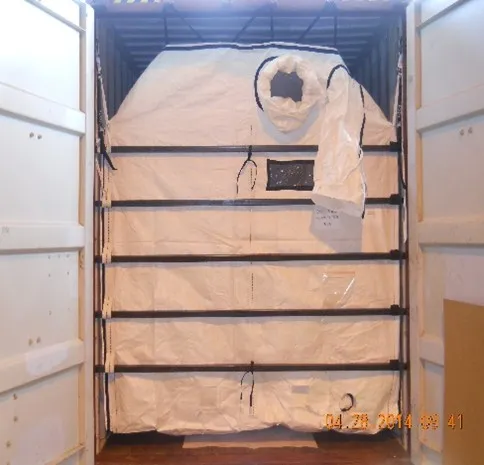
Titanium dioxide (TiO₂) is not difficult to ship because it is hazardous—it is difficult because it is white, fine, and commercially unforgiving. A small amount of rust from a container wall, a few dark fibers from a woven liner, or a moisture-caked lump at the discharge spout can turn an otherwise clean bulk shipment into a rejected delivery. This guide explains how to select and use a container liner that controls contamination, moisture, and powder leakage for titanium dioxide bulk transport.
For most industrial pigment-grade TiO₂, the primary recommendation is a sift-proof woven dry bulk container liner with double-sided PE coating and PU-taped seams. For high-purity, food, pharmaceutical, or cosmetic grades where residue and surface smoothness matter more, a PE film container liner with applicable food-contact certification is often the better choice.
What Makes TiO₂ a Demanding Bulk Cargo
Titanium dioxide pigment is a fine, high-brightness powder. Primary particles are often sub-micron, but commercial grades are agglomerated into free-flowing powders. Bulk density typically ranges from roughly 0.4 to 1.0 g/cm³ depending on crystal form, surface treatment, and grade. That variation matters because it directly affects how much product can legally and practically fit into a 20ft or 40ft container.
TiO₂ creates three specific shipping challenges:
Fine powder finds every defect. Uncoated stitching, pinholes, loose seams, or small tears will allow dust to escape. Once powder migrates outside the liner, the container is contaminated and cleaning becomes a cost and compliance problem.
White product exposes contamination instantly. A few dark fibers from an inferior woven surface, rust particles from the container floor, or residue from a previous cargo such as carbon black or colored pigment can cause visible specks in the finished paint, plastic, or coating.
Moisture causes caking and flow problems. TiO₂ is not as hygroscopic as salt or sugar, but surface-treated grades can pick up moisture and form lumps. Container condensation during sea transit is a common source of this moisture.
The container liner must therefore be considered part of the quality control system, not merely a packaging accessory.
Primary Contamination Risks in TiO₂ Bulk Shipping
1. Previous Cargo Residue
A container may previously have carried carbon black, fertilizers, metal shavings, colored pigments, or food waste. Even after washing, residues remain in floor corrugations, door seals, and corners. The liner must act as a complete physical barrier between the TiO₂ and all six interior surfaces of the container.
2. Container Rain and Condensation
Daily temperature swings during sea freight cause water vapor to condense on the container roof and walls. This moisture drips onto the cargo and is known as container rain. A liner with an effective moisture barrier prevents condensation from reaching the powder. Sealing loading and discharge spouts is equally important.
3. Powder Leakage Through Seams
A standard stitched woven liner leaves needle holes along the seams. For granular cargo this may be acceptable. For fine TiO₂ powder, it is not. Sift-proof construction is required.
4. Incomplete Discharge
TiO₂ that clings to a rough or textile inner surface reduces delivered quantity and slows unloading. A smooth PE film or PE-coated inner surface improves flow and minimizes residue.
5. Electrostatic Dust Adhesion
During pneumatic loading or dry weather, fine powder can become electrostatically charged. This makes dust cling to liner walls and increases dust emission during discharge. Anti-static liner treatment is not a fire-safety requirement for TiO₂ because TiO₂ is an inorganic, non-combustible material, but it is useful for handling quality and recovery.
Container Liner Requirements for Titanium Dioxide
A suitable TiO₂ container liner should meet these minimum criteria:
Sift-proof sealed seams — PU tape over sewn seams, not exposed stitching. This is the single most important feature for fine powder containment.
PE coating or PE film inner layer — This provides a moisture barrier, prevents powder adhesion, and produces a smooth discharge surface.
Food-grade compliance when required — If the TiO₂ is intended for food, pharmaceutical, cosmetic, or other regulated end uses, the liner must meet the relevant standards, such as FDA, LFGB, or EU food-contact requirements. Industrial pigment grades may not require this, but many buyers still specify virgin food-grade PE to reduce contamination risk.
High tensile and seam strength — The liner must survive pneumatic loading pressure, transport vibration, and the weight of the powder without tearing.
Top loading spout and bottom discharge spout — Dust-tight connections at both points prevent contamination during loading and unloading.
Load capacity matched to container and route limits — A liner may be rated for 20–40 tons, but the final payload is usually controlled by local road or rail weight regulations.
Sift-Proof vs Standard Dry Bulk Liner
The following comparison shows where each liner type fits for TiO₂:
| Liner type | Best for TiO₂? | Strengths | Limitations |
|---|---|---|---|
| Standard woven dry bulk container liner | Acceptable for coarse granular materials; not the first choice for fine pigment powder | Economical, high tear strength, broad compatibility | Stitched seams may leak fine dust; limited moisture barrier if uncoated |
| Sift-proof woven container liner | Best overall for industrial pigment-grade TiO₂ | Double-sided PE coating, PU-taped seams, high load capacity, dust containment | Sift-proof ratings are particle-size dependent; verify dust-tight performance for your actual TiO₂ fraction |
| PE film container liner | Best for high-purity, food-grade, or pharmaceutical TiO₂; maximum discharge recovery | 100% moisture and dust barrier, smooth non-stick surface, food-grade option | Lower puncture and tear resistance; requires careful handling during installation |
For context, a powder-focused sift-proof liner configuration may use 140 gsm HDPE woven fabric with double-sided PE coating, tensile strength of at least 1,800 N/5cm in the warp and 1,600 N/5cm in the weft, PU-taped seams, and a load capacity of 20–40 tons. This level of mechanical strength is appropriate for fine powders loaded under pressure.
However, TiO₂ is finer than the coarse test powders often used for general sift-proof ratings. A claim such as “sift-proof for particles ≥50 mesh” does not automatically guarantee zero leakage for sub-micron pigment dust. Always ask the supplier to demonstrate dust-tight performance using your actual particle size distribution before committing to a full order.
How to Specify a TiO₂ Container Liner in Practice
Material and Construction
Ask for the complete material structure, not just a product name. Key items include:
- Base fabric weight in gsm
- PE coating type and whether it is applied to both sides
- Film thickness if using a PE film liner
- Seam sealing method
- Moisture vapor transmission rate
- Tensile and seam strength values
For fine pigment powder, specify PU tape sealed seams on all load-bearing seams and no exposed stitching in the product contact zone.
Certifications and Compliance
Do not assume a certification means the liner is automatically suitable for your TiO₂ end use.
- ISO 9001 confirms a quality management system, not product performance.
- REACH and RoHS address chemical restrictions in the European Union.
- FDA and LFGB apply only when the TiO₂ is intended for food-contact or similarly regulated applications.
- Migration testing is required for food-contact liners when the cargo or liner surfaces will touch food, pharmaceutical, or cosmetic ingredients.
Regulatory status can also change by market. For example, the EU no longer authorizes E171 as a food additive, which does not remove TiO₂ from industrial or pharmaceutical use but does change documentation expectations for food-bound shipments. Confirm the actual end use before specifying liner compliance.
Test Before Full Order
A reliable supplier should be able to provide:
- A pre-production sample for material and seam evaluation
- A certificate of analysis for the liner material
- Tensile and seam strength test results
- Moisture barrier test data
- Dust containment test data using your TiO₂ particle size distribution
If possible, run a loading and discharge trial before placing a large order. This is the only way to verify residue rate, dust emission, and contamination control under your own operating conditions.
Loading and Discharge Best Practices
Even the best liner cannot protect TiO₂ if it is installed or used incorrectly.
Inspect the container first. Check the floor, walls, roof, and door seals for rust, holes, odors, and previous cargo residue. Reject or clean containers that are not dry and residue-free.
Install the liner to cover all six walls. Use the manufacturer’s straps, fixing ropes, and anti-slip base. Align the top loading spout and bottom discharge spout with the container openings.
Load through the filling spout with a dust-tight connection. Do not overfill beyond the liner’s rated load or the legal payload of the container and route. Load evenly to prevent shifting during transit.
Seal the loading spout immediately. Use cable ties, tape, or the liner’s sealed cover. An open spout during transit is a direct contamination path.
At destination, use only the designated discharge spout. For pneumatic discharge, control pressure and use proper grounding. For gravity discharge, ensure a clean receiving system. Do not cut random holes in the liner.
Inspect the liner after unloading. Document any tears, leakage, powder accumulation, or moisture found during discharge. This information is essential for supplier warranty claims and process improvement.
Common Mistakes That Contaminate TiO₂
- Using a standard stitched liner to reduce unit cost
- Installing the liner in a container that still has previous cargo residue
- Overloading beyond liner or container capacity
- Cutting the liner at non-designated points during discharge
- Leaving the loading spout open during transit
- Using a non-food-grade liner for food, pharma, or cosmetic TiO₂
- Failing to verify dust-tight performance with the actual TiO₂ particle size
- Not requesting batch test data or a certificate of analysis
Each of these mistakes is avoidable. Most result from treating the liner as a commodity rather than as a critical quality-control component.
Quality Verification Checklist
Use this checklist when requesting documentation from a liner supplier:
| Check item | What to ask for |
|---|---|
| Material safety | FDA, LFGB, REACH, RoHS certificates or compliance statements |
| Construction | Base fabric gsm, PE coating structure, seam sealing method |
| Mechanical strength | Tensile strength, seam strength, elongation test results |
| Moisture barrier | Moisture vapor transmission rate or water resistance data |
| Dust containment | Dust leakage test using your actual TiO₂ particle size distribution |
| Load rating | Maximum load and compatible container sizes |
| Traceability | Certificate of analysis, batch number, production date |
| Samples | Pre-production sample, production sample, installation instructions |
Frequently Asked Questions
What type of container liner is best for titanium dioxide powder?
For industrial pigment-grade TiO₂, a sift-proof woven container liner with double-sided PE coating and PU-taped seams is the most reliable option. For high-purity, food, pharmaceutical, or cosmetic grades, a PE film container liner with food-contact certification is often preferable because of its smooth surface and low residue.
Can titanium dioxide be shipped in a standard 20ft or 40ft container?
Yes. TiO₂ is routinely shipped in standard ISO containers using a dry bulk container liner. The realistic load depends on TiO₂ bulk density and the legal payload of the route. Even if the liner is rated for 20–40 tons, the container and road or rail weight limits usually control the final payload. Typical loads are often around 20–26 tons, depending on local regulations and container type.
Does TiO₂ need a food-grade container liner?
Only if the shipment is intended for food, pharmaceutical, cosmetic, or similarly regulated end uses. Industrial pigment grades generally do not require food-grade liners, but many buyers specify virgin food-grade PE to reduce the risk of foreign particle contamination. Confirm the end-use specification and destination regulations before ordering.
How do you prevent TiO₂ from caking during sea transport?
Use a liner with an effective moisture barrier, seal all spouts, and ensure the container is dry before installation. On routes with extreme temperature swings, condensation can still form on the outside of the liner. Desiccants may be added in the headspace, and a thermal liner with a moisture-barrier outer layer can reduce condensation by stabilizing wall temperatures.
Why do seams matter so much for TiO₂?
Because TiO₂ is a fine powder. Standard stitched seams leave needle holes that allow fine dust to escape. Sift-proof liners seal seams with PU tape, preventing powder leakage and cross-contamination. For pigment-grade TiO₂, sealed seams are not optional.
Is an anti-static liner required for TiO₂?
TiO₂ is not a combustible dust, so anti-static treatment is not a fire-safety requirement. However, anti-static liner material can reduce dust adhesion and improve discharge, making it a useful option for clean unloading and higher product recovery.
Need a TiO₂ Container Liner Specification?
Container liner selection for titanium dioxide is not a one-size-fits-all decision. The right liner depends on your TiO₂ grade, particle size, end-use compliance, route, and loading method.
Giant Flexpack manufactures dry bulk container liners for fine powders and granular cargo, including sift-proof woven container liners, standard woven dry bulk liners, and PE film container liners with ISO 9001, REACH, RoHS, and optional FDA food-contact certification.
To discuss your TiO₂ shipment or request a sample and test data, contact Giant Flexpack at [email protected] or +86 523 87683880.
From insight to product selection
Related products
Explore these packaging options, then confirm suitability for your cargo, dimensions and shipping conditions.
Continue your research
Related articles
Tell us about your shipment
Discuss your packaging requirements
Tell us what you ship and how you ship it. Add the container or pallet size, route and any moisture or temperature concerns so we can discuss an appropriate packaging option.