
Packaging Insights
Container Liners for Bulk Construction Material Shipping: Applications, Selection and Moisture Control
Dry bulk construction materials—cement, sand, gypsum, lime, fly ash, bentonite, kaolin, and mineral powders—create a distinct set of challenges when moved in ISO containers. Fine powders cake under humidity, abrasive particles accelerate container wear, and incomplete sealing can turn dust into cargo loss. A correctly specified container liner changes the operating condition: it converts a standard 20ft or 40ft dry container into a sealed, contamination-controlled bulk transport unit. The IMO/ILO/UNECE CTU Code stresses that cargo should be packed to withstand normal transport stresses without shifting, leakage, or damage [1]. For construction material exporters and logistics operators, liner selection is therefore not a packaging afterthought but a central part of shipment quality control.

Why Container Liners Matter for Construction Material Shipping
Construction materials are among the most demanding dry bulk cargoes because their handling characteristics can shift quickly with moisture, particle size, and storage conditions. Cement and gypsum harden or cake when exposed to condensation. Lime is highly alkaline and can generate dust that damages seals and contaminates adjacent cargo. Fly ash and fine silica are prone to sift leakage through stitching holes if the liner is not purpose-built for powder service. Clay-based minerals such as kaolin and bentonite absorb ambient moisture and may swell, clog, or lose product consistency.
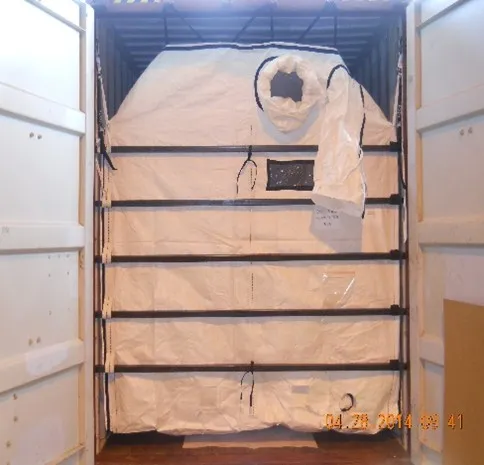
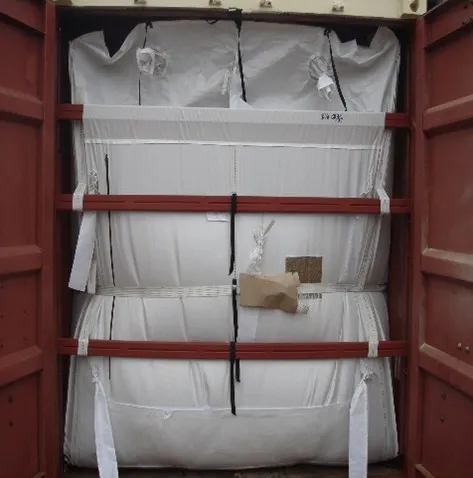
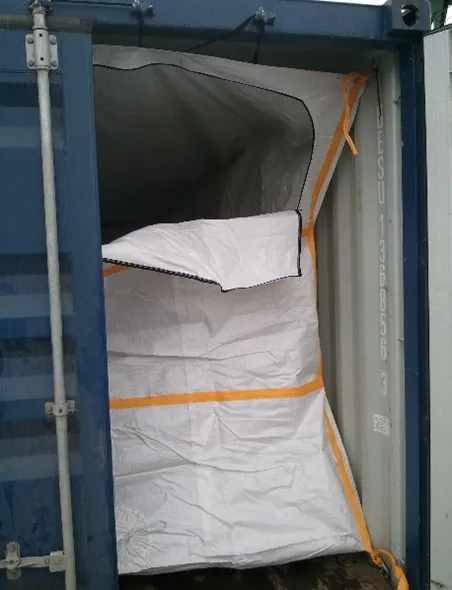
A dry bulk container liner provides the functional separation that a standard steel container does not offer. It seals the cargo against the container walls, blocks condensation formed by temperature differences during ocean or rail transit, and prevents residue from previous shipments from contacting the product. For operators moving construction powders in ISO containers, this reduces cargo loss, protects container condition, and supports cleaner discharge. ISO 668 defines the Series 1 freight container dimensions and maximum gross mass benchmarks that liner sizing must follow [2]. A 20ft general purpose container and a 40ft high cube container require different liner dimensions, wall lengths, and spout positions, so dimensional matching is a basic engineering step rather than a purchasing convenience.
The shift from bagged to lined bulk transport also changes handling economics. For example, a cement exporter moving from 25 kg bags to a lined 20ft container can reduce packaging waste, cut manual handling hours, and maintain a cleaner loading area. The same principle applies to gypsum, fly ash, and powdered lime: the liner becomes the working boundary that keeps the product contained from filling to discharge.

Liner Types and Material Selection for Construction Cargo
Container liners for construction materials generally fall into woven, coated woven, and PE film categories. Each type has a different balance of strength, moisture resistance, dust tightness, and cost.
Woven HDPE liners provide high tensile strength and tear resistance. The woven substrate is the load-bearing layer, while coatings or lamination control permeability. Uncoated woven liners are sometimes used for granular materials that require air circulation, but most construction powders require a coated or laminated structure to prevent fine particle loss and moisture ingress.
PE-coated woven liners combine the strength of woven HDPE with a polyethylene coating or lamination on one or both sides. For powder cargoes such as cement, lime, talc, and plastic powder, sift-proof performance depends on seam engineering. Giant Flexpack’s DBL-W06 woven sift-proof container liner uses double-sided PE coating and PU-tape sealed seams. The manufacturer’s specification states 100% sift-proof performance for particle sizes at or above 50 mesh, with tensile strength of at least 1,800 N/5cm in the warp direction and 1,600 N/5cm in the weft direction. This type is suitable for many neutral and alkaline construction powders, though it is not intended for strong acids or alkalis.
PE film liners are the lightest and most cost-efficient option for high-purity or moisture-sensitive construction minerals. The smooth LDPE surface helps powders slide during discharge and prevents product adhesion. The manufacturer’s DBL-F01 PE film container liner provides 100% moisture and dust barrier performance with specified load capacities from 15 to 35 tons depending on liner size and film specification. This type is commonly selected for gypsum powder, kaolin clay, bentonite, and other fine mineral cargoes where a clean surface and reliable discharge are priorities.
| Construction Material | Common Form | Primary Risk | Recommended Liner Type |
|---|---|---|---|
| Cement | Fine powder | Moisture caking and sift leakage | PE-coated woven sift-proof liner with sealed seams |
| Sand and aggregate fines | Granular or powder | Abrasion and dust | Woven HDPE liner with high tensile strength |
| Gypsum powder | Fine powder | Moisture setting and dust | PE-coated woven or PE film liner |
| Lime powder | Fine alkaline powder | Dust, moisture, and reactivity | Sift-proof woven liner with PU-taped seams |
| Fly ash | Ultra-fine powder | Leakage and moisture | Sift-proof liner with fine-particle barrier |
| Kaolin clay | Fine powder | Moisture contamination and caking | PE film or food-grade PE-coated woven liner |
| Bentonite | Fine clay powder | Moisture expansion | High-barrier PE film liner |
| Pigment and iron oxide | Fine colored powder | Cross-contamination and product loss | Dedicated PE film liner with smooth discharge surface |
For cement and lime powder programs, the DBL-W06 woven sift-proof liner offers sealed seams and controlled dust emission. For gypsum, clay, and pigment applications, the DBL-F01 PE film liner provides a smooth, moisture-blocking surface. Review the woven dry bulk container liner range or contact [email protected] or +86 523 87683880 for a specification recommendation matched to your material and route.

Application-Specific Liner Requirements by Construction Material
Cement and lime demand the highest level of sift control because both materials generate fine dust under loading pressure. Liner seams should be taped or heat-sealed, not merely stitched, and the discharge spout should support clean gravity or pneumatic extraction. For cement, side-wall pressure during loading means the liner must have sufficient fabric strength and adequate securing points to distribute force.
Gypsum and fly ash are finer and more sensitive to humidity. Both can cake when relative humidity inside the container remains high for extended periods. A moisture-blocking liner with a smooth inner surface supports more complete discharge and reduces residue. Loading crews should verify that the filling spout is correctly sealed after loading to prevent humid air from entering during transit.
Sand and aggregate fines are abrasive. The liner should be selected for tear resistance and puncture resistance, especially if the material has sharp or angular particles. Woven HDPE substrates generally perform better than unsupported PE film in high-abrasion applications.
Clay and bentonite gain volume when exposed to moisture. This can create dangerous internal pressure if the liner does not allow safe discharge or controlled venting. The liner supplier should confirm the moisture vapor transmission rate, the loading volume, and the discharge method before the first shipment. Pigments and iron oxides require dedicated or high-cleanliness liners to avoid color contamination and product loss across multiple shipments.

Loading, Discharge, and Transport Best Practices
Before installation, the empty container must be inspected for sharp edges, loose flooring, protruding nails, and residual cargo. The CTU Code provides the baseline inspection and packing principles for safe cargo transport units [1]. A liner installed over an unprepared floor or against a damaged wall will fail at the point of stress, not because of liner material weakness.
During loading, flow rate and fill level should be controlled according to the liner manufacturer’s instructions. Overfilling risks rupture at the seams and side walls, while underfilling can cause excessive cargo movement. The liner’s internal securing system, lifting loops, and anti-slip base are designed to keep the filled structure stable inside the container. Operators should confirm that all securing points are in place before closing the doors.
Discharge methods for construction materials include gravity, pneumatic, and manual systems. Gravity discharge through a bottom spout works well for free-flowing materials, while pneumatic discharge is common for fine powders such as cement and fly ash. Pneumatic pressure must be kept within the liner manufacturer’s rated limits to avoid burst damage. The discharge spout should be correctly positioned over the receiving hopper, and the liner should be inspected after discharge for retained powder or seam stress.
Moisture control is the underlying requirement across all construction material shipments. Because container walls cool and warm during long-haul transport, condensation can form on steel surfaces and migrate into the cargo. A properly sealed liner acts as the primary barrier, but shippers should also consider transit time, route climate, and whether desiccants are needed for highly moisture-sensitive cargo such as gypsum or bentonite.

Compliance, Quality Control, and Supplier Evaluation
Construction material liners used in international trade should be supported by an effective quality management system. ISO 9001:2015 provides a framework for consistent manufacturing, inspection, and traceability [3]. Buyers should ask for current certificates, test reports, and material traceability rather than relying on a supplier statement alone.
For shipments entering the European Union, REACH Regulation (EC) No 1907/2006 governs chemical safety and requires that substances and articles placed on the EU market meet registration, authorization, or restriction requirements [4]. RoHS Directive 2011/65/EU restricts certain hazardous substances, and while it is most commonly associated with electronics, it is also relevant for packaging materials supplied into regulated supply chains [5]. If construction minerals may be used in food-adjacent, potable water, or pharmaceutical-grade applications, food-contact requirements such as U.S. FDA 21 C.F.R. § 177.1520 for olefin polymers should be reviewed [6].
Supplier evaluation should also cover production capacity, seam strength testing, seal integrity testing, load capacity confirmation, and the supplier’s experience with construction powders. A reliable supplier should be able to recommend the correct liner type for the cargo density, particle size, discharge method, and destination climate. Requesting a technical data sheet, a sample liner, and a documented installation checklist reduces the risk of field failure.
Ready to Specify Your Construction Material Liner
Construction material shipping requires a liner that matches the cargo’s particle size, moisture sensitivity, loading pressure, and discharge method. For tailored dry bulk container liner solutions—including sift-proof woven liners and PE film liners for cement, gypsum, lime, clay, and mineral powders—contact Giant Flexpack at [email protected] or +86 523 87683880. Explore the woven dry bulk container liner and PE film container liner ranges for construction-grade dry bulk transport.
Frequently Asked Questions
Which container liner type is best for cement and lime powder?
A PE-coated woven liner with sealed seams is generally the best choice for cement and lime. The woven HDPE substrate provides tensile strength, while the PE coating and taped seams reduce fine dust leakage. A sift-proof liner such as the DBL-W06 is engineered for powdery materials and is suitable for many neutral and alkaline powders.
Can dry bulk container liners be reused for construction materials?
Reuse depends on the liner type, cargo, and discharge conditions. Some woven liners can be cleaned and reused if they remain structurally sound, but powder cargoes such as cement, lime, and gypsum can abrade or contaminate the liner surface. Buyers should follow the manufacturer’s guidance and never reuse a liner that shows seam stress, puncture, or retained chemical residue.
What load capacity should be expected for construction material liners?
Load capacity depends on the liner construction, fabric weight, container size, and cargo density. Manufacturer-rated dry bulk container liners commonly support from 15 to 35 tons depending on specification, with heavy-duty woven liners rated up to 40 tons for some powder applications. The final payload must also respect the container’s maximum gross mass limit under the applicable transport regulations.
How are construction material liners discharged?
Construction material liners are usually discharged by gravity through a bottom spout, by pneumatic equipment for fine powders, or by manual methods for smaller batches. Gravity discharge works well for free-flowing materials, while pneumatic discharge is common for cement, fly ash, and other fine powders. The discharge method should be confirmed with the liner supplier before ordering because spout size, position, and pressure limits vary by design.
How do container liners prevent moisture damage in construction powders?
A properly sealed liner acts as a barrier between the cargo and the container walls, preventing condensation from reaching the powder. This is critical for cement, gypsum, and clay-based minerals that cake or harden when wet. The liner also blocks humid ambient air from entering through seams or filling points, helping maintain product quality during long-haul ocean and rail transport.
References
[1] IMO/ILO/UNECE, Code of Practice for Packing of Cargo Transport Units (CTU Code), 2014.
[2] ISO 668:2020, Series 1 Freight Containers — Classification, Dimensions and Maximum Gross Mass, International Organization for Standardization.
[3] ISO 9001:2015, Quality Management Systems — Requirements, International Organization for Standardization.
[4] Regulation (EC) No 1907/2006 concerning the Registration, Evaluation, Authorisation and Restriction of Chemicals (REACH).
[5] Directive 2011/65/EU on the restriction of the use of certain hazardous substances in electrical and electronic equipment (RoHS).
[6] U.S. Food and Drug Administration, 21 C.F.R. § 177.1520, Olefin Polymers.
From insight to product selection
Related products
Explore these packaging options, then confirm suitability for your cargo, dimensions and shipping conditions.
Tell us about your shipment
Discuss your packaging requirements
Tell us what you ship and how you ship it. Add the container or pallet size, route and any moisture or temperature concerns so we can discuss an appropriate packaging option.