Packaging Insights
Mining Bulk Shipping: Container Liner Applications Explained
Minerals and mined commodities such as kaolin clay, alumina, silica sand, titanium dioxide pigment, cement, lime powder, and mineral concentrates often move by container when shipment size, route structure, or contamination control favors containerized bulk handling over bagged or bulk carrier alternatives. A well-specified dry bulk container liner protects these cargoes from moisture, dust, and cross-contamination while making loading and discharge more efficient.
A liner does not replace regulatory classification or sea transport documentation. Mineral concentrates that fall under the International Maritime Solid Bulk Cargoes (IMSBC) Code still require shipper declarations and, where applicable, compliance with transportable moisture limits and other cargo-specific requirements [1]. The liner supports clean transport; the shipper remains responsible for declaring the cargo correctly.

Why Mining Bulk Shipments Need Container Liners
Mining cargoes commonly face four risks in a steel shipping container: condensation, contamination, dust loss, and handling damage. Warm, moisture-laden air inside a container can condense against cold steel surfaces during ocean transit, and fine mineral powders can absorb that moisture, causing caking, strength loss, or color shifts. Liners with a moisture barrier reduce contact between cargo, container walls, and condensate.
Contamination works in both directions. Residues from a previous load can discolor white minerals such as kaolin or titanium dioxide, while fine dust from the current cargo can escape seams and contaminate the container or surrounding work areas. Sift-proof seams and coated fabric mitigate this. Liner systems with top loading spouts, bottom discharge spouts, and lifting loops also simplify transfer by pneumatic, auger, or gravity equipment and reduce manual handling.
Matching Liner Construction to Mineral Cargo
The correct liner starts with a cargo profile: particle size, bulk density, moisture sensitivity, abrasiveness, and any purity or regulatory requirement. The table below summarizes common starting points.
| Mineral cargo | Primary risk | Liner construction to evaluate | Useful specification points |
|---|---|---|---|
| Kaolin clay and white minerals | Moisture, discoloration, contamination | PE film or coated woven liner | Smooth surface, moisture barrier, optional food-grade |
| Alumina powder | Abrasion, dust, sifting | Heat-welded sift-proof woven liner | Sealed seams, dustproof covers, high tensile |
| Silica sand and mineral sands | Abrasive weight, dust | 140 gsm or heavier woven PE | High warp/weft tensile, anti-slip base |
| Titanium dioxide and pigments | Contamination, discoloration | Smooth PE film or coated woven liner | Clean-loading surface, controlled discharge |
| Cement and lime powder | Moisture, dust, sifting | Sift-proof coated woven liner | Sealed seams, closed loading/discharge ports |
| Mineral concentrates | Moisture, regulatory classification | Moisture-resistant liner plus IMSBC compliance | Cargo-specific moisture limits, shipper declaration |
This table is a selection starting point, not a final specification. Confirm liner dimensions, discharge configuration, and material compatibility against the actual cargo and route. As a reference, a standard woven dry bulk liner made from 140 gsm HDPE fabric typically offers warp tensile strength around 1,800 N/5 cm and load capacity from 10 to 30 tons depending on container size and cargo density.
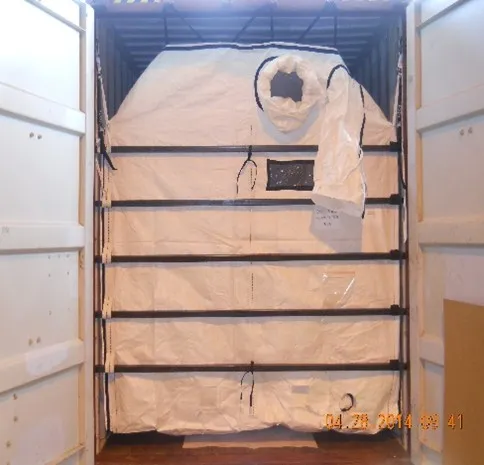
For many dry mineral loads, a 140 gsm HDPE woven liner with top loading and bottom discharge openings provides a reliable baseline of strength and contamination control. <DBL-W01 Dry Bulk Container Liner covers standard woven specification, load ratings, and certification options.

Controlling Moisture, Dust, and Cross-Contamination
Moisture management is usually the highest-stakes variable for mining shipments. A dry bulk liner acts as a barrier between the cargo and the container structure, limiting direct contact with condensation and reducing the amount of moisture the cargo can absorb during temperature swings. For high-purity or strongly hygroscopic minerals, coated or laminated woven liners or PE film liners are commonly preferred.
Dust and sifting control matter for both cargo loss and workplace safety. Fine powders can escape through needle holes, seam gaps, or loose closures. Heat-welded construction and PU tape-sealed seams reduce leakage paths, while closed loading and discharge covers help keep dust inside the system. Cross-contamination is controlled by using a clean, dedicated liner for each load and by specifying liners with smooth internal surfaces for materials that must not retain residue. The IMO/ILO/UNECE CTU Code provides practical guidance on packing, load distribution, and securing of cargo transport units [2].
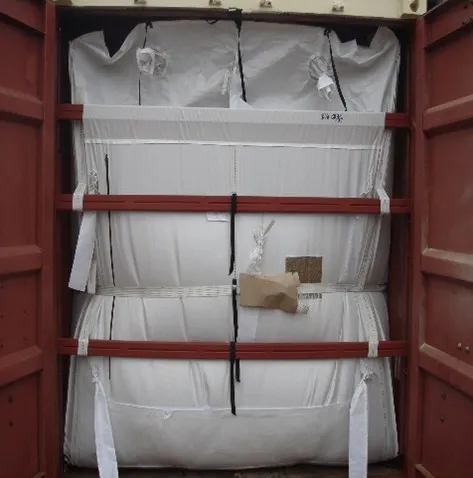
For fine mineral powders such as kaolin, lime, and pigment-grade fillers, seam leakage can create cargo loss, dust exposure, and cross-shipment contamination. <DBL-W06 Woven Sift-Proof Container Liner covers PU tape-sealed seams and coated fabric options for sift-prone cargo.
If you are reviewing liner options for a specific mineral, email [email protected] with the cargo type, particle size, moisture content, and target container or wagon size to receive a focused recommendation.
Road, Rail, and Sea Transport Considerations
Each transport leg imposes different forces. Ocean freight exposes cargo to long-duration humidity changes, salt air, and condensation cycles, so six-wall coverage and a consistent moisture barrier are important. Road and intermodal moves introduce vibration and handling shocks, which place stress on seams, lifting loops, and fixed points. Rail transport adds sustained vibration and shunting impacts, especially for dense, abrasive materials.
Abrasive cargoes such as alumina or silica can wear through lighter films during rail or road vibration. Heat-welded wagon liners remove stitched seams and reduce pinhole risk, and they are designed for rail wagon dimensions rather than standard ISO containers. Container liners should also match the actual equipment: 20ft, 40ft, and 40HQ units have different internal geometry, and ISO 1496-1 defines the structural and dimensional framework for Series 1 freight containers [3]. Specify the liner to the container type, not a generic “container” size.
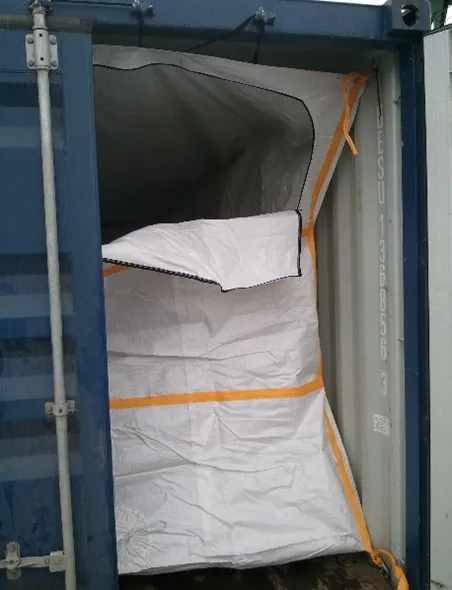
For alumina and other industrial powders moving by rail from mine or processing site to port, a heat-welded wagon liner reduces leakage and dust loss under sustained vibration. <DBL-04W Wagon Liner covers seamless construction, rail wagon sizing, and load ratings for heavy industrial minerals.

Regulatory, Quality, and Supplier Evaluation Checklist
Quality and regulatory expectations for mining shipments vary by destination and end use. A manufacturer’s quality management system should follow ISO 9001:2015 so that raw material traceability, process control, and nonconformance handling are systematic [4]. For shipments entering the European Union, REACH compliance is relevant for chemical substances and materials used in packaging [5]. Where mined materials may enter food, pharmaceutical, or feed ingredient chains, food-contact statements may be required; for polyolefin-based liners, U.S. FDA 21 CFR 177.1520 is a common reference [6].
Before selecting a supplier, request documentation that can be verified rather than relying on product claims alone. Useful items include:
- Liner specification sheet matched to the cargo profile and transport equipment
- Tensile strength, elongation, and moisture or gas transmission test reports
- Details of seam construction: heat-welded, coated, or tape-sealed
- Load rating and lifting loop or fixing point capacities
- Quality system certification such as ISO 9001
- REACH, RoHS, or food-contact declarations where applicable
- Loading and discharge configuration drawings for the intended route
A structured technical review is usually more useful than a price-only comparison. Send the draft cargo profile and destination-market requirements to a liner manufacturer, and ask for a written specification proposal before comparing unit costs.
Plan Your Mining Liner Specification
Giant Flexpack (Taixing) Co., Ltd. supplies dry bulk container liners for mineral, chemical, and industrial bulk transport, including woven liners, sift-proof liners, PE film liners, and rail wagon liners. To receive a technical review or quotation, email [email protected] or call +86 523 87683880.
Please include the following information in your inquiry:
- Mineral or powder type and particle size distribution
- Bulk density and expected load per container or wagon
- Moisture content and any food-contact or purity requirement
- Transport route and equipment: 20ft, 40ft, 40HQ, or rail wagon
- Loading and discharge method: top loading, gravity, pneumatic, or auger
- Destination-market certifications or compliance requirements
Frequently Asked Questions
Which container liner is best for mineral powders?
Fine mineral powders usually benefit from sift-proof construction. PE-coated woven liners with sealed seams work well for many powders, while PE film liners with smooth surfaces are often preferred when residue release and clean discharge are critical.
Can container liners handle abrasive cargo such as alumina or silica sand?
Yes, when the fabric and seams are specified for abrasion. Heavier woven fabrics, heat-welded construction, and high-tensile seams perform better under the vibration and contact loads of dense abrasive materials.
How do liners prevent moisture damage in mining shipments?
They provide a physical barrier between cargo and container walls, reducing contact with condensation and limiting the moisture the cargo can absorb during temperature changes. Coatings or laminations improve this barrier; liners do not remove the need to manage cargo moisture content before loading.
What certifications should mining buyers require?
The essential baseline is a supplier quality system such as ISO 9001. Depending on destination and end use, REACH, RoHS, or food-contact declarations may also be relevant. Ask for the specific standard or test report that supports each claim.
Can container liners be used for rail-to-port alumina transport?
Yes. Heat-welded wagon liners are designed for rail wagon dimensions and can reduce dust loss and leakage on the rail leg. The liner should be specified to the wagon size, loading system, and discharge equipment used at the port.
References
[1] International Maritime Organization, International Maritime Solid Bulk Cargoes (IMSBC) Code, 2023 ed. London, U.K.: IMO Publishing, 2023.
[2] IMO, ILO, and UNECE, Code of Practice for Packing of Cargo Transport Units (CTU Code). Geneva, Switzerland: UNECE, 2014.
[3] ISO 1496-1:2013, Series 1 Freight Containers — Specification and Testing — Part 1: General Cargo Containers for General Purposes. Geneva, Switzerland: ISO, 2013.
[4] ISO 9001:2015, Quality Management Systems — Requirements. Geneva, Switzerland: ISO, 2015.
[5] European Parliament and Council, Regulation (EC) No 1907/2006 concerning the Registration, Evaluation, Authorisation and Restriction of Chemicals (REACH). Brussels, Belgium: Official Journal of the European Union, 2006.
[6] U.S. Food and Drug Administration, 21 CFR 177.1520, Olefin Polymers. Washington, DC: U.S. Government Publishing Office.
From insight to product selection
Related products
Explore these packaging options, then confirm suitability for your cargo, dimensions and shipping conditions.
Tell us about your shipment
Discuss your packaging requirements
Tell us what you ship and how you ship it. Add the container or pallet size, route and any moisture or temperature concerns so we can discuss an appropriate packaging option.