
Packaging Insights
Preventing Discoloration of TiO2 During Container Transport
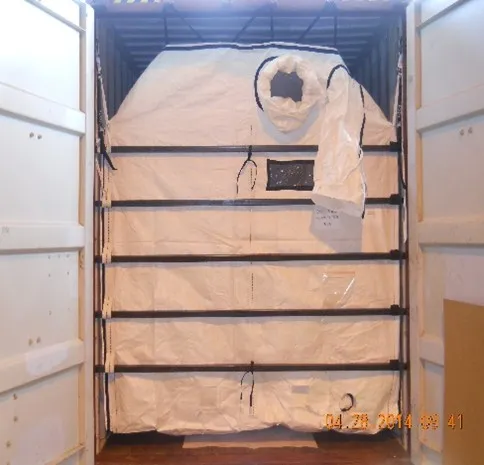
Titanium dioxide (TiO2) is one of the most widely used white pigments in global industry, but its commercial value depends on consistent color purity and stable optical performance. A single bulk container shipment that develops discoloration can turn a high-grade pigment into an off-spec product, triggering rejection, rework, or contractual penalties. Bulk TiO2 transport in ISO containers presents specific risks: condensation, cross-contamination from residual cargo, excessive heat, and abrasive handling. Most discoloration incidents are preventable when shippers use a purpose-built liner system, correct loading procedures, and disciplined pre-shipment inspection.
Why TiO2 Discolors in Container Transport
TiO2 pigment is not chemically aggressive, but it is physically and optically sensitive. Discoloration during transit typically results from four interacting factors:
- Moisture and condensation — the most common cause
- Metallic or carbon contamination from container walls, residual cargo, or low-quality liners
- Sustained high temperatures that accelerate degradation of organic surface treatments
- Particle abrasion and residue mixing during loading and unloading
Each factor can be controlled. The starting point is understanding what actually happens inside a closed container during a multi-week ocean voyage.
Moisture and Condensation: The Primary Risk
TiO2 is often shipped as a fine powder with a bulk density between 0.4 and 0.9 g/cm³ depending on grade. While dry TiO2 itself is not highly hygroscopic, its surface is frequently treated with alumina, silica, or organic coatings to improve dispersion and weather resistance. Those surface treatments can hydrolyze when exposed to moisture, causing pigment particles to agglomerate, cake, and shift away from bright white.
The real problem is the container rain effect. A closed container loaded in a humid climate will trap warm, moisture-laden air. As the vessel crosses cooler ocean zones or experiences day-night temperature swings, the container walls cool below the dew point. Water condenses on the ceiling and side walls, then drips onto the cargo. Even small amounts of liquid water can create localized discoloration, hard lumps, and mold growth on the liner surface.
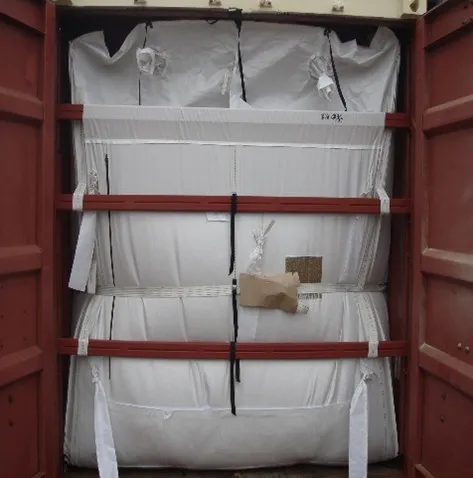
A high-barrier container liner is the first line of defense. For TiO2, a PE film container liner made from 140-micron LDPE provides a 100% moisture and dust barrier, preventing both external water ingress and internal moisture migration. Smooth film surfaces also reduce product adhesion, which helps avoid residue buildup that can later bake onto hot container walls and cause yellowing.
Contamination Risks from Container Liners and Residual Cargo
TiO2 is exceptionally sensitive to trace metallic contamination. Iron oxide particles from rusted container walls, carbon fines from previous coal or graphite shipments, or colored residues from recycled plastics can all impart a gray, yellow, or brown tint. Because TiO2 pigment is white, even a small amount of dark contaminant is highly visible.
Two common mistakes lead to contamination:
- Reusing an unapproved liner that previously carried colored powder, organic pigments, or industrial chemicals. Residual fines can migrate into the TiO2 during loading, discharging, or transit movement.
- Using a liner made with recycled content or without proper seam sealing. Loose fibers, pinholes, and open stitching allow external dust and rust particles to enter the cargo space.
For powdered TiO2, a sift-proof woven container liner is the appropriate direct-contact layer. The DBL-W06 uses 140 gsm HDPE woven fabric with double-sided PE coating and PU tape-sealed seams, achieving 100% sift-proof performance for particles of 50 mesh and finer. This prevents both product loss and external contamination. It is resistant to most neutral and alkaline powders and can be supplied in food-grade variants when required.
Heat and Temperature Fluctuations
Sustained high temperatures can cause organic surface treatments on TiO2 to oxidize or degrade, leading to gradual yellowing over a multi-week voyage. More importantly, temperature fluctuations drive condensation even when the cargo itself is dry.
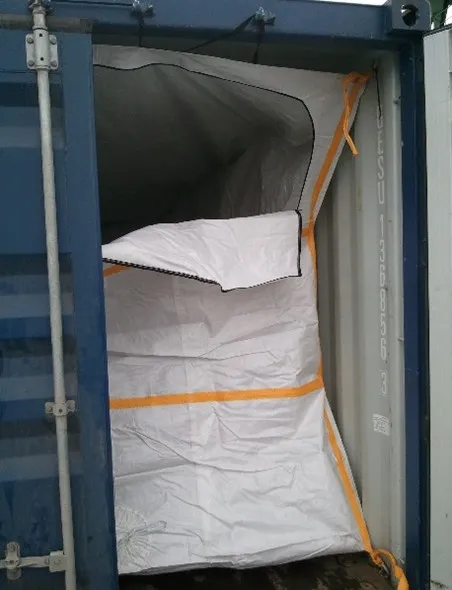
A container exposed to direct sunlight on deck can see internal temperatures exceed 60°C. A thermal container liner placed against the container walls buffers those extremes. The GewenChamp™️ EPE foam thermal container liner uses a four-layer construction of PET aluminum foil, woven PE, 3 mm EPE foam, and a second PET aluminum foil. It has a thermal conductivity of ≤0.038 W/(m·K) and a moisture vapor transmission rate of ≤0.033 g/(m²·h·kPa). This reduces radiant heat gain and slows temperature swings, which in turn lowers the risk of condensation and thermal degradation.
Liner Selection for TiO2 Bulk Shipments
No single liner is right for every TiO2 grade and route. The table below summarizes the most effective combinations.
| Liner Type | Key Features | Why It Protects TiO2 | Recommended Product |
|---|---|---|---|
| Sift-proof woven container liner | 140 gsm HDPE + PE coating + PU sealed seams; 100% sift-proof for ≥50 mesh | Blocks external contamination, prevents powder leakage, withstands abrasive discharge | DBL-W06 |
| PE film container liner | 140-micron LDPE; 100% moisture and dust barrier; smooth non-stick surface | Stops moisture migration, reduces residue, available food-grade | DBL-F01 |
| EPE foam thermal container liner | PET aluminum foil / woven PE / 3 mm EPE / PET aluminum foil | Reduces temperature peaks, lowers condensation risk, protects organic surface treatments | GewenChamp™️ TL-02 |
For high-value TiO2 grades on long-haul routes, a multi-layer approach often delivers the best result: install a thermal liner against the container walls, then use a food-grade PE film or sift-proof woven liner as the direct product contact layer. This combines temperature buffering with a dedicated contamination and moisture barrier.
Pre-Shipment and Loading Best Practices
Even the best liner will not protect cargo if the container is not prepared correctly. Before loading TiO2:
- Inspect the container for rust, holes, dents, and residues from previous cargo. Reject any container with visible corrosion or chemical odor.
- Confirm the liner is correct for the grade — food-grade TiO2 for human or pharmaceutical use requires FDA-compliant or equivalent certified liner material.
- Check seam integrity and spout seals. Look for pinholes, open stitching, or torn spouts before installation.
- Test product moisture content before loading. If the TiO2 moisture content is above the supplier specification, pre-drying may be required.
- Use dry, oil-free compressed air for pneumatic loading. Moisture or oil droplets in air lines can cause immediate localized discoloration.
- Close and seal the loading spout immediately after filling. Secure the discharge spout to prevent accidental opening during transit.
- Avoid loading during rain or high humidity unless the loading area is enclosed.
- Consider adding desiccant packs as a supplementary measure for routes with extreme temperature swings, but do not rely on desiccants as a substitute for a proper moisture barrier liner.
Frequently Asked Questions
Can moisture alone discolor TiO2 without any contaminant present?
Yes. Moisture can hydrolyze alumina or organic surface treatments on the pigment, causing agglomeration and a dull, off-white appearance. Container rain can also create hard lumps that cause customer rejection even if the chemical composition is unchanged.
What liner material is safest for direct contact with TiO2?
Food-grade PE film or HDPE woven fabric with food-grade PE coating is best. Both provide a clean, chemically inert contact surface. Avoid liners with recycled content, loose fibers, or unsealed sewing seams.
Do I need a thermal liner for TiO2?
Not always. If the shipping route is short, temperate, and free from extreme heat, a moisture barrier liner may be sufficient. For long-haul ocean voyages through tropical or high-temperature zones, a thermal liner significantly reduces heat-related yellowing and condensation risk.
How should I inspect a container liner before loading TiO2?
Check for visible pinholes, open seams, torn spouts, and foreign particles inside the liner. Ask the supplier for third-party test reports covering sift-proofness, moisture vapor transmission, and food-contact compliance.
What is a typical TiO2 bulk load in a 40ft container?
Depending on bulk density and liner specification, a 40ft high cube container can hold approximately 20 to 40 metric tons of TiO2. The liner must be rated for the full load weight and discharge method.
Protect TiO2 Color Integrity with a Certified Liner System
Giant Flexpack (Taixing) Co., Ltd. is a Sino-American joint venture established in 2004, specializing in thermal packaging technology and high-performance dry bulk container liners. Our product range includes food-grade PE film liners, sift-proof woven liners for fine powders, and GewenChamp™️ thermal insulation liners certified to FDA, LFGB, ISO9001, REACH, and RoHS standards.
For TiO2 bulk transport, we provide liner specification support, third-party testing documentation, and customized sizing for 20ft, 40ft, and 40HQ containers. To discuss your specific TiO2 grade, route, and loading equipment, contact our technical team at [email protected] or +86 523 87683880. We will help you select and validate the liner system that keeps your pigment bright, dry, and uncontaminated from loading port to final destination.
From insight to product selection
Related products
Explore these packaging options, then confirm suitability for your cargo, dimensions and shipping conditions.
Tell us about your shipment
Discuss your packaging requirements
Tell us what you ship and how you ship it. Add the container or pallet size, route and any moisture or temperature concerns so we can discuss an appropriate packaging option.