
Packaging Insights
Textile Chemical Bulk Export: Choosing Safe Container Liners
Bulk textile chemical shipments often fail through a chain of small interactions rather than a single event: moisture uptake, friction during loading, incompatible liner material, temperature cycling, or a seam that opens under pressure. In textile chemical bulk export, the container liner is not a peripheral accessory; it is a containment boundary, a contamination barrier, and a safety control.
The cargo range is broad: dye intermediates, optical brighteners, pre-treatment agents, finishing resins, softeners, anti-foams, sodium sulphate, soda ash, titanium dioxide, and specialty pigment powders. Many are hygroscopic, fine, chemically active, or classified as dangerous goods under the IMDG Code [1]. The first task in liner selection is therefore to understand the chemical, not the container.
What Makes Textile Chemical Cargo Different
Textile chemicals place more stress on bulk liners than ordinary agricultural loads. Many products are fine powders below the particle range that conventional woven liners can reliably hold. Others are hygroscopic and will cake, clump, or harden when relative humidity rises inside the container. A smaller group is aggressive enough to degrade the liner film or stitching.
Under the UN Model Regulations [2], dangerous goods classification depends on the chemical hazard profile: oxidizing solids, toxic substances, corrosive materials, or environmentally hazardous substances each carry different packing and segregation requirements. The shipper must work from the Safety Data Sheet and confirm the UN number, class, packing group, and any special provisions before assigning a liner.
Bulk textile chemicals also tend to flow poorly once moist. A liner that controls sifting but not moisture ingress may still fail the shipment by changing the physical state of the product. The liner must therefore perform two jobs at once: keep the chemical in and keep environmental moisture out.

Liner Selection by Chemical Form
The correct liner type follows the physical form and hazard level of the cargo more than the trade name of the chemical.
| Chemical form | Typical textile chemical examples | Preferred liner type | Main reason |
|---|---|---|---|
| Fine powders and pigments | dye powders, optical brighteners, pigment powders, titanium dioxide | sift-proof woven liner | sealed seams and coated fabric prevent dust loss |
| Granules and pellets | resin binders, masterbatch pellets, polymer feedstocks | PE film liner or woven bulk liner | smooth surface and moisture/dust barrier |
| General dry granules | soda ash, sodium sulphate, textile salt | woven dry bulk liner | high tensile strength for 10–30 ton loads |
| Hygroscopic powders | anti-foaming agents, finishing intermediates | PE-coated or laminated liner | blocks moisture and reduces caking |
| Aggressive acids or alkalis | strong dye auxiliaries, concentrated treatment chemicals | consult manufacturer | material compatibility must be validated |
This table is not a substitute for chemical compatibility testing. The liner manufacturer should review the SDS and confirm the fabric, coating, seam tape, and spout material are chemically compatible.
Material Compatibility and Sift-Proof Design
For fine or dusty textile chemicals, the highest-risk area is the seam. Standard stitched seams can allow fine powder to escape. In a closed container, that powder then settles on other cargo, container floors, or discharge equipment. It can trigger cross-contamination claims, worker exposure concerns, or port delays.
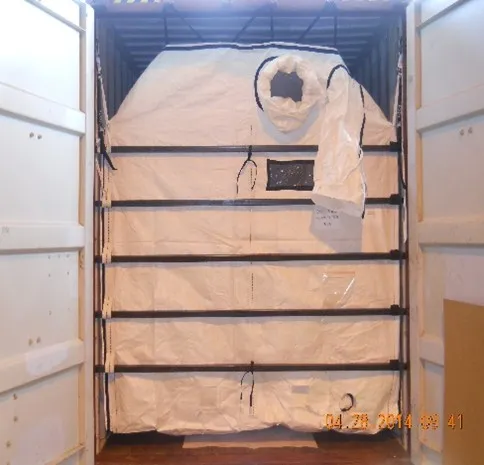
A sift-proof design addresses the seam first. The DBL-W06 woven sift-proof container liner uses a 140 gsm HDPE woven body with double-sided PE coating and PU tape sealed seams. The aim is to hold particle sizes at or above 50 mesh without leakage. The product load range is 20–40 tons, with certification under ISO 9001, REACH, and RoHS. It is suited to many neutral and alkaline powders, but is not intended for strong acids or strong alkalis. That limitation is an example of why chemical compatibility must be verified rather than assumed.
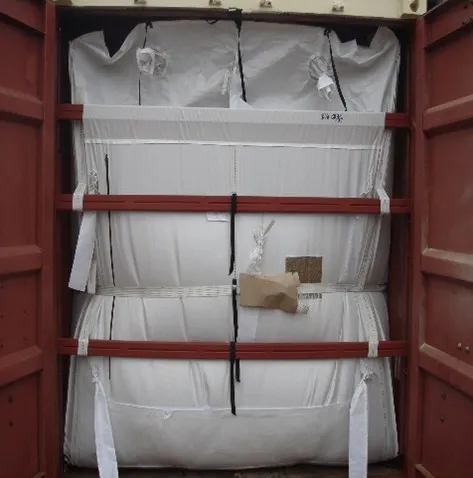
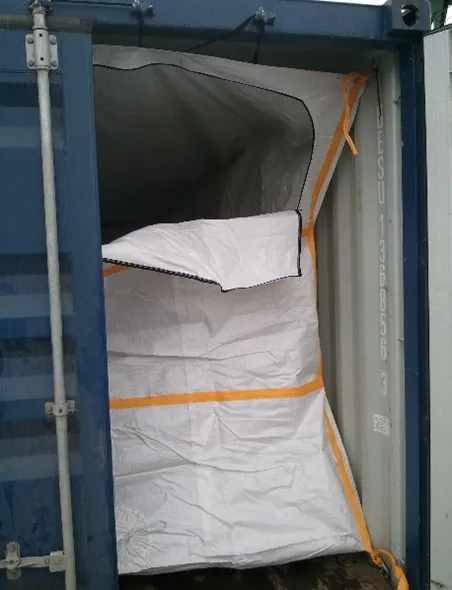
For granular textile chemical feedstocks and resin pellets, the DBL-F01 PE film container liner offers a more economical route. It uses a 140-micron LDPE film, provides a moisture and dust barrier, and avoids the adhesion problems that can occur when plastic granules settle against a rougher woven surface. The DBL-W01 dry bulk container liner remains the general-purpose choice for free-flowing dry textile intermediates.

Safety and Compliance Chain
Packaging safety for textile chemical export sits inside a larger compliance chain. The liner itself is not the only document; it must be defensible inside the shipment record.
REACH compliance matters when the chemical enters the European Union. The substance itself may require registration, authorization, or restriction, and the liner should not introduce restricted substances into the load [3]. Equally, CLP classification drives the hazard labelling, SDS format, and downstream handling controls [4]. If the textile chemical is classified as dangerous goods, the shipper must coordinate the liner with the container packing certificate, dangerous goods declaration, and any port segregation rules.
From a quality-system perspective, ISO 9001:2015 certification provides useful discipline in liner manufacturing, traceability, and batch consistency [5]. Buyers should verify that the manufacturer can provide material traceability and batch-level QC records, not only a certificate at company level.
Loading, Filling, and Discharge Controls
Even a correctly matched liner can be compromised by poor loading. The container should be inspected for nails, splinters, protrusions, or residues before liner installation. The liner should be opened carefully with no cutting tools near the fabric body. Top-loading spouts should be connected securely to the filling line, and dust extraction should be used where fine powders could create an airborne hazard.
The fill rate should be controlled to avoid air entrapment and linear stress. A liner inflated too quickly can tear at fixing points or burst a seam before the cargo settles. Load distribution matters: uneven fill can shift the liner, pull on the discharge spout, and make the discharge stage more dangerous.
Discharge should follow the liner’s designed method, whether gravity, pneumatic, or manual. Workers should avoid knives near the liner body and use the designated spout openings. For chemicals with exposure limits, the discharge area needs ventilation and the PPE identified on the SDS.

Pre-Shipment Inspection Checklist
| Check item | What to verify |
|---|---|
| SDS and UN classification | Correct UN number, class, packing group, and special provisions |
| Liner material compatibility | Fabric, coating, spout, and seam tape tested against the chemical |
| Seam construction | Sift-proof sealing method confirmed for the particle size |
| Tensile and load rating | Liner rated for the planned cargo weight |
| Spout configuration | Matches top-load or side-load equipment at origin |
| Moisture barrier | Coating or film thickness suitable for hygroscopic cargo |
| Certification chain | REACH, RoHS, ISO 9001, and any food or chemical-grade requirements |
| Container condition | Clean, dry, no protrusions or previous cargo residues |
A short pre-loading review against this list can prevent most liner-related failures before the container leaves the warehouse.
Working with a Liner Manufacturer: Key Questions
Before quoting, a reliable supplier should ask for the SDS, target route, loading equipment, discharge method, and shipment volume. If the conversation begins only with “what price per unit,” the risk assessment has not started.
Send the following to your liner manufacturer:
- The chemical’s SDS, with UN classification if applicable
- Particle size range or mesh specification
- Container type and fill weight
- Loading and discharge method
- Any EU, US, or destination-market compliance obligations
From there, the manufacturer can propose a liner type, spout configuration, and seam construction rather than offering a generic solution. If you need a compatibility review for a specific textile chemical, email the technical team at [email protected] with the SDS and loading method.
Conclusion
Container liner selection for textile chemical bulk export should be treated as a safety and quality decision, not a packaging afterthought. The right liner aligns with the chemical’s particle size, moisture sensitivity, corrosiveness, regulatory status, and loading method. When that alignment is missing, even minor condensation or seam leakage can become a rejected shipment, a contamination claim, or a safety incident.
The strongest position for an exporter is to build a short specification record: SDS, UN classification, liner material, seam type, load rating, and compliance certificates. That record makes the shipping decision auditable and repeatable across routes, seasons, and suppliers.
Contact Giant Flexpack for Textile Chemical Liner Support
Giant Flexpack (Taixing) Co., Ltd. manufactures dry bulk container liners, sift-proof woven liners, and PE film liners for chemical, resin, mineral, and food-grade bulk transport. For a textile chemical liner proposal matched to your SDS and loading system, contact the technical team:
Email: [email protected]
Phone: +86 523 87683880
Frequently Asked Questions
Which textile chemicals can be shipped in container liners?
Most dry textile chemicals can be shipped in container liners, including dye powders, optical brighteners, pigment powders, resin pellets, soda ash, sodium sulphate, and finishing intermediates. Liquids, heavy sludges, and some highly reactive chemicals fall outside standard dry bulk liner use and require separate review.
How do sift-proof liners prevent powder leakage?
A sift-proof liner combines a coated woven body with sealed seams and sealed connection points. This reduces the fine openings around stitching and film edges, helping the liner contain powders without dust escape during loading and transit.
Does a container liner need UN certification for dangerous goods?
The liner itself is not simply assigned a UN mark in isolation. Dangerous goods packaging is regulated as a system, and classification, testing, and packing requirements follow the UN Model Regulations and the IMDG Code. The liner must be compatible with the chemical and with the required outer containment.
What documentation supports textile chemical container liner export?
Typical documentation includes the SDS, dangerous goods declaration when applicable, container packing certificate, liner material compliance records, and any destination-market documentation required by the chemical. The liner supplier should provide batch-level traceability.
Can residues be cleaned so the liner can be reused?
Reuse depends on the chemical’s hazard level, residue behaviour, and liner construction. Many dry bulk liners are designed as single-trip packaging. Reuse should only follow a documented cleaning and compatibility review.
References
[1] International Maritime Organization. International Maritime Dangerous Goods (IMDG) Code, 2024 Edition. London: IMO.
[2] United Nations. Recommendations on the Transport of Dangerous Goods: Model Regulations, Rev. 23. New York and Geneva: United Nations.
[3] European Parliament and Council. Regulation (EC) No 1907/2006 concerning the Registration, Evaluation, Authorisation and Restriction of Chemicals (REACH). Official Journal of the European Union.
[4] European Parliament and Council. Regulation (EC) No 1272/2008 on classification, labelling and packaging of substances and mixtures (CLP). Official Journal of the European Union.
[5] International Organization for Standardization. ISO 9001:2015 Quality management systems — Requirements. Geneva: ISO.
From insight to product selection
Related products
Explore these packaging options, then confirm suitability for your cargo, dimensions and shipping conditions.
Tell us about your shipment
Discuss your packaging requirements
Tell us what you ship and how you ship it. Add the container or pallet size, route and any moisture or temperature concerns so we can discuss an appropriate packaging option.