
Packaging Insights
Passive Cooling Materials in Container Shipping: Performance and Limits
Passive cooling in container shipping is a thermal management strategy, not a refrigeration replacement. It slows heat gain, dampens temperature swings, and reduces condensation without a powered compressor. The result is a transport environment that protects many temperature-sensitive cargoes for a meaningful portion of the journey — provided the material stack is matched to the route, cargo sensitivity, and expected thermal load.
This article explains the materials behind thermal container liners, the performance metrics that matter, and the realistic limits of passive cooling. It also covers how to compare material systems and what to request from a supplier before committing to a liner programme.
How Passive Cooling Works in a Shipping Container
A dry shipping container is a thin steel box with high thermal conductivity. During sea freight, several heat flows act on the cargo space: solar radiation heating the roof and walls, conduction through the steel envelope, convection inside the container, and longwave radiation exchange between hot surfaces and cargo. The Code of Practice for Packing of Cargo Transport Units highlights that external weather, stowage position, and ventilation conditions directly influence the climatic stress experienced by cargo [4].
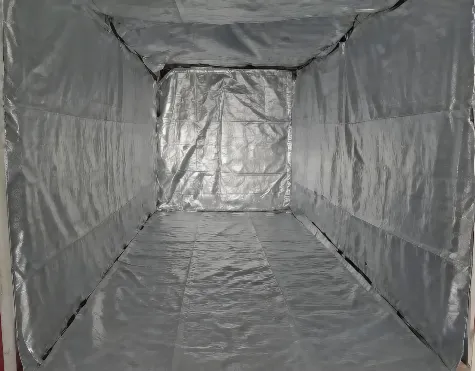
A passive thermal liner does not remove heat. It reduces the rate at which heat enters the container and slows the exchange between the container wall and the cargo space. A full six-wall liner creates a reflective and insulating boundary that works by three mechanisms: reflecting radiant heat, interrupting conductive paths, and trapping still air to reduce convective transfer.

This boundary is most effective when installed to maximise air-tightness at door seals, top corners, and floor junction points. If large gaps remain, convection paths form and passive performance drops quickly.
Material Systems Behind Passive Cooling
Thermal container liners are typically composite structures. Each layer has a distinct thermal or mechanical function. The main material categories are reflective facings, insulating cores, and moisture-control films.
Reflective Facings: Aluminum Foil and Metalized PET
Reflective facings reduce radiant heat gain. Aluminum foil or metalized PET reflects a high percentage of incident infrared radiation, which is the dominant mechanism for heat entering a container exposed to solar loading. In the GewenChamp TL-01 woven thermal liner, the laminated aluminum foil surfaces are specified to reflect 95–97% of radiant heat.
Metalized PET, used across the TL series, performs a similar function while remaining lightweight and flexible. MPET layers reflect radiant heat while also providing a smooth, low-friction surface for handling and a partial moisture barrier.
Insulating Cores: EPE Foam, Woven PE, and Bubble Layers
Between reflective facings, the core layer determines how much conductive and convective heat transfer the liner blocks.
Expanded polyethylene foam is a low-density closed-cell material with low thermal conductivity. The GewenChamp TL-02 EPE foam liner uses a 3 mm foam core with thermal conductivity of ≤0.038 W/(m·K). This low value means heat moves slowly through the foam, which matters when cargo must sit for hours or days inside a hot container.

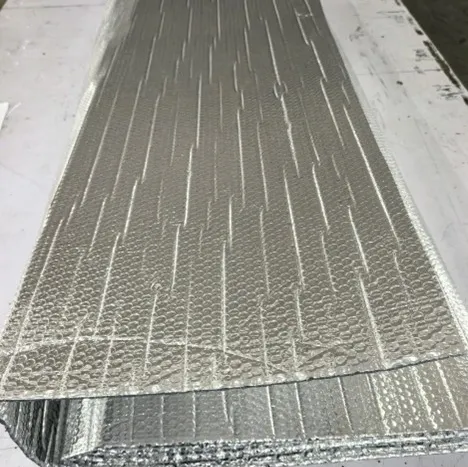
Air-filled bubble layers work on the same principle. The GewenChamp TL-03 uses a 5 mm double-bubble cushion that traps static air and adds shock absorption while the MPET layers reflect up to 98% of radiant heat.
Woven polyethylene fabric is another core material. It contributes tensile strength, tear resistance, and installation reliability. In TL-01-style liners, the woven PE layer supports the foil facings and resists stress during fitting and container movement.
Moisture Control Layers
Moisture control is inseparable from thermal performance. As air near the container wall cools, water can condense and drip onto cargo — the container rain effect. Composite liners use low water-vapour-transmission films to reduce moisture migration. The TL-02 EPE foam liner has a moisture vapour transmission rate of ≤0.033 g/(m²·h·kPa), which helps prevent humid outside air from contacting cooler internal surfaces.
Performance Metrics That Actually Matter
A single number cannot predict whether passive cooling will protect a shipment. The most useful metrics fall into five categories.
Thermal conductivity describes how well a material conducts heat. It is reported in W/(m·K). Lower values indicate better insulation. For thin flexible composites, total thickness must be considered alongside conductivity.
R-value expresses thermal resistance. It is derived from thickness and thermal conductivity under steady-state conditions. R-value is useful for comparing insulating materials, but it does not by itself predict cargo temperature over a multi-day route. Tests should follow ASTM C518 or ISO 8301 heat-flow-meter methods [1][2].
Radiant reflectance indicates how effectively a surface rejects solar-derived infrared energy. This matters more in container shipping than in many building applications because metal container panels can become intensely hot under direct sun. Values above 90% are typical for metalized facings.
Moisture vapour transmission rate measures how much water vapour passes through a film. For food, pharmaceutical, and electronics cargo, a low MVTR is a key protection against condensation, caking, mould, and corrosion.
Service temperature range defines the limits at which the liner remains mechanically stable and functional. A liner rated for -50°C to 80°C is more appropriate for extreme routes than one rated for a narrower window.
Standard container thermal requirements and general thermal-container classifications are addressed in ISO 1496-2, which provides a useful reference point for understanding thermal performance expectations [3].

Real-World Performance: What Passive Cooling Can and Cannot Do
Passive cooling performs best when the thermal load is moderate, the journey duration is limited, and the cargo has an acceptable temperature bandwidth rather than a single critical setpoint.
For example, a reflective and insulating liner can reduce the peak daytime temperature inside a container and slow nighttime cooling. The GewenChamp TL-04 MPET/PE composite liner is specified to maintain cargo between -10°C and 30°C for 24–48 hours at an ambient temperature of 25°C, extendable with ice packs for shorter controlled windows. This is sufficient for many fresh produce, standard pharmaceutical, cosmetic, and electronics loads on temperate routes.
The limits are equally clear. A passive liner cannot lower cargo below ambient temperature. It cannot actively remove heat already inside the container. On a multi-week tropical route for vaccines, chocolate, or high-value biologics, passive cooling alone is not a substitute for a reefer or a validated phase-change-material system. The CTU Code also emphasises that temperature-sensitive cargo should be packed and monitored based on the specific commodity requirements, route duration, and expected environmental conditions [4].

Passive cooling is therefore best understood as a risk-reduction layer: it narrows the temperature range, reduces peak stress, improves moisture control, and may reduce the amount of active cooling required — but it does not replace active cooling when the thermal load exceeds the liner’s buffering capacity.
Selecting Materials by Cargo and Route
The right material system depends on what the cargo tolerates and what the route imposes.
Food commodities such as cocoa beans, sugar, flour, and bulk grains require low MVTR and food-contact safety. Polyethylene-based layers intended for food contact fall under U.S. FDA 21 CFR 177.1520 for olefin polymers [5] and the EU framework set out in Regulation (EC) No 1935/2004 for materials and articles intended to come into contact with food [6].
Pharmaceutical and biological products need tight thermal buffering, moisture resistance, and full coverage with reliable door seals. Passive liners can stabilise temperature during last-mile or airport transfer windows, but shipment validation should include data loggers and route-specific testing.
Chemical, polymer, and industrial cargoes need mechanical strength and chemical compatibility. Substance restrictions under REACH [7] and hazardous-substance limits under RoHS [8] are part of the compliance picture when selecting raw materials and adhesives.
Electronics and precision goods benefit most from the combination of reflective radiation control and condensation prevention. Moisture damage is often more expensive than thermal drift for this category.
A practical material-stack comparison can be summarised as follows:
| Material stack | Primary mechanism | Typical application |
|---|---|---|
| Woven PE + aluminum foil lamination | Reflects 95–97% of radiant heat; adds tensile strength | Reusable six-wall protection for general temperature-sensitive cargo |
| PET foil / woven PE / EPE foam / PET foil | Low-conductivity foam core; ≤0.038 W/(m·K) | Food, pharmaceutical, chemical, and precision electronics shipments |
| MPET / double bubble / PET MPET | Up to 98% radiant reflection; trapped-air insulation | Frozen/fresh food, vaccines, biologics, and shock-sensitive cargo |
| MPET / PE composite film | Lightweight radiant barrier and moisture/dust membrane | Fresh produce, standard pharma, cosmetics, and electronics |
Because route-specific validation matters more than any single datasheet value, shippers should ask for ASTM C518 or ISO 8301 test reports, MVTR data, and material-compliance documentation before committing. If you are evaluating thermal container liners for a new route, send your route, cargo temperature band, and container type to [email protected] with “Passive cooling evaluation” in the subject line. The Giant Flexpack technical team can match the GewenChamp TL-01, TL-02, TL-03, or TL-04 stack to the required performance envelope and provide supporting documentation.
Sourcing and Quality Checks for Passive Cooling Liners
Before buying, request the following from the manufacturer:
- Thermal resistance or thermal conductivity test reports under ASTM C518 or ISO 8301 [1][2].
- MVTR data for the specific laminate construction.
- Tensile, seam, and tear strength results.
- Food-contact documentation such as FDA, LFGB, or EU compliance where relevant.
- Confirmation of REACH, RoHS, and ISO 9001 manufacturing quality controls [7][8].
- A clear statement of installation requirements, fitting time, and whether full six-wall coverage is achieved.

Samples should be evaluated in the container type that will be used, because fit, door closure, and corner geometry all affect performance. A liner that performs well in a controlled test chamber may still fail if it does not seal properly around the door gaskets and floor corrugations.
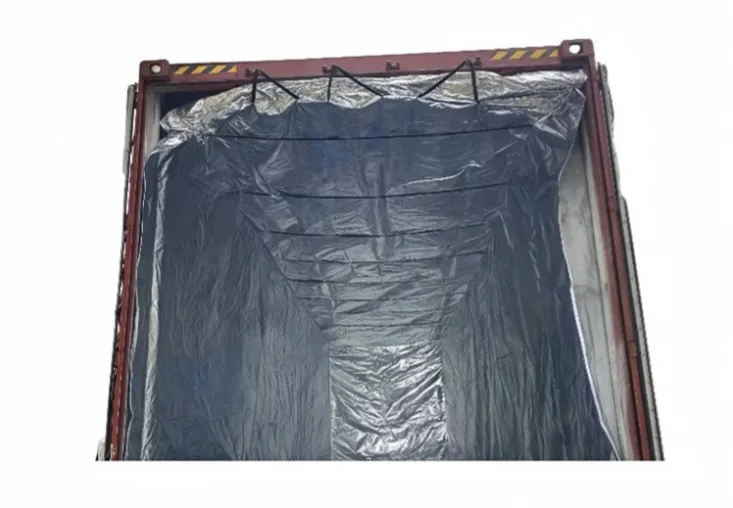
For buyers comparing material systems, the thermal insulation container liner and thermal insulation pallet cover ranges provide a practical reference for material configurations and dimensional compatibility.
From Material Selection to Route-Specific Confidence
Passive cooling succeeds when the material stack is selected as rigorously as the routing decision itself. That means moving beyond a single reflectivity percentage and instead evaluating thermal conductivity, moisture transmission, service range, certification, and installation fit together.
The most reliable process is to define the cargo’s acceptable temperature window, estimate the likely thermal load for the voyage, and then compare liner data against that envelope. Monitoring with data loggers closes the loop, revealing whether the passive system held the required conditions for the exact route and season.
Specify a Passive Cooling Liner with Confidence
Giant Flexpack (Taixing) Co., Ltd. manufactures GewenChamp thermal container liners and thermal pallet covers with FDA, LFGB, ISO 9001, REACH, and RoHS certifications. For project-specific material recommendations, test reports, or sample evaluation, contact [email protected] or call +86 523 87683880.
When submitting an inquiry, include the cargo type, required temperature band, container size, route, and voyage length. This allows the technical team to recommend a liner with realistic passive-cooling performance rather than a generic specification.
FAQ
What is the difference between passive cooling and active cold chain?
Passive cooling uses reflective surfaces, insulating cores, and phase-change or moisture-control layers to slow heat transfer without powered refrigeration. Active cold chain uses mechanical cooling, such as reefer containers, to remove heat and hold a narrow setpoint. Passive cooling dampens temperature swings; it does not create a cold source.
Which material is best for reducing condensation?
Low-MVTR facings and closed-cell cores are the most effective condensation-control layers. Foil-laminated and EPE foam systems with moisture vapour transmission values below approximately 0.05 g/(m²·h·kPa) are especially useful for food, pharmaceutical, and electronics cargo because they reduce moisture ingress and container rain.
How long can a thermal container liner hold temperature without a reefer?
It depends on the material stack, ambient conditions, cargo type, and route. A lightweight MPET/PE composite liner may maintain between -10°C and 30°C for 24–48 hours at 25°C ambient, while thicker foam composites provide stronger buffering over longer periods. For narrower setpoints or longer tropical crossings, active cooling or phase-change materials should be considered.
What tests should I request from a liner supplier?
Request thermal conductivity or thermal resistance reports under ASTM C518 or ISO 8301, MVTR data, tensile and seam strength results, food-contact certification if applicable, and evidence of REACH, RoHS, and ISO 9001 compliance. Also request a fitting trial in the actual container size.
Can passive cooling replace a reefer for food or pharmaceutical shipments?
In many short-haul and moderate-route scenarios, yes. Passive thermal liners protect a wide range of food, fresh produce, standard pharmaceutical, and chemical cargoes. For vaccines, biologics, frozen goods, or long equatorial voyages with a strict setpoint, passive cooling should be treated as a supplement to active cooling, not a replacement.
References
[1] ASTM C518-21, Standard Test Method for Steady-State Thermal Transmission Properties by Means of the Heat Flow Meter Apparatus, ASTM International, 2021.
[2] ISO 8301:1991, Thermal insulation — Determination of steady-state thermal resistance and related properties — Heat flow meter apparatus, International Organization for Standardization, 1991.
[3] ISO 1496-2, Series 1 freight containers — Specification and testing — Part 2: Thermal containers, International Organization for Standardization.
[4] IMO/ILO/UNECE Code of Practice for Packing of Cargo Transport Units (CTU Code), 2014.
[5] U.S. Food and Drug Administration, 21 CFR 177.1520, Olefin polymers.
[6] European Parliament and Council, Regulation (EC) No 1935/2004 on materials and articles intended to come into contact with food.
[7] European Parliament and Council, Regulation (EC) No 1907/2006 concerning the Registration, Evaluation, Authorisation and Restriction of Chemicals (REACH).
[8] European Parliament and Council, Directive 2011/65/EU on the restriction of the use of certain hazardous substances in electrical and electronic equipment (RoHS).
From insight to product selection
Related products
Explore these packaging options, then confirm suitability for your cargo, dimensions and shipping conditions.
Tell us about your shipment
Discuss your packaging requirements
Tell us what you ship and how you ship it. Add the container or pallet size, route and any moisture or temperature concerns so we can discuss an appropriate packaging option.