
Packaging Insights
Pharmaceutical Bulk Packaging: Temperature, Hygiene and Liner Choice
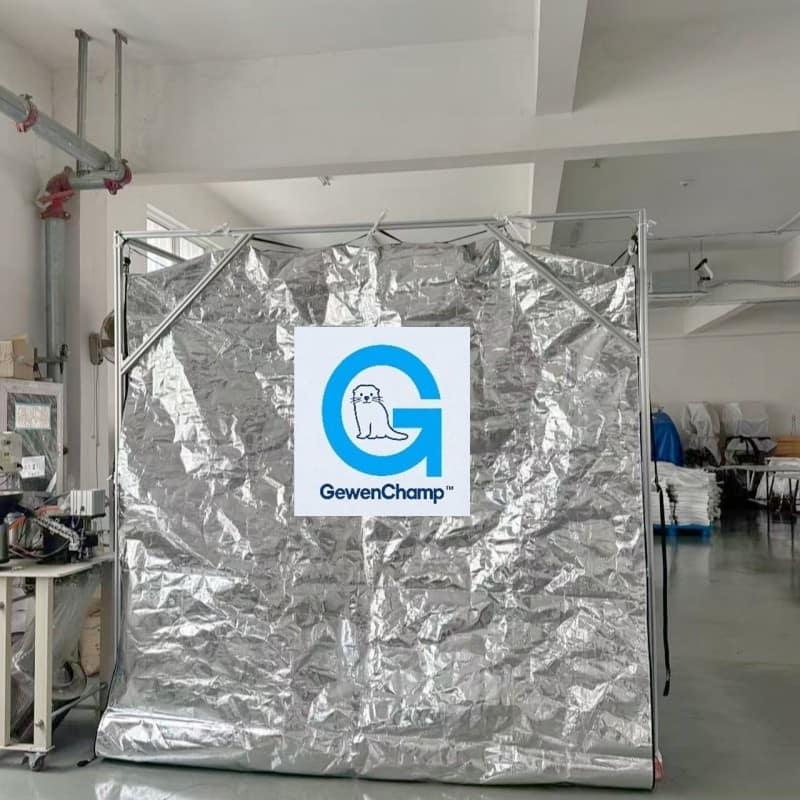
Pharmaceutical bulk shipments—APIs, excipients, granulated intermediates, or finished bulk powder for downstream processing—can lose an entire batch to a packaging decision made too early in the sourcing process. The problem is rarely the container itself. It is a liner selected for general dry cargo when the product needed a pharmaceutical-grade barrier with controlled temperature, validated hygiene, and documented compliance.
That is the focus of this guide: how temperature, hygiene, and liner choice interact in pharmaceutical bulk packaging, what specifications actually matter, and how to evaluate a container liner supplier before a single container is loaded.
Why pharmaceutical bulk packaging is not standard bulk packaging
A liner that safely moves plastic pellets or kaolin clay may be completely unsuitable for a pharmaceutical intermediate. Pharmaceutical cargo carries higher regulatory risk, narrower temperature tolerances, and far lower tolerance for contamination. Even minor condensation inside a 40ft container can promote microbial growth, cause hydrolysis of moisture-sensitive APIs, or trigger rejection at a destination audit.
Three technical factors separate pharmaceutical-grade liners from general-purpose liners:
- Temperature stability: Many pharma products require storage and transport within a defined range—often 15–25°C or 2–8°C for biologicals. Passive thermal liners can maintain these ranges without reefer energy cost, but only if the liner is engineered for the route and exposure time.
- Hygiene and extractables: Food-grade and pharma-grade liners need documented compliance with FDA, LFGB, or equivalent food-contact standards. The wrong film grade can leach contaminants or release particulates into the cargo.
- Contamination control: Fine powders, hygroscopic products, and sterile intermediates require a sealed, sift-proof environment. Gaps, pinholes, or poorly sealed seams create dust leakage, cross-batch contamination, and moisture ingress.
A pharmaceutical buyer should therefore approach liner selection the same way they approach primary packaging: as a validated, specification-driven decision—not an afterthought.
Temperature control: passive thermal liners vs reefer containers
Reefer containers are a common default for temperature-sensitive pharmaceuticals, but they are expensive and require power throughout the entire journey. On routes with cold-chain discontinuities, transshipment delays, or inland trucking legs without power, a passive thermal container liner can provide a more resilient and lower-cost layer of protection.
Passive liners work by reflecting radiant heat and slowing conductive/convective heat transfer. The material structure determines performance:
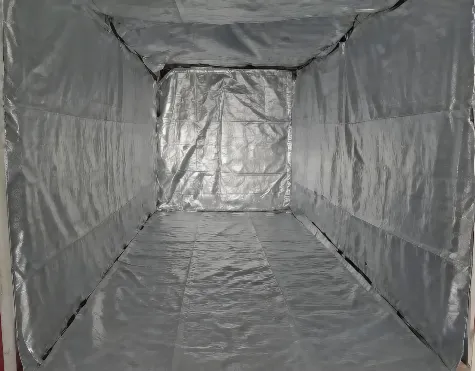
- TL-02 thermal container liner uses a 4-layer construction: PET aluminum foil, woven PE, 3mm EPE foam, and PET aluminum foil. Thermal conductivity is ≤0.038 W/(m·K), and the moisture vapor transmission rate is ≤0.033 g/(m²·h·kPa). This is the preferred choice when the cargo has strict temperature limits and condensation must be avoided.
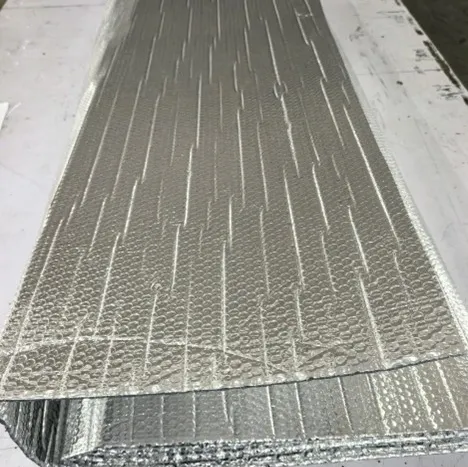
- TL-03 thermal container liner uses MPET and a double bubble cushion to reflect up to 98% of radiant heat while also dampening physical shock. It is suitable for vaccines, biologics, and high-value pharmaceutical cargo where both temperature and mechanical protection matter.
- TL-01 thermal container liner offers a balance of radiant heat reflection, tensile strength, and reusability, maintaining an internal range between -20°C and +60°C with ±5°C variance. It installs in 10–15 minutes without tools.
The key point for pharma planners: passive insulation does not make cargo colder; it slows heat transfer. If the cargo needs active cooling for days, a thermal liner alone will not be enough. But for ambient pharmaceuticals, APIs with moderate temperature tolerance, or as insurance against heat spikes and condensation on long sea routes, passive liners reduce excursion risk at a fraction of reefer cost.
Hygiene and contamination control: what pharma buyers must verify
Pharmaceutical cargo demands more than a “clean” liner. Buyers should require verifiable evidence across four areas:
- Food-contact or pharma-grade material certification. The film or coated fabric must meet FDA 21 CFR or LFGB requirements. Not all PE films are food grade, and not all woven fabrics have a food-contact inner layer.
- Barrier performance. The liner must prevent moisture vapor transfer, not just liquid water. A liner with high MVTR lets humidity reach hygroscopic powder, leading to caking, hydrolysis, or microbial growth.
- Sift-proof construction. Fine pharmaceutical powders can escape through stitched seams. A sift-proof liner uses heat-welded or PU tape-sealed seams to eliminate pinholes and dust leakage.
- Batch traceability and cleanroom packing. The supplier should maintain production lot records, raw material traceability, and controlled packing procedures. This is part of ISO 9001 quality management, but pharma buyers should ask for specific documentation, not just a certificate on the wall.
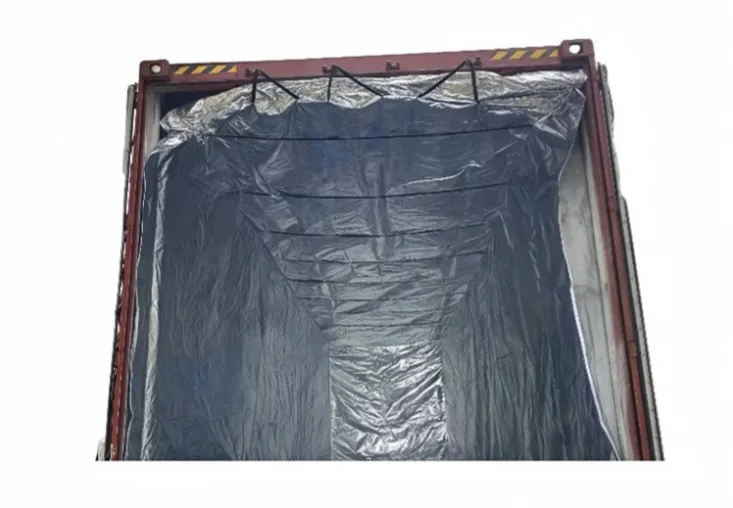
For dry powder and granule pharmaceutical cargo, the DBL-W06 woven sift-proof container liner is engineered for zero dust emission at particle sizes ≥50 mesh. All sewn seams are sealed with high-adhesion PU tape and double-sided PE coating. For less demanding but still hygiene-sensitive products, the DBL-F01 PE film container liner provides a 100% moisture and dust barrier with optional FDA-grade LDPE.
A common misconception is that “food grade” automatically means “pharmaceutical grade.” It does not. Food-contact certification demonstrates low migration and safe materials for food, but pharmaceutical buyers must also assess particle cleanliness, extractables, endotoxin levels for sterile products, and compatibility with the specific API or excipient. These are product-specific validations that should be done with the supplier’s technical team.
Liner material selection for pharmaceutical bulk cargo
The right liner depends on the dosage form, physical state, temperature sensitivity, and route profile. The table below summarizes the main options from the thermal insulation container liner, PE film container liner, and woven dry bulk container liner ranges.
| Liner type | Material structure | Best pharmaceutical use | Hygiene/certification | Temperature capability |
|---|---|---|---|---|
| TL-01 | Woven PE + double-sided aluminum foil lamination | Ambient APIs, intermediates needing moderate thermal protection | FDA, LFGB | -20°C to +60°C, ±5°C |
| TL-02 | PET aluminum foil / woven PE / 3mm EPE foam / PET aluminum foil | Heat- or cold-sensitive APIs, anti-condensation requirements | FDA, LFGB, MVTR ≤0.033 | -50°C to +80°C |
| TL-03 | MPET / double bubble / MPET | Vaccines, biologics, shock-sensitive pharma | FDA, LFGB, ISO 9001, SGS | Radiant heat reflection up to 98% |
| TL-04 | MPET / PE composite film | Standard pharmaceuticals without ultra-low temp need | FDA, LFGB, ISO 9001, SGS | -10°C to +30°C for 24–48 h |
| DBL-F01 | 140-micron LDPE film | Dry powders, granules, non-hygroscopic pharmaceutical ingredients | FDA optional, ISO 9001, REACH, RoHS | Ambient only |
| DBL-W06 | 140 gsm HDPE woven + PE coating + PU tape seams | Fine powders, sift-prone APIs, dusty excipients | ISO 9001, REACH, RoHS | Ambient only |
This table is a starting point, not a final specification. A pharmaceutical buyer should validate the liner for the specific cargo under the expected temperature profile and humidity conditions, with sample testing and migration data where required.
Matching liner choice to pharmaceutical cargo and shipping route
A few examples illustrate how the decision changes in practice:
- Moisture-sensitive antibiotic powder shipped from India to Europe via Suez Canal in summer. The risk is condensation caused by day-night temperature swings inside the container. A TL-02 thermal container liner with low MVTR and foam insulation reduces both heat transfer and condensation risk better than a plain PE film liner.
- Free-flowing granulated excipient exported from China to Southeast Asia. Cargo is not highly temperature sensitive, but humidity is high and the destination warehouses are not air-conditioned. A DBL-F01 PE film container liner with 100% moisture barrier may be sufficient, provided the film is FDA-grade and the route does not expose the cargo to extreme heat.
- Fine API powder with particle size below 100 mesh. A standard sewn liner will leak dust. The DBL-W06 woven sift-proof container liner is mandatory unless the loading and discharge system is fully enclosed and the liner is heat-welded.
The route matters as much as the cargo. A liner that performs well on a short Southeast Asia trade lane may fail on a 35-day journey through the Red Sea with transshipment delays in high-humidity ports. Buyers should ask the supplier for route-based temperature simulation or at least technical guidance on expected internal temperature swings.
Supplier qualification: documentation, testing, and technical support
When evaluating a container liner manufacturer for pharmaceutical bulk packaging, build the qualification process around five questions:
- Can you provide FDA and LFGB test reports for the exact liner construction being quoted—not only for the resin but for the finished product? Many suppliers quote raw material data without finished-product migration testing. Finished-product validation matters.
- Do you have documented batch traceability from raw material lot to finished liner? This is critical for pharmaceutical audit trails and recall scenarios.
- What is your seam construction process? For fine powders, ask specifically whether the liner is heat-welded, how seams are tested, and what particle size the sift-proof certification covers.
- Do you offer OEM/ODM customization for pharma-specific spout placement, discharge design, and anti-static or anti-UV treatments? Standard liners frequently force pharmaceutical buyers to accept compromised loading methods. A manufacturer that can modify spout position, add sealed discharge ports, or integrate filling line compatibility reduces operational risk.
- What technical support follows the sale? You need guidance on installation, loading, and troubleshooting—not just a product. Pharma supply chains run on SOPs. The supplier should help you write them.
A Sino-American joint venture like Giant Flexpack (Taixing) Co., Ltd. brings value here because the manufacturing and quality systems often combine Chinese production capacity with American management discipline. Since 2004, we have focused on thermal protection and bulk packaging. Our GewenChamp™ series is built specifically for temperature-sensitive and hygiene-critical cargo. We maintain ISO 9001, FDA, LFGB, REACH, and RoHS certifications across relevant product lines.
Common mistakes that cause pharmaceutical cargo rejection
- Choosing a standard dry bulk liner to save cost. It may lack the barrier performance, certification, or seam integrity needed for pharma. The risk cost far exceeds the liner savings.
- Ignoring condensation. Many pharma powders are hygroscopic. A liner that blocks liquid water but not water vapor fails on humid routes.
- Skipping cargo-liner compatibility testing. Extractables and leachables can differ by product pH, lipid content, and temperature. What works for one API may fail for another.
- Assuming a reefer container solves everything. Reefers manage temperature but do not solve dust, contamination, or mechanical protection. A compatible liner inside the reefer is still needed.
- Treating installation as unskilled labor. A poorly installed liner with wrinkles, gaps, or loose straps creates contamination and damage points. Supplier-provided installation training materials reduce operator error.
Frequently asked questions
Can one container liner be used for both raw pharmaceutical ingredients and finished bulk product?
Not without validation. You can reuse a liner for the same product and same transport lane, but switching products or dosage forms requires new compatibility and contamination assessment.
Do passive thermal liners meet cold chain requirements for vaccines?
Passive liners can maintain a temperature band for a limited time, but cold chain compliance for vaccines typically requires continuous temperature monitoring and active cooling. Passive liners are best used as an additional protective layer or for products with wider temperature tolerance. Always confirm with your QA team.
What is the difference between FDA food-grade and pharmaceutical-grade liner certification?
FDA food-contact certification confirms the material is safe for food use under specified conditions. Pharmaceutical-grade requires additional validation: particle cleanliness, extractables profile, and compatibility with the specific drug substance. A food-grade liner is the starting point, not the completion of pharma qualification.
How do I request pharma liner samples for testing?
Ask the manufacturer for samples cut from the exact production batch you will order, along with certificates of analysis, migration test reports, and lot numbers. Request enough material to run compatibility tests with your specific API or formulation.
Are thermal liners reusable for pharmaceutical cargo?
Some thermal liners are physically reusable, but reuse for pharmaceutical cargo should be avoided or strictly controlled. Cross-contamination risk and regulatory scrutiny make single-use or dedicated-lane reuse the safer default. Confirm with your quality system before reusing any liner.
Next step: get a pharma-specific liner specification, not a generic quote
Pharmaceutical bulk packaging decisions should start with a documented requirement set: target temperature range, humidity limits, product particle size, filling and discharge method, route duration, and regulatory standards. Only then does liner selection become clear.
If you are sourcing liners for pharmaceutical bulk shipment or need to validate whether your current liner is adequate, contact Giant Flexpack at [email protected] or +86 523 87683880. We supply pharma-compatible thermal container liners, PE film liners, and woven sift-proof liners with the documentation and technical support that pharmaceutical buyers expect.
From insight to product selection
Related products
Explore these packaging options, then confirm suitability for your cargo, dimensions and shipping conditions.
Tell us about your shipment
Discuss your packaging requirements
Tell us what you ship and how you ship it. Add the container or pallet size, route and any moisture or temperature concerns so we can discuss an appropriate packaging option.